
Finding Old-Growth Forests in Surprising Places
A Historic Perspective
Editor’s Note: Although Dave Orwig arrived at the Harvard Forest to launch a long-term study of the threat of hemlock woolly adelgid that was just emerging in Connecticut, he brought much knowledge and many tools with which to begin side studies of the few old-growth forests that were being discovered across the region. Here, we asked Dave to share some of the insights that he has gleaned through decades of research, much with his longtime friend and colleague Neil Pederson. His response focuses especially on forest stands and trees that have surprising ages and characteristics. – David Foster
Widespread clearing for agriculture and tree cutting for development, fuel, construction and other reasons throughout the nineteenth century removed most forests across the Northeastern landscape. So complete was this clearing that some estimates of remaining old-growth forests are less than 1% of the land. This leaves little old-growth forest to study, describe, and learn from. What is surprising is that there continue to be new “discoveries” of previously undescribed old-growth forests.
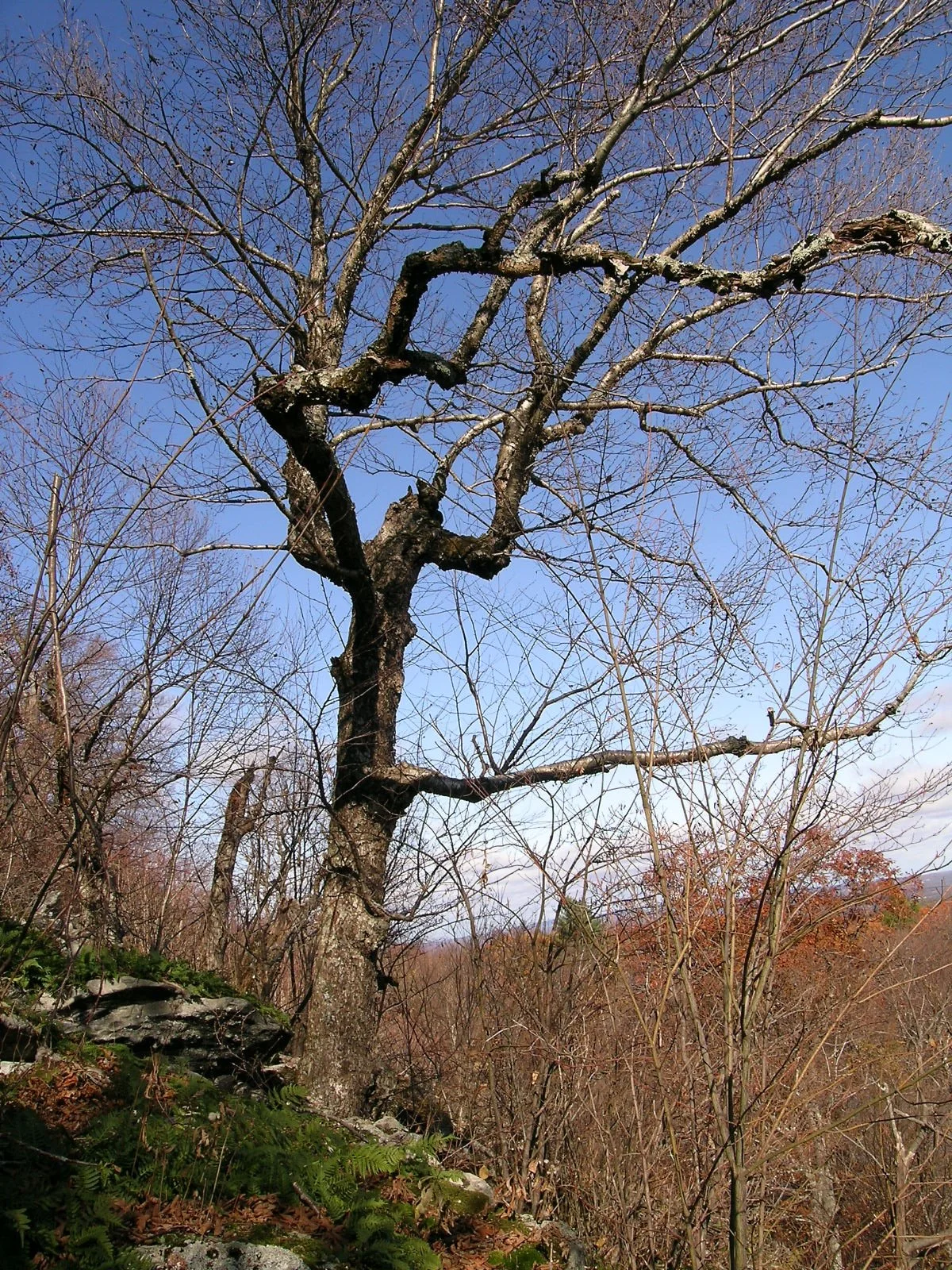
Twisted crown of an old yellow birch, Wachusett Mountain. Photo © David Orwig
Yale ecologist Frank Egler and other early scientists proclaimed that there were no remaining old-growth (primeval) forests remaining across the entire Berkshire Plateau of Massachusetts, helping to perpetuate the myth that all had been removed in the eighteenth and nineteenth centuries. Yet, in the 1990s with the help of works like Mary Bird Davis’s Eastern Old-Growth Forests, researchers like Dr. Ed Cook of Lamont-Doherty Earth Observatory, and aficionados like Bob Leverett, that narrative began to change. After meeting Bob in 1995 when I moved to Massachusetts and with the assistance of an amazing PhD student (now Professor at the University of Vermont), Tony D’Amato, we were able to help characterize and study all of what is currently considered old-growth forest in the state of Massachusetts. While this work confirmed that there were still at least 33 old-growth forests, their combined acreage amounted to about 1,200 acres, or only one-tenth of 1% of the Massachusetts landscape. Most were dominated by the shade-tolerant evergreen species, eastern hemlock, and were found on inaccessible steep slopes in the Berkshire and Taconic Mountains in the northwestern and southwestern portions of the state.

Gnarled bole of an old (300+ years) red oak at Wachusett Mountain. Photo © David Orwig
One of the big surprises was the discovery of stands on Wachusett Mountain, one of the only areas of old-growth forests east of the Connecticut River in Massachusetts. Not long after I began working at the Harvard Forest, I accompanied Director Dr. David Foster to the mountain to examine an area of forest that had generated much interest and controversy. Residents, environmental groups, and Nipmuc Tribal members were upset that a portion of the mountain was slated for cutting and a new ski trail. Based on prior graduate school experience in studying old-growth stands in the mid-Atlantic area, when I viewed the side slope marked off for trail construction, I knew immediately that the trees were quite old. They had gnarled canopies, unusual bark plates, and twisted stems, and they looked like they had experienced many decades of storms and impacts.
Characteristics of (Some) Old Trees
Seldom is big size by itself, or even majestic stature, an indication of great age among trees. Indeed old trees are survivors and often display indications of a history of wear and tear and stress in their shape and characteristics. Learning the indicators of age helps to identify areas of old-growth forest that have escaped direct human impacts for a long time.
Bark. Many trees develop thick bark plates as they get older. This differentiates them from younger trees, which generally have smoother bark. With great age, these plates slough off, so there are sections where some of the thick plates remain and then smoother bark where it has sloughed off.
Sinuous branches and stems. Heavily damaged or gnarled crowns. Since trees remain in place for centuries, they experience wind, ice, and snowstorms, and other trees falling on them. If they survive, they will have branches that change direction with each damaging event, resulting in twisted branches.
Leaning stems and stems with many smoothed-over branch nubs. Over centuries, branches break off and often form bark over the break point, leading to a main stem with rounded bumps that were formerly branches. Following storms or other trees falling on them, some trees remain leaning or close to lateral positions in the tree canopy, reaching for sunlight
Low stem taper. Trees with stem diameters that are not dramatically different than upper portions of the stem near the tree crown are often indicative of great age. Over time if trees slow growing in height, upper stem sections can increase in radial growth, reducing the difference in diameter between upper and lower stem sections.
See also Pederson, N. (2010). External Characteristics of Old Trees in the Eastern Deciduous Forest. Natural Areas Journal, 30(30), 396–407.
Despite an initial report from Dr. Charlie Cobill showing that some of the trees were old, state officials wanted more information. I began a more comprehensive study, collaborating with Charlie, David Foster, and Dr. John O’Keefe. Amazingly, not only did we document ancient trees near the proposed ski trail, but we also located and characterized old-growth forests throughout the upper slopes around the mountain. A fascinating century-old link with Harvard Forest also emerged. Just before being appointed as the first Director of Harvard Forest, Dr. Richard Fisher was asked by the state to undertake a survey of the mountain and its forests. Tucked away in an early 1906 Superintendent’s Annual Report, he noted an area, “the hemlocks” in the vicinity of what would become Jack Frost Trail, containing old, slow-growing trees. This was one of the first places I investigated. My increment coring proved that hemlock and red oak trees on these upper western slopes surpassed 275 years old.
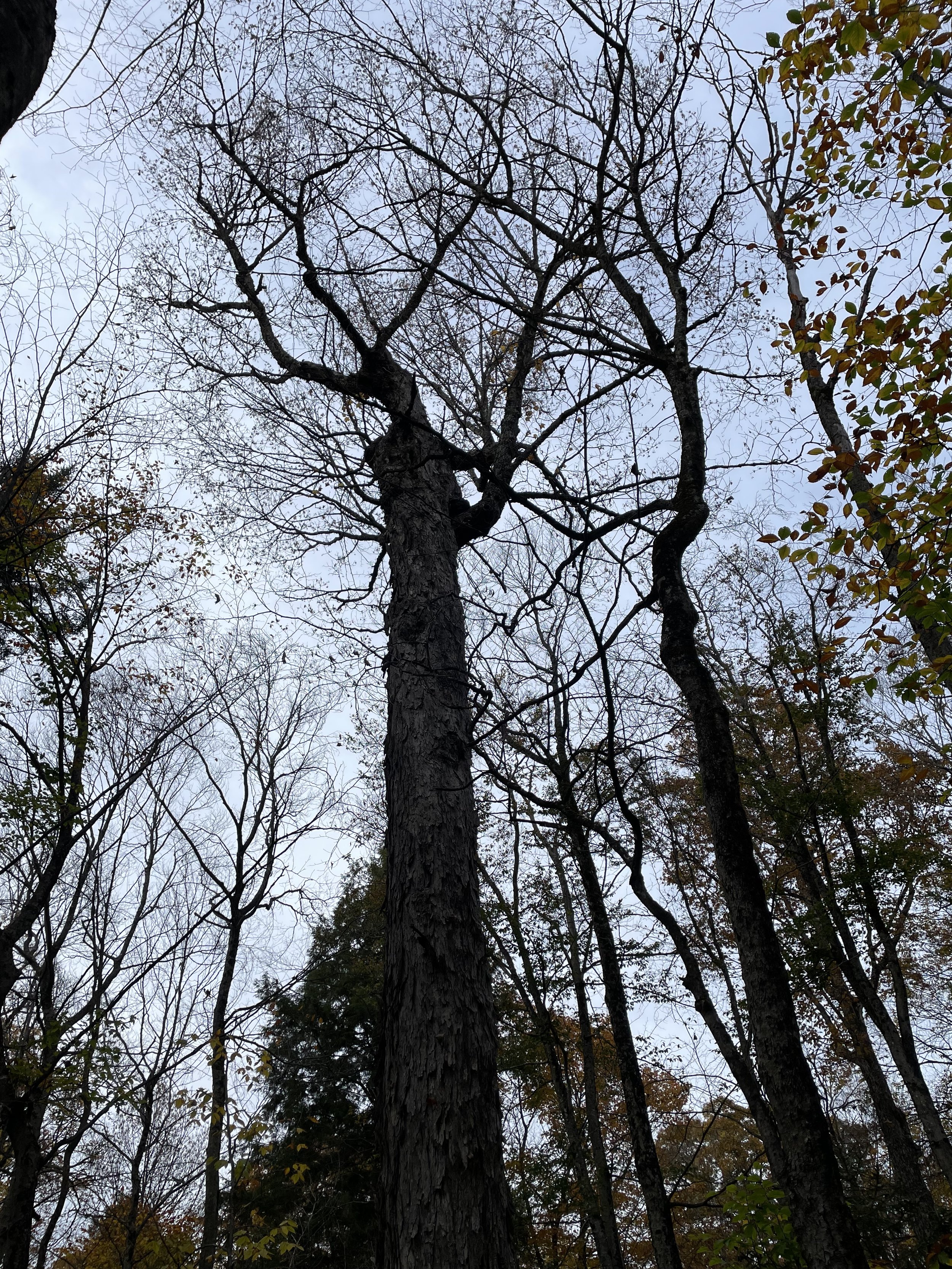
Limited stem taper on an old-growth tree. Photo © David Orwig
An additional diverse assortment of tree species exceeding 250 years of age was found throughout the upper mountain. Yellow birch, black birch, eastern hemlock, red maple, sugar maple, American beech, and red oak had all been there for centuries. Most strikingly, three red oak trees in the proposed ski trail remain the oldest known trees of this species in the world, at just over 350 years old. On an adjacent rocky slope, a 20-foot-tall yellow birch growing among fern-covered boulders is one of the oldest known, at 400 years old. With these discoveries, ski-trail expansion was abandoned, and today the old trees remain.
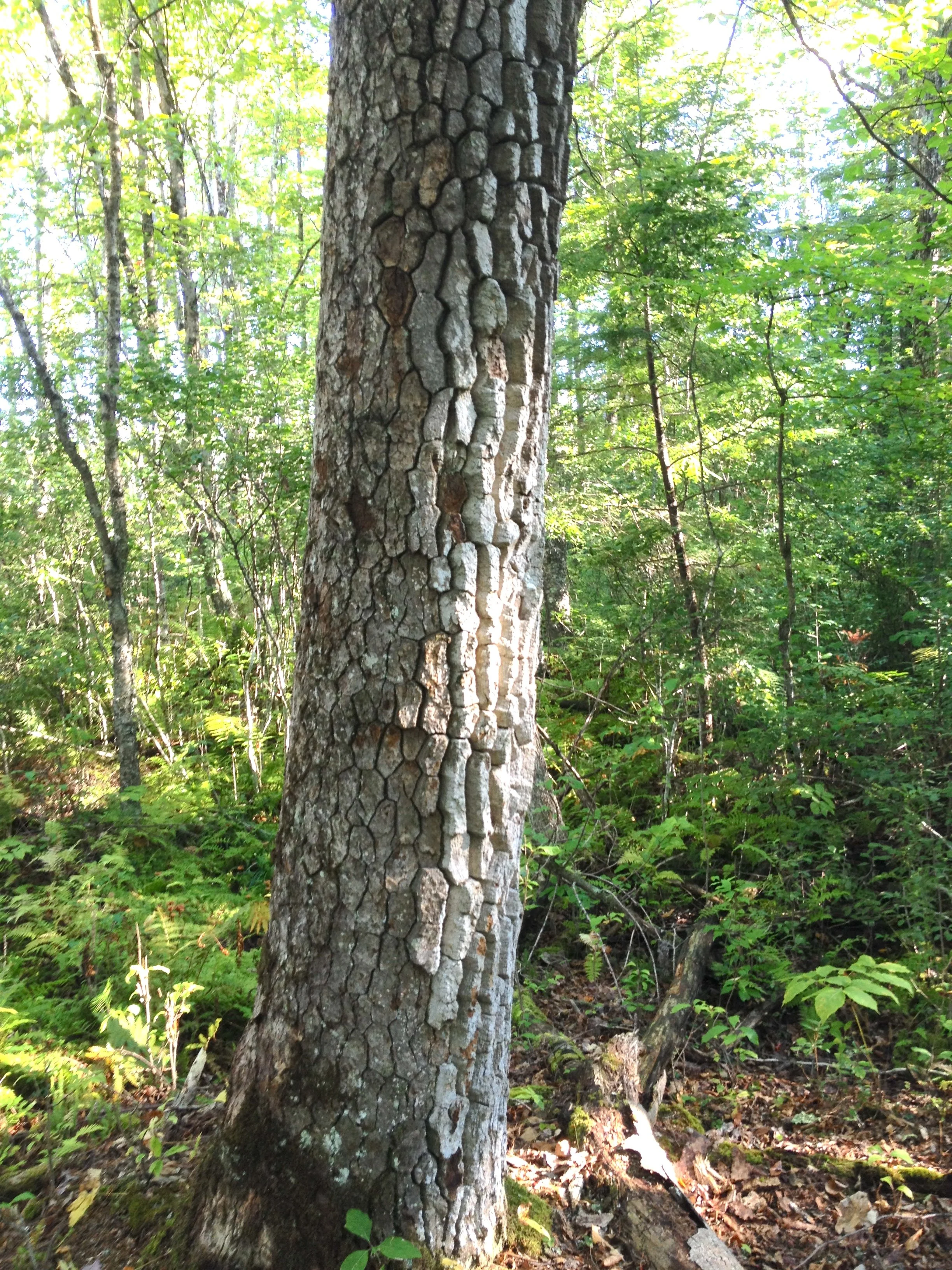
As trees get old, their bark often breaks into raised plates, as on this black gum tree. Photo © David Orwig
So how had centuries of visitors to this popular mountain (currently more than 750,000 people annually) not recognized the old-growth forests? For the same reason that early scientists had not accounted for them—they did not fit the mold of what most people expect old trees to look like. Most old trees are generally not tall and statuesque like a nature calendar of giant redwood or pines. They are just the opposite: short-statured, twisted, and often with damaged or leaning stems. Some of this is due to rocky, shallow, and nutrient-poor soils. Upper elevations on mountains also receive regular ice accumulation in winter and frequent windstorms. Such short-statured and damaged forests would be less desirable for lumber and so were left uncut, in view but unnoticed for centuries.
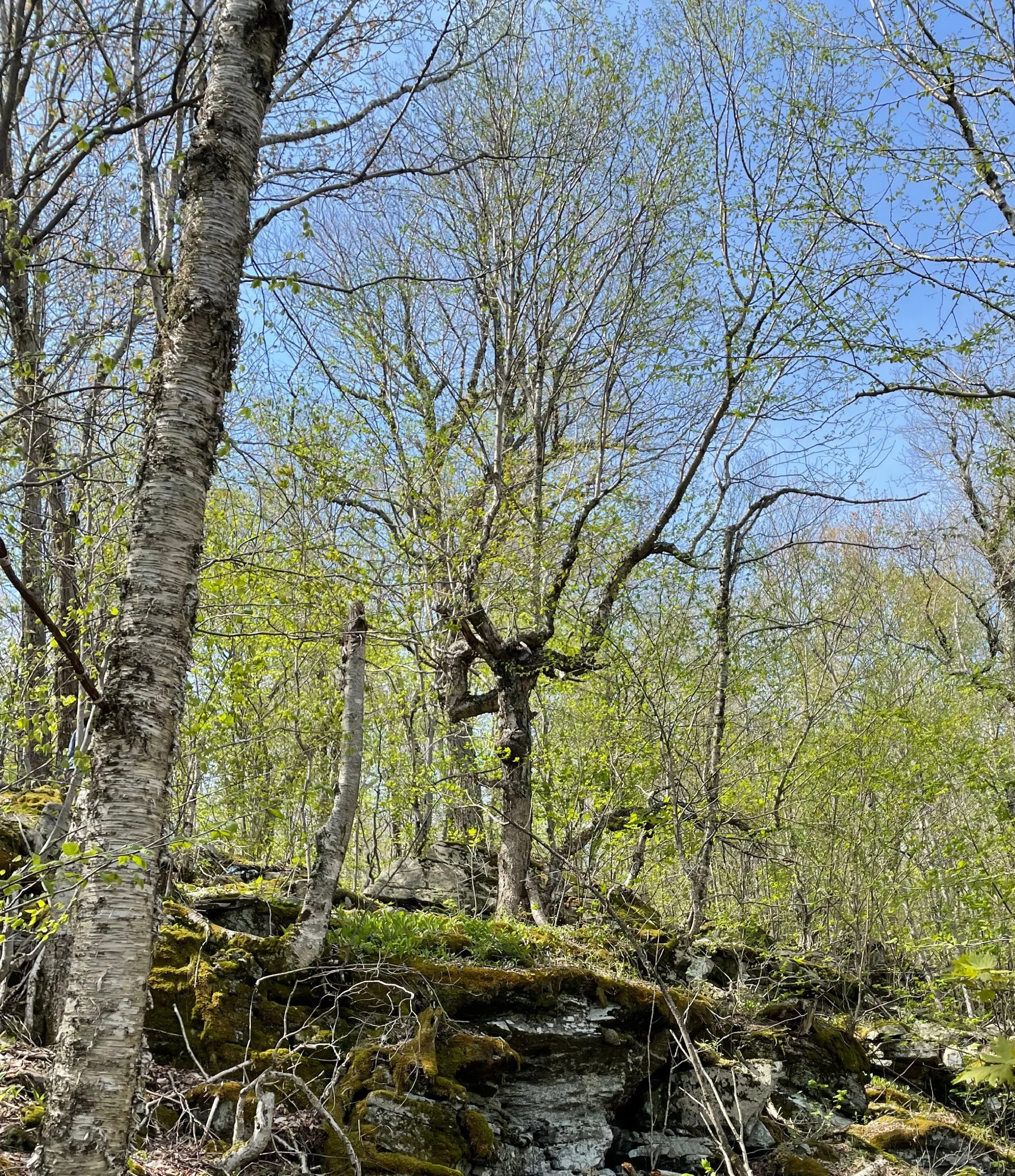
Over time the crown of this large yellow birch has suffered repeated damage. Photo © David Orwig
This is not to say that all known old-growth forests in the Northeast are small-statured and hanging on to upper slopes. I recently participated in a 3-year sampling of 29 additional old forests from Ohio to northern Maine with friend Dr. Neil Pederson. We encountered a wide variety of locations, from flat, productive sites containing trees greater than 140 feet tall, to gentle slopes with northern hardwood trees around 100 feet tall, to steep rocky slopes with 40-foot-tall red spruce and balsam fir. Some of these locations were previously known but not well documented. Others were like the Wachusett example, unknown and hiding in plain sight. One such location was Ricketts Glen State Park in northeastern Pennsylvania. Known for its old and large white pine and hemlock trees, Ricketts Glen also shared surprises literally feet from one of their parking lots. As I stopped by one March afternoon to scout the trees, extremely thick bark plates of a chestnut oak caught my eye from my parking spot. It could not have been more than a foot in diameter, but the appearance of the tree shouted that it was old. Sampling of these and nearby white oaks showed them to be between 170 and 256 years old. Because they were not large, and were surrounded by much larger white pines, these trees had blended into the landscape without any recognition or fanfare.

This large yellow birch at Wachusett Mountain displays many typical characteristics: low stem taper, rounded branch scars, and damaged crown. Photo © David Orwig
One final example is an amazing site we sampled in the northwestern Adirondacks. Unmentioned in descriptions of the area, the 950-acre site (Polliwog Pond) had been recommended to us by one of Neil Pederson’s close colleagues, Dr. Stephen Jackson. There, we documented a dizzying array of old trees: a white pine 345 years old, spruces up to 430 years old, and yellow birches and hemlocks exceeding 300 years old. Despite its proximity to Saranac Lake, it had not previously been documented, yet it was an extremely easy site to access, close to a road, and on flat to very gentle slopes that could easily have been cut in the past. The early focus on large spruce trees by loggers may have spared this site. These are just a few of the examples of old-growth discoveries found in surprising places. These finds highlight that there is more old growth out there if we continue to look with new eyes.
Presentation from the Northeastern Old Growth Conference 2025
September 17-21, 2025 | Middlebury College - Bread Loaf campus | Ripton, Vermont
View all recorded presentations from the conference.
David Orwig is Senior Ecologist at the Harvard Forest. His research in forest ecology and ecosystem science focuses on the long-term dynamics of old-growth forests and the role of land use history and disturbance in shaping forests. Orwig teaches Research at the Harvard Forest: Global Change Ecology-Forests, Ecosystem Function, the Future, a Harvard University first-year seminar.