
In this Issue
Features
Rewilding Our Forests, Rewilding Ourselves. The 2025 Northeastern Old Growth Conference—A Call to Action by Lynda V. Mapes 🎧
Old Growth: Defining, Describing, and Protecting the Ancient Forest by Liz Thompson
Think Like a Cougar: A Vision for Rewilding the Northeast by John Davis
Conversations
From Loss to Hope by John Elder
Imagining Old Growth: Clues from the Past, Clues from the Present by Charles V. Cogbill
Managing for Biodiversity and Climate Mitigation: An Integrated Approach Guided by History by David Foster
Trees, Mothering, and Reciprocity: An Interview with Leslie Jonas, Indigenous Elder by Liz Thompson
Modeling Future Scenarios of Massachusetts Forests: A Tale of Resilience by Meg Graham MacLean 🎧
Forests and the Climate Reckoning: Lessons from Thoreau and the Far North Story by Jamie Sayen and Illustrations by Jon Luoma
Wilderness Comes Home, 25 Years Later by Christopher McGrory Klyza 🎧
Reflections
At the Log Decomposition Site in the H.J. Andrews Experimental Forest, a Visitation by Derek Sheffield 🎧
Cat on the Mountain by Robert T. Perschel 🎧
Policy Desk
New England Policy Chronicle by Alex Redfield 🎧
Conservation in Action
Old-Growth Forest Network: Twelve Years of Creating Access to the Ancients by Joan Maloof 🎧
Seeing the Forest from Above: How a Good Map can be a Game-Changer for Old-Growth Forest Conservation by John M. Hagan 🎧
Finding Old-Growth Forests in Surprising Places: A Historic Perspective by David A. Orwig
Read. Watch. Listen.
Watch: Presentations from 2025 Northeastern Old Growth Conference
Watch: Northeast Wilderness Trust Reaches 100,000 Acres Protected - Northeast Wilderness Trust
Read: Restoring Old-Growth Characteristics - University of Vermont and UMass Amherst
Watch: Howland Research Forest - Northeast Wilderness Trust
Watch: In Whose Presence: On the Nature and Language of Place and Poetry
Read: Together, Maine timber companies and conservationists can protect old-growth forests - Portland Press Herald
Read: Senate declines to halt plan to kill off half-million barred owls by Fish and Wildlife Service - The Guardian
Listen: Could smaller families ‘rewild’ the planet — and make humans happier? - NPR Weekend Edition Saturday
Read: 2,100+ Acres of Forest in the West Quabbin Region Now Permanently Conserved! - Kestrel Land Trust and Trustees of Reservations
Read: Vermont Fish and Wildlife Department to pursue new ‘public access’ license amid ‘financial restructuring’ - Vermont Digger
Read: Land Trust Expands Long Trail Corridor Protection, Creates ‘Forever Wild’ Preserve - VTDigger
Read: The End of Old Growth as We Know It - Adirondack Explorer
Read: Cougar Cubs Confirmed in Michigan - Mountain Lion Foundation
Watch: Environmental Poetry in the Time of Climate Crisis - Sundog Poetry Center
Watch: Forest Dynamics and Stewardship at a Crossroads, Anthony D’Amato - Forest Ecosystem Monitoring Cooperative (FEMC)
Bookshelf
The Arrogant Ape. The Myth of Human Exceptionalism and Why it Matters by Christine Webb
Take to the Trees: A Story of Hope, Science, and Self-Discovery in America’s Imperiled Forests by Marguerite Holloway
Town Ecology: Concord, Thoreau and Onward by Richard T.T. Forman
Bulletin Board
Artists featured in this issue
Gallery of contributing artists (from this issue and previous issues)
🎧 = Available for listening. Visit the Audio archive or listen on your favorite podcast platform.
Welcome to the Winter 2026 issue of From the Ground Up!
Even as we are in winter’s depth, the days are already getting longer here in the northern hemisphere.
And in the deepest winter, with snow carpeting the ground and weighing down hemlock boughs, we can appreciate old-growth forests, the subject of this issue. We can walk in them and see the majesty of ancient trees. We can clamber over huge fallen logs that are covered with mosses, liverworts, lichens, fungi, and snow. We can see the tree cavities where birds and mammals will raise young in the spring and summer. We can watch as woodpeckers move quietly from tree to tree, gathering insects from under loose bark.
Old-growth forests are a vital part of the integrated approach to conservation set forth by the Wildlands, Woodlands, Farmlands & Communities vision for New England. In each issue, we dive into a different aspect of the vision—ecological forestry in spring 2025, farmland and food systems in summer 2025, and the community-conservation connection in autumn 2025. All of the landscapes and waterways are woven together in their support of this vision.
Ecologically managed forests provide us with many useful products—timber, paper, firewood, and mushrooms, for example—and they provide species habitat and carbon storage.
Old-growth forests, on the other hand, are unique in their contributions to biodiversity; their high rates of carbon storage; their ability to mitigate flooding and improve water quality; and a sense of peace that visitors experience in ancient forests. They are critical to the tapestry of conserved lands in the region.
In September of 2025, more than 200 people gathered at Middlebury College’s Bread Loaf campus for the Northeastern Old Growth Conference to celebrate old-growth forests. The conference theme, “Wildlands and Old-Growth Forests: A Vision for the Future,” set the stage for the gathering co-hosted by Middlebury College and the University of Vermont. It was a celebration of old-growth forests and a call to protect them, enhance them, and encourage places for them to develop and thrive in the future.
In this issue, we feature some of the high points of the conference, and we offer further exploration of old growth insights by a few of the speakers, as well as some other voices.
Lynda Mapes, a widely published reporter and author and a keynote speaker at the conference, arrived at Bread Loaf just in time to get into the woods to look at little things in old forests: slime molds, mosses, and salamanders. In her feature article she describes her experience in that first encounter, and also offers highlights of the conference. She talks about “turning toward new thinking,” to a hopeful future in which nature can be revered, and loved, and protected.
What are old-growth forests? That question always comes up at these conferences (this was the eighth in a series), and we heard from several scientists on this. We offer a synopsis here:
An old-growth forest is one that has been shaped primarily by natural ecological processes for several centuries. These processes include—but are not limited to—single tree death and decay; wind; fire; flooding; pests and pathogens; and ice and snow loading. Human influence has been, and remains, minimal. Read more
And where are old-growth forests? Sometimes where you least expect them. John Hagan and colleagues describe how the LiDAR mapping tool has helped them identify late-successional and old-growth forests in Maine. And David Orwig and colleagues describe old-growth forests hiding in plain sight, as stunted trees on a mountaintop in Massachusetts.
Finally, where will old-growth forests be in the future? Where will they be able to develop in the next four centuries or so? We hear visions of rewilding the Northeast from John Davis and Jamie Sayen. This is one pathway to more old-growth forests, the pathway that was the theme of the conference: Wildlands. Rewilding. Passive Management.
Our suggestions for you: Invite people into old forests. Tell your neighbors and friends where they are, if they are on public land. Let children experience them. Walk in them yourself, every day if you can. Take in the softness of the ground, the moisture, the fragrance of decaying wood. Let those experiences deepen your connection to Nature and guide you to protect these special places.
With gratitude,
The Editors of From the Ground Up
Brian Donahue, David Foster, Marissa Latshaw (Publisher), Alex Redfield, and Liz Thompson (Managing Editor)
A big thank you to the following individuals whose hard work and dedication made this issue possible:
Jack Prettyman, design and web development
Maura Grace Harrington Logue, copyediting
Fisher Green Creative, social media
And, thank you to the Highstead Foundation for their sponsorship and financial support.
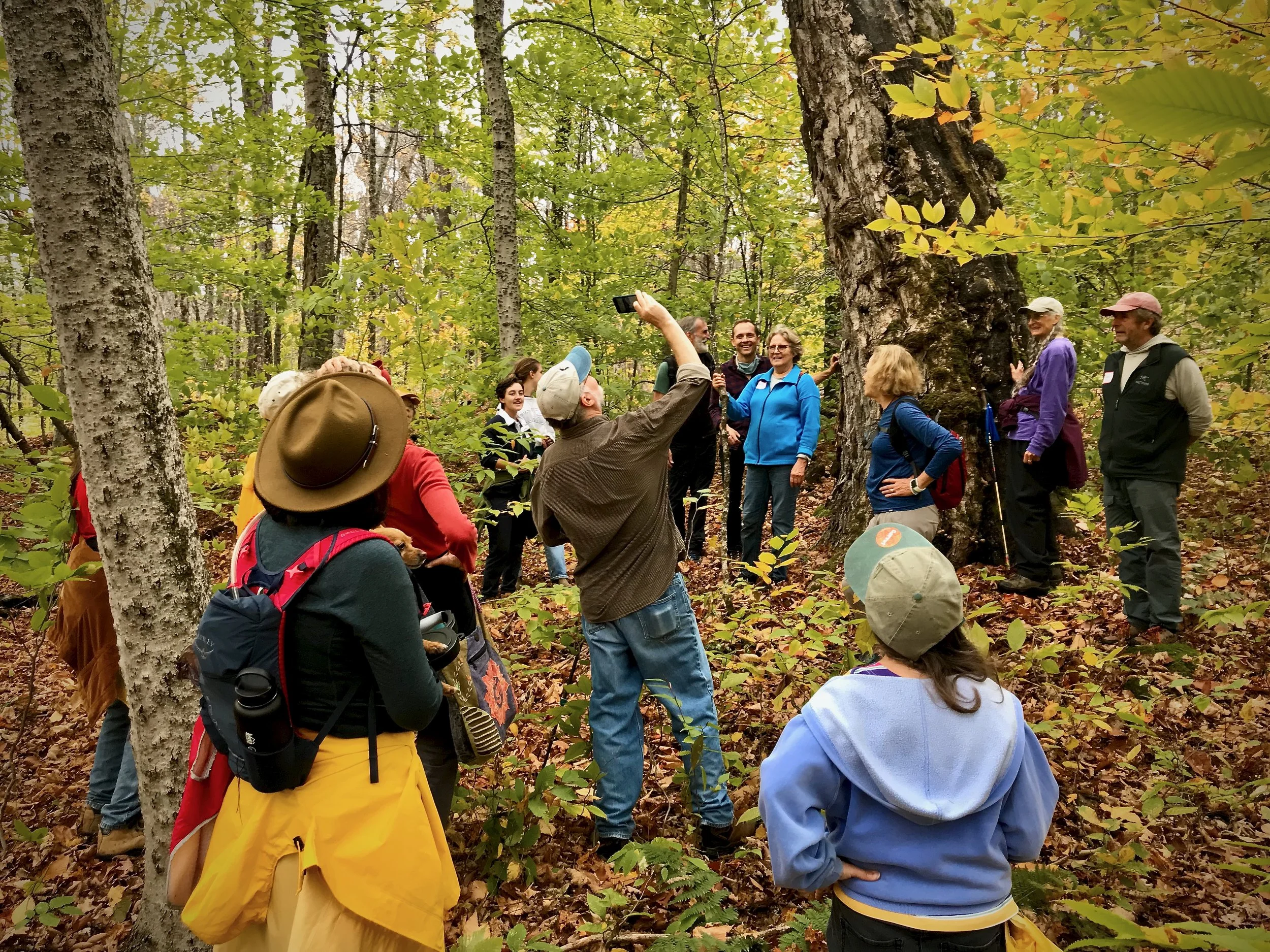
People admiring an old forest in Vermont. Photo © Liz Thompson