
An Interview with Sarah Schumann
Editor’s Note: Sarah Schumann’s perspective as a scholar, advocate, facilitator, and commercial fisherman challenges us to consider the ocean as “wilderness,” in addition to our other conceptions. New England marine ecosystems offer us all food, recreation, beauty, and cool summer breezes, not to mention their natural contributions to mitigating climate change, but how much more should we ask of them? How can we reconcile the need to immediately decarbonize our society with the need to protect the integrity of the waters that sustain us? Schumann offers insight into how she and her colleagues in the fishing industry have attempted to navigate these impossible questions. – Alex Redfield
Alex Redfield (AR): Sarah, thanks for talking to us today! You’ve been working as a fisherman, in support of fishermen, with fishing communities, and in support of marine ecosystems for a long time and in a lot of interesting capacities. Could you share how you came to the work, and what you’re spending your time on these days?
Sarah Schumann (SS): I didn’t grow up in a fishing family like a lot of people in this work did. I grew up in Washington, D.C., child of lawyers, as is typical in that place. When I was nine, my fourth-grade teacher made us read the Weekly Reader about Earth Day 1990, which was the 20th anniversary of the first Earth Day. It was a really big deal, and it really hit me hard to learn about all the trouble that the planet was in. So, I decided then and there that I wanted to dedicate my life to that. But the question for the next 10 years was “How? Where do I plug in?”
That was a big question for me. I wound up dropping out of college because I didn’t feel like that was necessarily the right place to plug in at that time, and I went to South America. It was there, on the coast of Chile, where I learned about efforts by local small-scale fishermen to combat the damage of the industrial fishing that was taking place off their shores. I got to know some of these fishermen, I got to hang out at their association’s office and watch when the boats came in, and I got to see how the women helped prepare the gear and helped process the catch. I became totally infatuated. It was a sort of a lust that just wouldn’t leave me alone: to become part of this world and to use it as a platform to advocate for the marine environment and the environment in general. Growing up in the 90s, I remember hearing President Bush talking about this trade-off between jobs and the environment, stating that we can either have decent livelihoods for humans or we can have a thriving environment for other species—and I just hated that trade-off. So, when I met these fishermen in Chile, I thought, “Wait a minute, there’s no trade-off here. These are people whose livelihoods depend entirely on healthy, thriving, intact ecosystems, and… What could be better than sort of becoming one of them and doing what they’re doing?”

Sarah Schumann, holding a tautog caught off the Port of Point Judith, Rhode Island. Photo courtesy of Sarah Schumann
So, I went back to college in the marine affairs program at the University of Rhode Island. At that time, they still had some very cool classes that were a remnant from their old fisheries technology program, where they taught hands-on skills you’d need in the fishing industry, like how to mend a trawl net or how to build a lobster trap. I went through that program, landed a job on a boat, and, for the last 20 years I’ve been working as a crew member on fishing vessels, both off the port of Point Judith in Rhode Island and in the town of Dillingham, Alaska, where I fish for salmon in the summertime. Throughout the last few decades, I’ve also worked with fellow fishermen on both coasts to learn about the threats that are facing them and to figure out how I could be of service to the fishing community. In Alaska, that work has been focused on the proposed Pebble Mine, which, if constructed, would be one of the world’s largest copper and gold mines, right at the headwaters of two of the world’s most precious and productive salmon rivers, the Nushagak and Kvichak. On the East Coast, the major concern has turned out to be offshore wind and what looks like—at least to people in the fishing community—the industrialization of New England’s marine ecosystem that started in the 1970s and 1980s with proposed offshore oil drilling off of Georges Bank, and has continued straight through with the development of liquified natural gas terminals in the Gulf of Maine. Using the ocean as a source of industrial-scale energy production is something that has been on the radar of commercial fishermen in the Northeast for 50 years at this point, but for the last 15 or 20 years, that has been manifested in the boom of offshore wind development.
This has caused some cognitive dissonance for me, because, of course, offshore wind is not a fossil fuel. The majority of the people who are promoting offshore wind are doing so because they view it as an essential step to decarbonize our economy so we avoid the worst impacts of climate change. It depends on which side of the coin you’re looking at. Is this push for offshore wind another example of industrial energy development located right in the deep wilderness of the Gulf of Maine? Or is it going to save us from the runaway carbon pollution that needs to be addressed immediately?
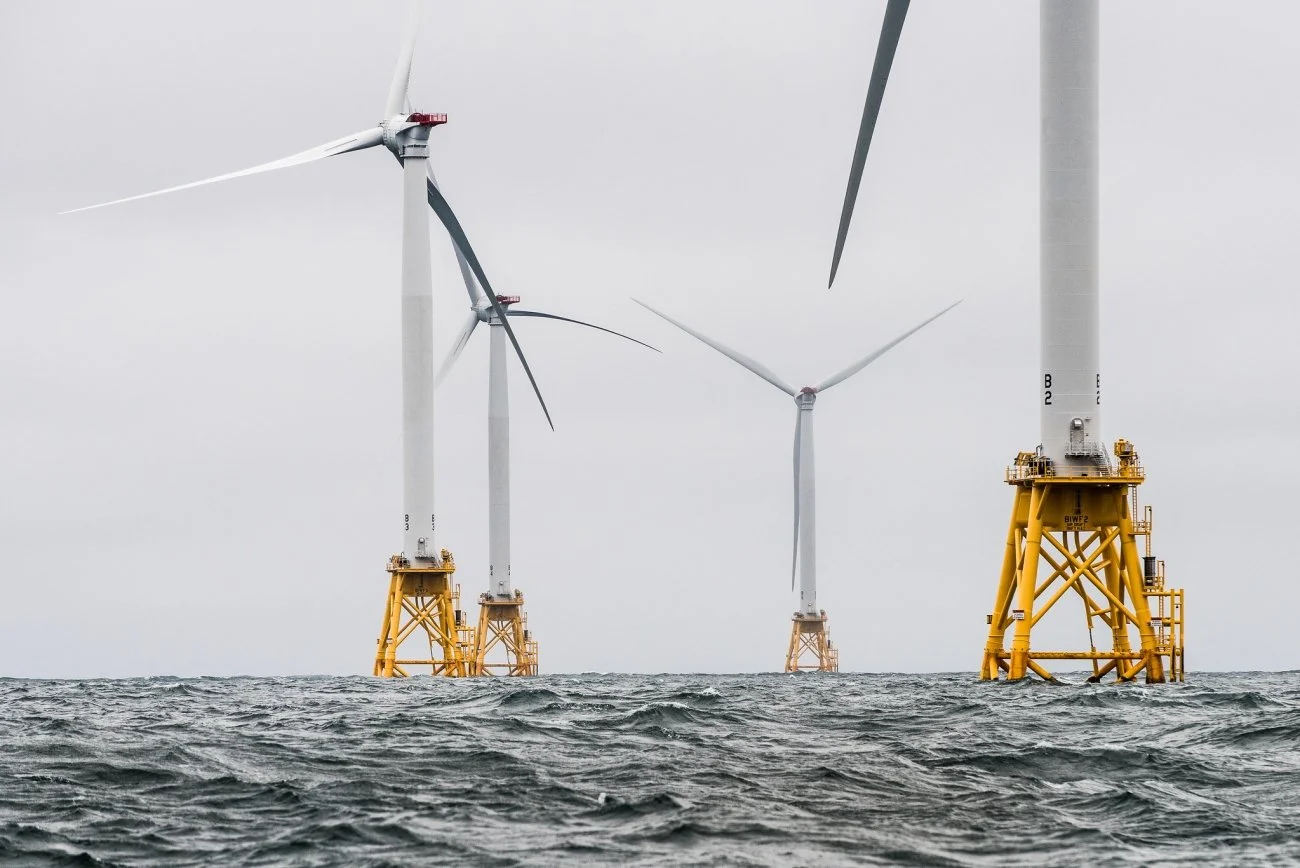
The Block Island Wind Farm, 13 miles from mainland Rhode Island, was the first commercial-scale offshore wind development in North America, with five turbines producing approximately 30 MW of power. Since the project first came online in 2016, an additional 222 turbines have been installed in the Northeast, generating over 2,500 MW of power at peak capacity. Photo © Dennis Schroeder/National Renewable Energy Lab
Those experiences have all contributed to where I’m working now and how I’m approaching these really difficult questions.
AR: Could you share about the Fishery Friendly Climate Action work that you’re doing now? And how does that organizing tie into the threats that fishing communities are wrestling with?
SS: For me, as a fisherman, an environmentalist, a community organizer, or even as a “climate warrior,” it’s been really difficult to be here in Rhode Island at what is essentially ground zero for offshore wind in the United States. We had the first offshore wind farm in the United States, a pilot-scale wind farm off of Block Island, but since then, we’ve also seen a very accelerated build-out in a large swath of ocean south of Rhode Island and Massachusetts. Are you familiar with the “precautionary principle?” I know that’s not unique to ocean conservation, but it’s something we take really seriously in the marine sector. The general idea is you try something. You start small, you experiment, and if a new strategy is found to not have a detrimental impact, you can slowly scale up through adaptive management. That’s just not what we’ve seen with offshore wind at all. It did start, as I said, with a small pilot project off Block Island, but those were teeny tiny turbines by today’s standards. But states (with support from the federal government until this year) have been trying to really go big and to partner with developers, most of which are European state-owned oil companies who have integrated offshore wind into their portfolios, to get installations online as fast as possible.
So, the state, federal, and corporate entities have essentially decided that the marine environment—from the coast of Maine all the way down south to North Carolina, into the Gulf of Mexico, off the coast of California—it’s all fair game, and we’re going to start by doing it all at once, as opposed to seriously testing the effects on fisheries. We’re seeing environmental groups and advocates siding with the corporations that are seeking to profit from this resource, because environmental allies are saying the most important thing is to stop climate change, everything else be damned. What’s scary about that is that there is no guarantee that throwing up a bunch of offshore wind turbines is going to stop climate change, because we still don’t have a cap on carbon emissions. We don’t have a prohibition on continued extraction of fossil fuels. With the new energy demands coming from artificial intelligence and cryptocurrency, it seems likely that things like offshore wind might just represent energy addition rather than energy substitution. So, fishermen are quite right to be very concerned about it, but at the same time, just saying no to offshore wind alone isn’t enough. I became really interested in figuring out how we could get to the end goal of carbon neutrality by 2050 in the most fishery-friendly manner possible.
The 2024 Gulf of Maine sale was the first commercial auction for floating offshore wind on the Atlantic Coast, aiming to utilize deep-water areas.
And that’s not the only question that matters! I’m a fisherman, so I’m asking that question about fisheries, but if people want to ask the same question about farms and forests, these are all very legitimate questions as well. I’m sticking up for fish, because that’s the world I know and because it’s a part of the world that gets so often overlooked. The ocean doesn’t have a lot of constituents who can fight for it—it’s really commercial fishermen and a few environmental groups who have the oceans as part of their portfolio. So right now, when it comes to offshore wind, it’s really only commercial fishermen who are fighting for the oceans to ensure that the oceans get a fair shake when it comes to how they are used as solutions for the climate crisis.
One interesting thing about the oceans is that they kind of get stuck with all the environmental damage that humans do, even upstream or inland, because everything flows downhill. Even damaging development at the top of a mountain, or deforestation hundreds of miles inland—it all comes back to harming fisheries. But, despite the inevitable impact that all our decisions have on fisheries, there’s no good analytic method to look at all of the different options we have in front of us to get to that net-zero carbon future and to evaluate them based on their non-carbon environmental impacts. We (in the United States) don’t have that method or framework, and we’re not even trying to make it. Instead, we’re saying “Let’s throw subsidies at everything that is considered a possible climate solution and let the companies have at it.” There was no real effort to plan out the optimal way to get to net zero by 2050 while supporting communities and the terrestrial and marine environments. That’s the core of the Fishery Friendly Climate Action Campaign.
AR: Could you share how previous attempts to create new climate policy have or haven’t successfully included the voice of commercial fishermen?
SS: The fishing industry has actually been very involved in the planning, permitting, and research around offshore wind. Fishermen are very plugged into data collection and have seen some wins in convincing policymakers that any research needed to happen at all. But these projects take a huge amount of work, and that’s really a drain on folks who are making a living fishing. There was a panel created in Rhode Island called the Fisherman’s Advisory Board, designed to advise our state’s coastal zone permitting agency on permitting offshore wind farms. The entire panel quit as a whole a few years ago, in frustration with the process. After years and years of submitting their input on application after application, from all these different wind companies pushing through the process, the fishermen just decided that they weren’t being listened to, so why were they wasting their time? They were lending a veneer of legitimacy to something they felt had proven itself to be illegitimate. Those members published an op-ed saying they’ve put thousands of hours of volunteer time into reviewing applications. That sounds insane, but that’s what it takes! Yes, the fishing industry does have a few trade associations that can represent them to a degree, but participating in these planning processes still falls on the shoulders of volunteer fishermen who are taking time off work, which hurts the industry and families.
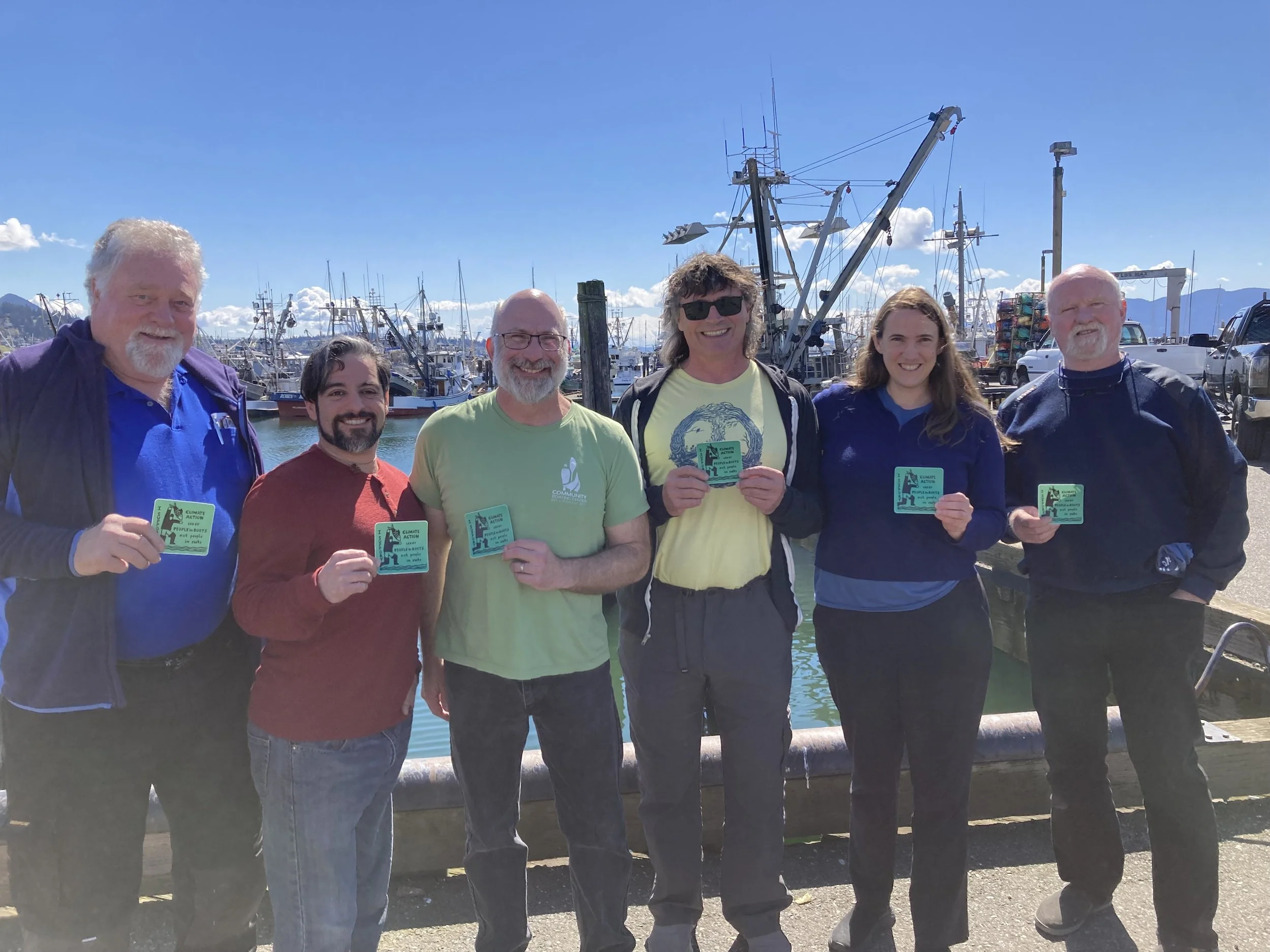
Fishermen pose with Sarah Schumann in Bellingham, Washington, after a workshop focused on a transition to a low-carbon fishing fleet. Photo courtesy of Fishery Friendly Climate Action Campaign
AR: Have there been any good examples of how the perspectives and experience of the fishing community can be successfully integrated in climate planning moving forward?
SS: In terms of public processes where fishermen could plug in, I was excited about the Climate Pollution Reduction Grants that were part of the Biden Administration’s Inflation Reduction Act. These were non-competitive grants available to any state, metropolitan statistical area, or tribe that wanted to receive the funding. The funding was widely available, but had to be used to produce climate action plans, and those plans had to include a map of the options available to achieve greenhouse gas reduction goals. I was wondering “Why didn’t we start this a decade ago!? That’s exactly the kind of process we should be doing.” It involves data analysis as well as modeling options and alternatives. And it lets the people decide. Unfortunately, those processes were required to be wrapped up by December 2025, coinciding exactly with the repeal and elimination of most of the climate-focused programs started under the Inflation Reduction Act. Now, states are saying, “Without federal funds, we can’t achieve our goals, period, let alone can we find the best way to achieve them.” I was trying to get fishermen engaged in those processes, but unfortunately, I had to read the writing on the wall, and ask myself if this was the best way for me to spend my time. Is this the best way for other fishermen to spend their time? This beautiful exercise in public engagement to collectively plan the best way to get to a needed societal goal—it became meaningless when the federal government started going in the opposite direction.
AR: Is any of the social infrastructure that you tried to build in response to that opportunity persisting into the next round of climate action?
SS: That’s what I’m trying to figure out. I realize that, no matter what happens or which way the pendulum swings in the future, there will always be a need for good relationships within the fishing industry. So, I’ve been knitting together a network of fishermen and fisheries leaders that spans Alaska, the West Coast, and New England. But, you need an issue to organize around. The issue I’ve been focusing on recently is exploring a set of technological innovations grouped under the name “Marine Carbon Dioxide Removal” (mCDR). These aren’t proven technologies—they’re at the research and development stage. It’s a basket of different approaches that would leverage the Earth’s oceans as a carbon pump to sequester even more carbon dioxide from the atmosphere. We now know we need to be removing carbon that’s already in the atmosphere, not just reducing our emissions, so there’s a lot of interest in what tools we have to accomplish this additional sequestration.
AR: These mCDR technologies—what do they look like in practice?
SS: One example is ocean iron fertilization, where you dump a bunch of tiny iron particles into specific areas of the ocean that are iron deficient. Iron is a trace nutrient that marine organisms need to live, but there are certain areas that are abundant in most nutrients but low in iron. By adding iron shavings to the ocean, you can trigger a phytoplankton bloom, which would either be consumed by zooplankton and little fish and big fish and go up the food chain—something that might be great for fishermen—or it could sink to the bottom of the ocean. In that case, it’s considered a carbon removal technique because the phytoplankton have consumed carbon dioxide while they’re growing, and then when they die and sink, it locks their carbon away in the deep ocean for a certain amount of time.
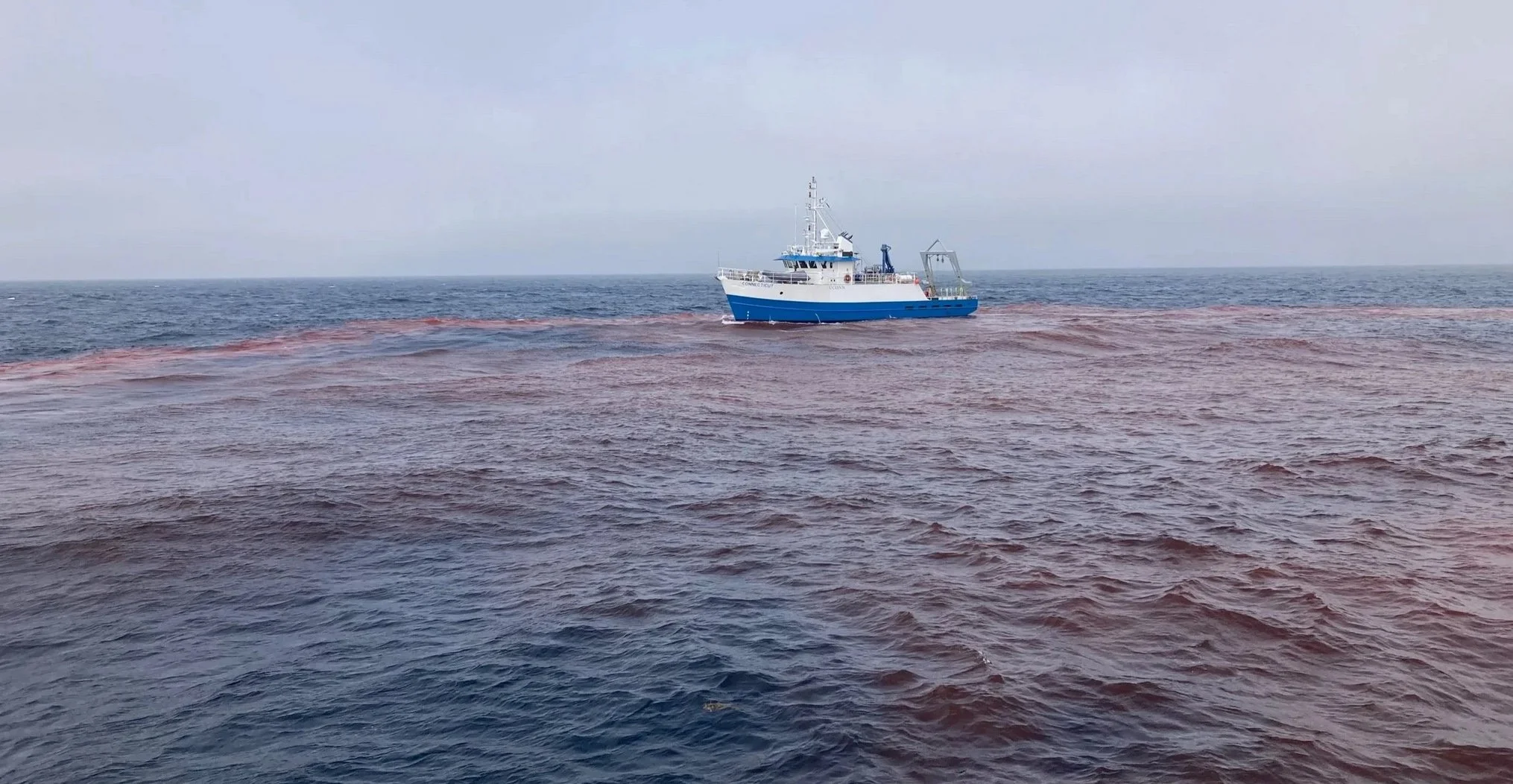
The research vessel Connecticut collects data in the alkaline patch created by the offshore support vessel Mahoney’s dispersal of rhodamine-dyed sodium hydroxide on August 13, 2025. This mCDR pilot project increases the pH of a small patch of ocean water to encourage a short-term bloom of ocean life. Photo courtesy of the Fishery Friendly Climate Action Campaign
For the fishing community, the biggest concerns (regarding mCDR technologies) are still the same: What are the impacts these technologies will have on the marine ecosystem? These new methods could theoretically help fisheries by rebuilding the food web for the fishing stock or by investing capital into the waterfront, but we just don’t know. Are these man-made algal blooms going to replenish feed stocks, or are they going to be toxic blooms that kill marine life? What I’m focusing on right now is the educational piece, making sure that the fishing community understands that this is out there, that scientists are experimenting with it, and that companies are getting started. There have already been hundreds of thousands of dollars worth of carbon credits sold through offsets to be generated by mCDR, so this is already happening even though we don’t have proof that they work or what their impacts to the marine environment might be. I’ve been trying to create infrastructure in the community to cultivate awareness and to build connections with scientists, policy experts, and even some of the companies who are trying to pioneer this stuff, to say, “Hey, wait a minute, fishermen really matter here!”
AR: As you said, the ocean has been seen as a key piece for energy infrastructure over the last 50 years: for cooling nuclear plants, for gas terminal development, and now for offshore wind. In each of those examples, we saw a similar trajectory of political momentum: Solutions for the pressing crises of the day are introduced, and they’re advanced when capital mobilizes behind them. Those solutions aren’t necessarily being considered in a way that values the benefits that intact ecosystems are providing for economies and for the natural communities of life. Then, if those considerations aren’t being factored in, we’re pushed toward a solution without knowing the true extent of the impact. Is that a fair characterization of the rollout of mCDR and other similar ideas on how to use the ocean to solve all our problems?
SS: It is. I think the problem is that humans in general are so terrestrial-centric. The ocean is just sort of out of sight and out of mind, and so the ocean essentially becomes a giant sacrifice zone. People are not nearly as uncomfortable doing something that might have catastrophic consequences out in the ocean as they would be doing it next door. In a lot of ways, it’s similar to the systemic targeting of non-white communities as environmental sacrifice zones. It’s the same old story: Whoever has the power wants to push these “solutions” as far away from themselves as they can and into a place where nobody can fight back. What’s interesting to me is that the fishing community has never really been considered an environmental justice community, but in a lot of ways, we have a lot in common with peers in that space. So, we’re just reminding people how much the oceans matter. The oceans have already done so much for us. They have absorbed 30 percent of the carbon dioxide the Global North has emitted since the Industrial Revolution. They’re already doing enough! I don’t know that we should be asking them to do more, but we’re always looking for someone to do something for us for free. Instead of accepting a “polluter pays” principle where those who have benefitted the most from this carbon-centric economy must take on the burden of solving the problem, we’re trying to push the burden onto ecosystems that are already doing more than their fair share.
AR: It’s hard to get more terrestrial than me. I live on the coast, but have really only dreamed of exploring more of what’s offshore. And, to be transparent, I’ve often pushed aside the impacts that offshore wind may have, precisely because of the immediacy of the climate crisis and the temptation of unlimited locally-produced clean energy. That temptation is hard to ignore, but when I hear you describe the ecosystem where those turbines would go as “ocean wilderness,” I’m immediately imagining how I would react to a proposal that would deliver the same benefits but required major development of, say, the North Woods of Maine. That’s so much harder for me to push aside, because I know those woods and have seen just how special they are, whereas the Gulf of Maine is out of sight and out of mind, just as you said. This brings me back to where you started and the questions of how we can consider trade-offs. Are these choices even real? Are they false dichotomies that we’re being asked to choose between? How do you handle this tension?
SS: That’s exactly it. These are false dichotomies. If we’re taking sides where some people are fighting for climate action and some people are fighting against building out the ocean with wind turbines, and those two sides aren’t working together...that’s a lose-lose situation. There doesn’t need to be a false dichotomy, and disputing those false choices is really what the Fishery Friendly Climate Action Campaign is all about. We’re saying “Climate change is a real problem, and so is industrializing the ocean with energy development at this breakneck speed. These are both problems, let’s be real about it. Let’s not deny that either of those has major consequences, but let’s figure out what options we have to solve both problems simultaneously.”
One of the special things to remember about how fisheries function is that they are an effective way to simultaneously feed ourselves and support biodiversity. When we’re catching (wild) fish, the beautiful part of it is that we let nature do its thing up to the point of harvest. Until it’s caught, the fish has lived an entirely wild and natural existence, dependent on and contributing to a wild food web. Mother Nature did everything up to that final point of harvest, processing, and distribution. When we do it right, it’s really a both/and.
AR: I don’t know that I am more optimistic about getting it right than I was at the beginning of this conversation, but I do know that I’m better informed. And, I appreciate how bringing people into a critical conversation, equipped with the information they need to think comprehensively, has been a goal of yours for a long time. Thanks for introducing us to your work and sharing your perspectives!
Sarah Schumann fishes commercially in Rhode Island and Alaska and is the director of the Fishery Friendly Climate Action Campaign, which works across the U.S. fishing community to unlock a groundswell of fishermen-driven climate leadership and foster momentum toward fishery-friendly climate solutions. Sarah has been a salmon cannery machinist; farmers market seafood sales associate; and deckhand on gillnet boats, lobster boats, a seine boat, and an oyster farm. Previously, Sarah founded the nonprofit Eating with the Ecosystem; authored Rhode Island’s Shellfish Heritage and Simmering the Sea: Diversifying Our Cookery to Sustain Our Fisheries; marshaled the creation of Rhode Island’s fisheries interpretive trail; galvanized Atlantic fishermen to support their Pacific colleagues in blocking open-pit mining in Alaska’s Bristol Bay; and orchestrated the Resilient Fisheries RI project, a participatory visioning process for the future of Rhode Island’s fisheries in a changing world.