
Staying On Top of the Mud
Shellfish Harvesters Protect the Future of the Fishery
Editor’s Note: Marissa McMahan offers this personal and professional account of how shifting environmental, economic, and demographic conditions on Maine’s coast are impacting both wild and human communities. The same story (with slightly different characters) is playing out in inland communities dependent on intact forests and timber products. Perhaps the integration of harvesters and commercial fishermen into fishery management and governance structures offers a model for good stewardship that can be replicated inland. – Alex Redfield
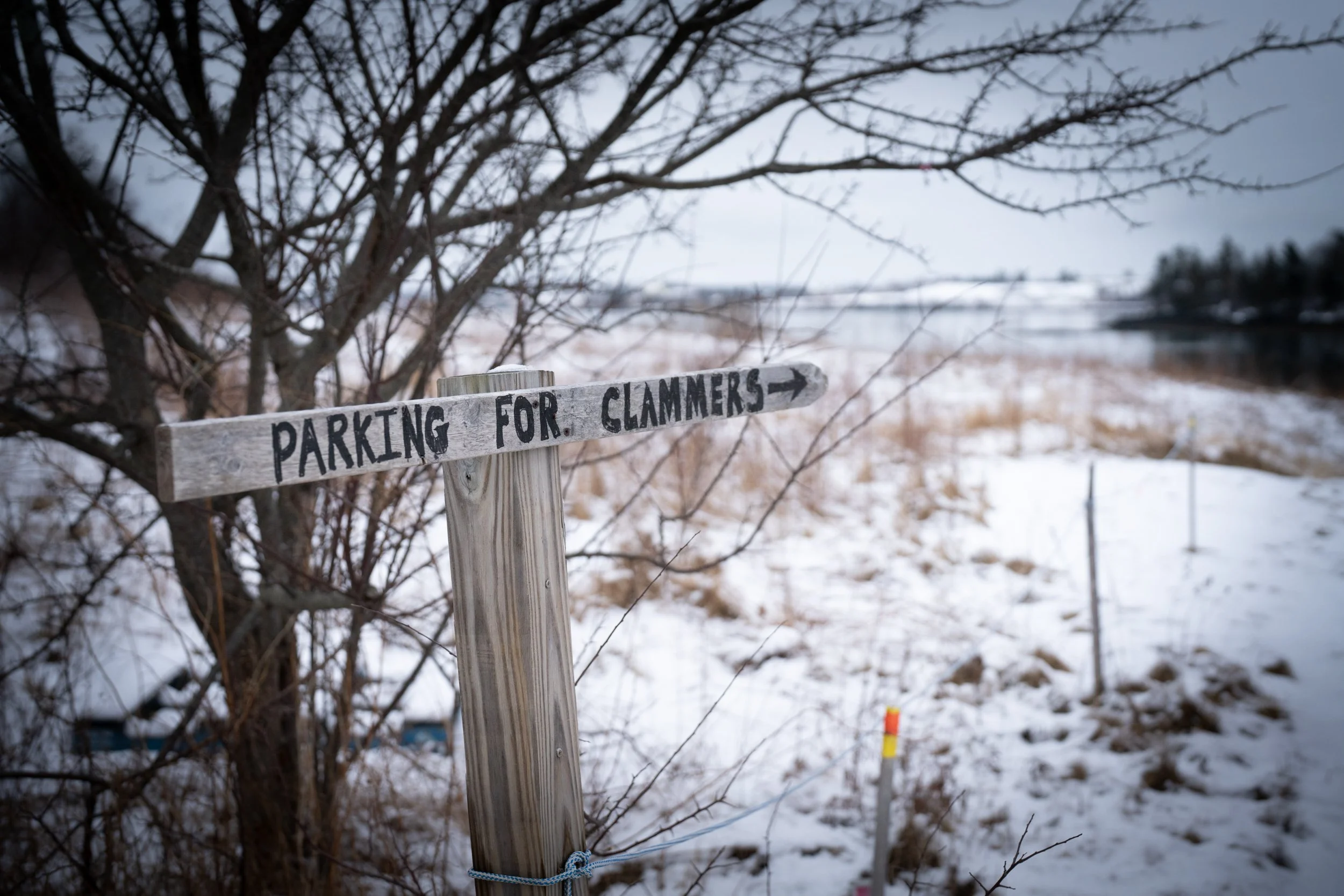
Photo © David McClain for the Maine Coast Fishermen’s Association
I grew up in a fishing family in a small coastal community in Maine called Georgetown. One of my most vivid memories as a child was going clam digging with my family in Sagadahoc Bay. The Bay is massive. On a low draining tide, you walk for over a mile to get from the beach at the head of the Bay to the low tide line at the mouth. We would go out and dig a peck of clams for dinner, making sure we weren’t in the way of the commercial clam diggers out there making a living.
Tidal mudflats may seem like a bare and desolate landscape, but they are teeming with life: Clams, worms, snails, crabs, amphipods, and many other species thrive here. At high tide, when the flats are covered with water, they are an important feeding ground for fish, ducks, and other marine organisms. At low tide, gulls and shorebirds arrive to feast. I’ve even seen raccoons out on the flats digging for clams.
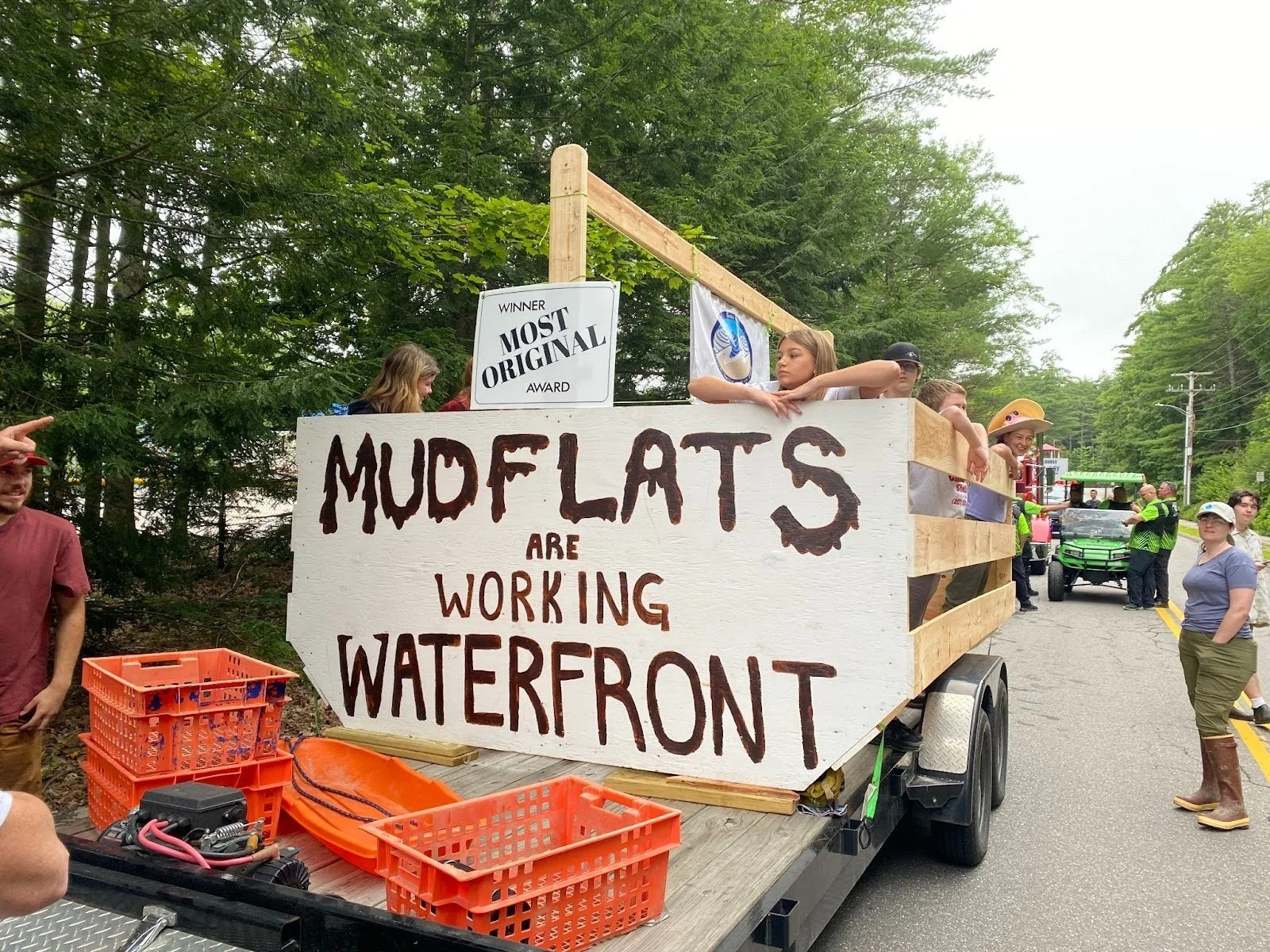
Local harvesters and the Casco Bay Regional Shellfish Working Group entered this mudflat float in the 2023 Yarmouth Clam Festival parade to raise awareness about the importance of shoreline access. Photo courtesy of Manomet Conservation Sciences/Marissa McMahan
In addition to their ecological importance, mudflats also hold immense cultural, social, and economic value. Wabanaki people have been harvesting and stewarding intertidal shellfish resources for millennia. In 2024, soft-shell clam harvest was the second most valuable fishery in Maine, supporting thousands of livelihoods. Despite the significance of this habitat, mudflats remain understudied and often overlooked. The scientific community knows far more about salt marshes and sand dunes than we do about mudflats. But we do know that this important and sensitive ecosystem, at the root of so much tradition and at the core of a valuable rural livelihood, is facing many challenges. Even if mudflats fly under the radar of traditional environmental advocacy or conservation work, the people whose lives are most closely tied to this place—shellfish harvesters—are well equipped to provide and implement creative solutions.
In Maine, intertidal shellfish are co-managed by state and municipal shellfish programs, which means there is hyperlocal jurisdiction and oversight to complement state law and regulations. At the municipal level, shellfish management bodies are generally composed of harvesters and community members who volunteer their time—sometimes an immense amount of it—to manage resources and policy in their towns. This system of co-management works well in some ways, but falls short in others. From a conservation standpoint, there are many positive aspects of co-management, including the ability of towns to enact harvest closures, control license numbers, address water quality issues, and enhance stocks with hatchery-raised clam seed—all based on the economic and ecological conditions of any particular local area. However, the co-management structure also favors landholding governments (i.e., municipalities), which, in large part, excludes Wabanaki people from accessing areas of great importance to sustenance lifeways practices and is a reminder of the continuing injustices of colonial practices that displace Wabanaki people from their traditional homelands.
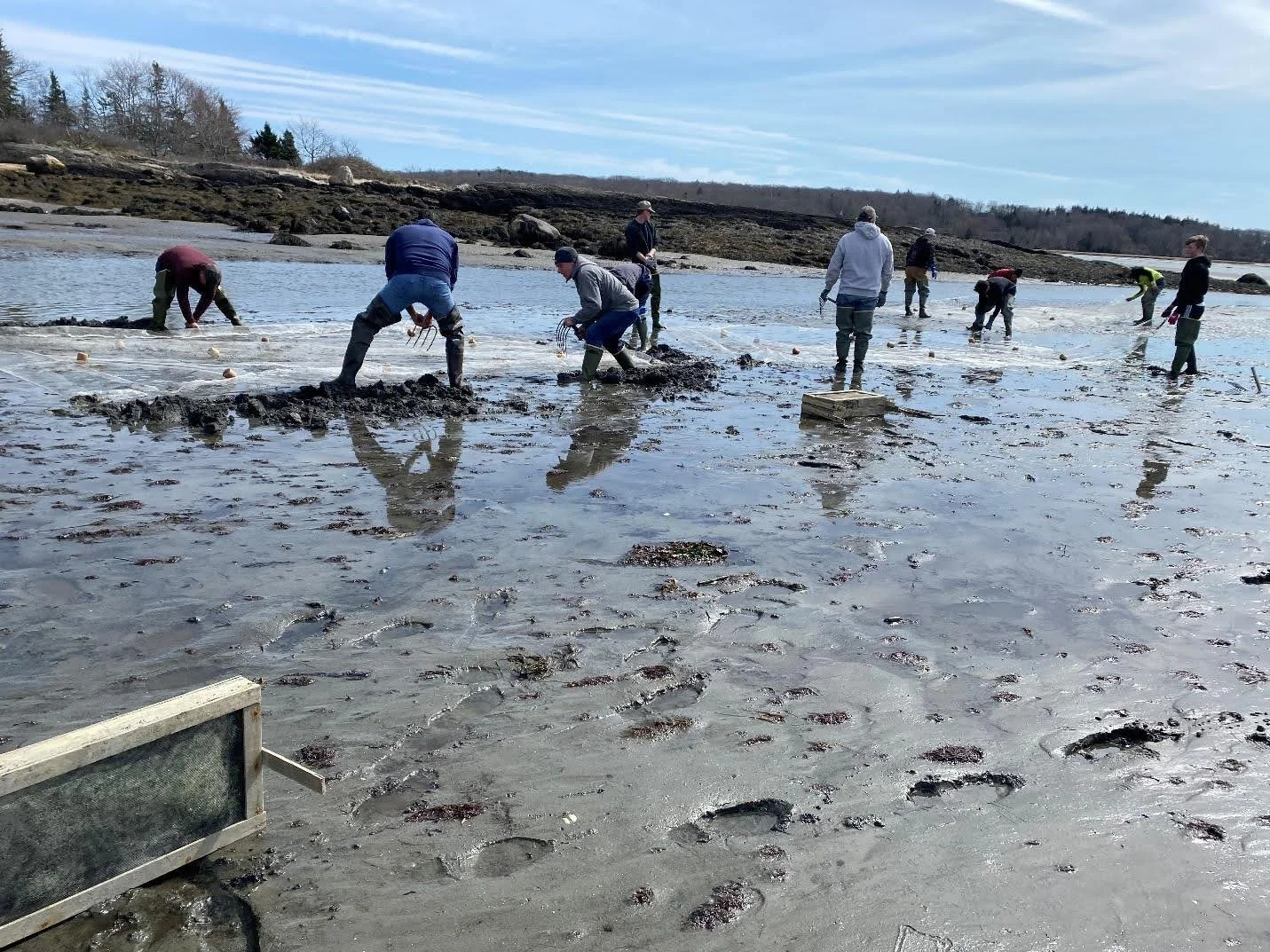
Shellfish harvesters and community members reseeding the mudflats in Georgetown. Photo courtesy of Marissa McMahan
In recent years, the integrity of the shellfish industry has faced two major new challenges, both of which are rooted in patterns and conditions of abundance but from dramatically different species. First, the migration of people to coastal Maine, which greatly accelerated during the height of the COVID-19 pandemic, has created a wave of gentrification that has limited access to the shoreline. To get to the mudflats, harvesters rely on upland access points—often landings where they can park a vehicle and walk with their gear down a footpath to the shoreline. In many coastal towns, 50 to 90 percent of these access points may be privately owned with no formal agreement that protects access for harvesters. When a property changes hands, the new owner may choose to restrict or eliminate access, and as the rate of coastal properties transferring ownership has increased, loss of access to the mudflats has become a major issue. When access is lost, harvesters often have to travel farther to get to the flats, jeopardizing an already precarious business model and directly impacting their physical and mental health and well-being.
Gentrification has also driven up property values, which, in turn, displaces from coastal communities the people whose livelihoods depend on the ocean. In the case of the shellfish industry, commercial licenses are tied to residency—if you move out of the town you’re licensed in, you lose your license. More people on the coast also means more potential sources of pollution that can impact water quality. Shellfish are filter feeders, which means poor water quality can make them unsafe to eat, resulting in shellfish harvest closures that have a major economic impact for harvesters. Climate change exacerbates this issue as the frequency and intensity of rainfall events increases, and as stormwater runoff delivers more bacteria and other pollutants to the ocean.
Just as the number of people moving to the Maine coast has increased, so too has the population of the invasive European green crab (Carcinus maenas), resulting in one of the greatest challenges the shellfish industry faces today. Green crabs are voracious predators of bivalve shellfish, particularly soft-shell clams, and they’ve flourished as waters have warmed in the Gulf of Maine. In some areas, like Northern Bay in Penobscot, Maine, green crabs have completely annihilated both soft-shell clams and, accordingly, the ability of people to make a living digging clams in what was once an incredibly productive bay. Despite massive efforts undertaken by municipal shellfish management programs to mitigate the impact of green crabs, we have yet to see a solution that works.
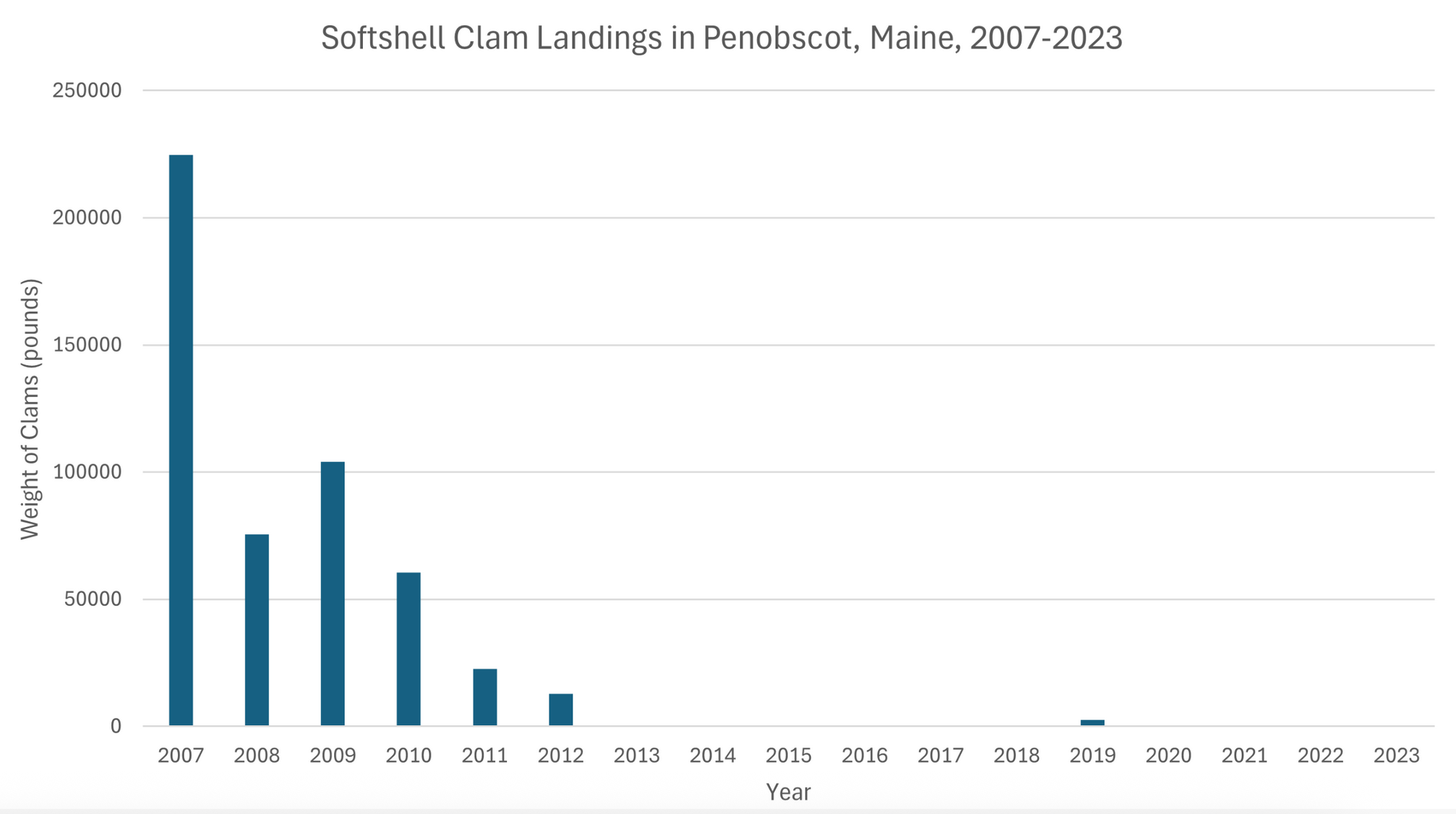
In 2012, the Penobscot shellfish committee sounded the alarm about invasive green crabs decimating the clam population. Today, there are almost no clams in Northern Bay, and commercial landings have plummeted. Figure courtesy of Manomet Conservation Sciences
Despite these many challenges, the shellfish industry perseveres, and commercial fishermen are often at the center of effective solutions. Being flexible and creative in solving new problems is just part of the job. Communities up and down the Maine coast have responded to the challenges by intentionally facilitating new relationships between commercial harvesters and new landowners; by taking on water quality and pollution monitoring at the local level; by enhancing local stocks with hatchery-raised clam seed; and by raising money to fund conservation work.
“The people whose lives are most closely tied to this place—shellfish harvesters—are well equipped to provide and implement creative solutions.”
As far as green crabs are concerned, the focus has shifted in recent years to developing new opportunities by utilizing the invasive scourge. There are too many new products and companies to list, and more coming online every day. Lemons. Lemonade.
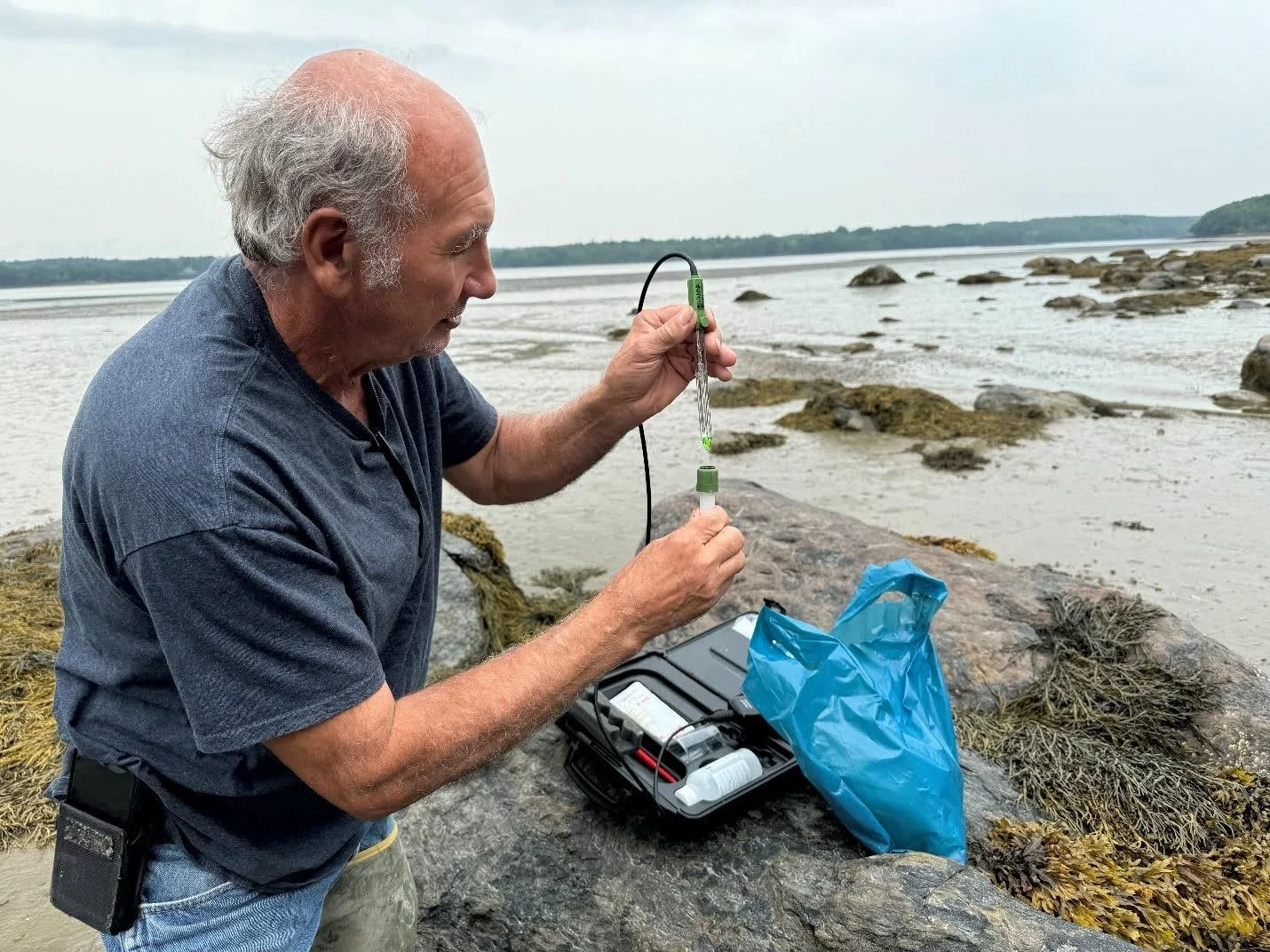
David Taylor, Georges River shellfish committee chair and commercial fisherman, taking pH and water quality measurements. Photo courtesy of Manomet Conservation Sciences/Marissa McMahan
These are just a few examples of the types of innovation happening throughout Maine’s shellfish industry. Harvesters have been, and will continue to be, essential to the stewardship, management, and protection of intertidal ecosystems. They are uniquely positioned to balance the competing needs that these ecosystems and communities have, even as those needs shift over time. The challenges may be vast, and the solutions aren’t easy or readily available, but a surprising amount of progress can be made with a group of dedicated people who won’t give up. Maine’s shellfish harvesters are those people.
Marissa McMahan is the Senior Director of Fisheries at Manomet Conservation Sciences. Much of her life has also revolved around working as a commercial fisher. She grew up on her father’s lobster boat and spent much of her young adult life lobstering. As a fisheries scientist, she has relied heavily on her industry background and collaborative partnerships with commercial fishermen. Much of her research focuses on restoring ecosystem productivity and strengthening and diversifying fisheries resources through diverse fishing industry partnerships, community engagement, and knowledge co-production. She also works to advance adaptive fisheries co-management and elevate the importance of fishing industry participation in decision-making processes.