
Rewilding Our Forests, Rewilding Ourselves
The 2025 Northeastern Old Growth Conference—A Call to Action
Editor’s Note: As a keynote speaker, author of two books dealing with old trees and forests in New England, and longstanding environmental writer for the Seattle Times, Lynda Mapes is perfectly positioned to provide insights concerning the 2025 Northeastern Old Growth Conference theme, Wildlands and Old-Growth Forests: A Vision for the Future. Her engaging talk at the conference was a major hit, and she continues to enliven us with her reflections here. – David Foster
Bending low over the rotted log, a wonder of this forest was revealed. Slime molds.
“We think of things that are large and charismatic,” said Shelby Perry, Wildlands Ecology Director for Northeast Wilderness Trust (NEWT), who with wildlands ecologist Jason Mazurowski started off the 2025 Northeastern Old Growth Conference with a walk, archly entitled Small Wonders.
Sure, this wasn’t old growth. But look closer, she entreated: here was a salamander, peeping out at us with ancient amphibian calm from its hole in a downed log. We cradled a peeper in our palms, enjoying the delicate, cool touch of its toe pads before placing it ever so gently back in the forest duff. And then there was the miniature magnificence of the slime molds, the jewelry of the forest, vivid and finely wrought. And with such names! Chocolate tube slime, dog vomit, wolf’s milk—what was not to love?
And so it was that we were enchanted all over again in the life of the forest, from that salamander giving us the side-eye, to the tucked-away middens of pine cone seeds, shelved carefully by a chipmunk or squirrel in downed logs. The buzzing nest of ground-nesting bees, scrape marks made by a bear still visible in the freshly-turned soil, from its search for tasty, nutritious larvae deep in the ground. All this, in a short walk exploring the extraordinary islands of biodiversity to be found in rotted logs in this ordinary, second-growth forest. If you know where and how to look.
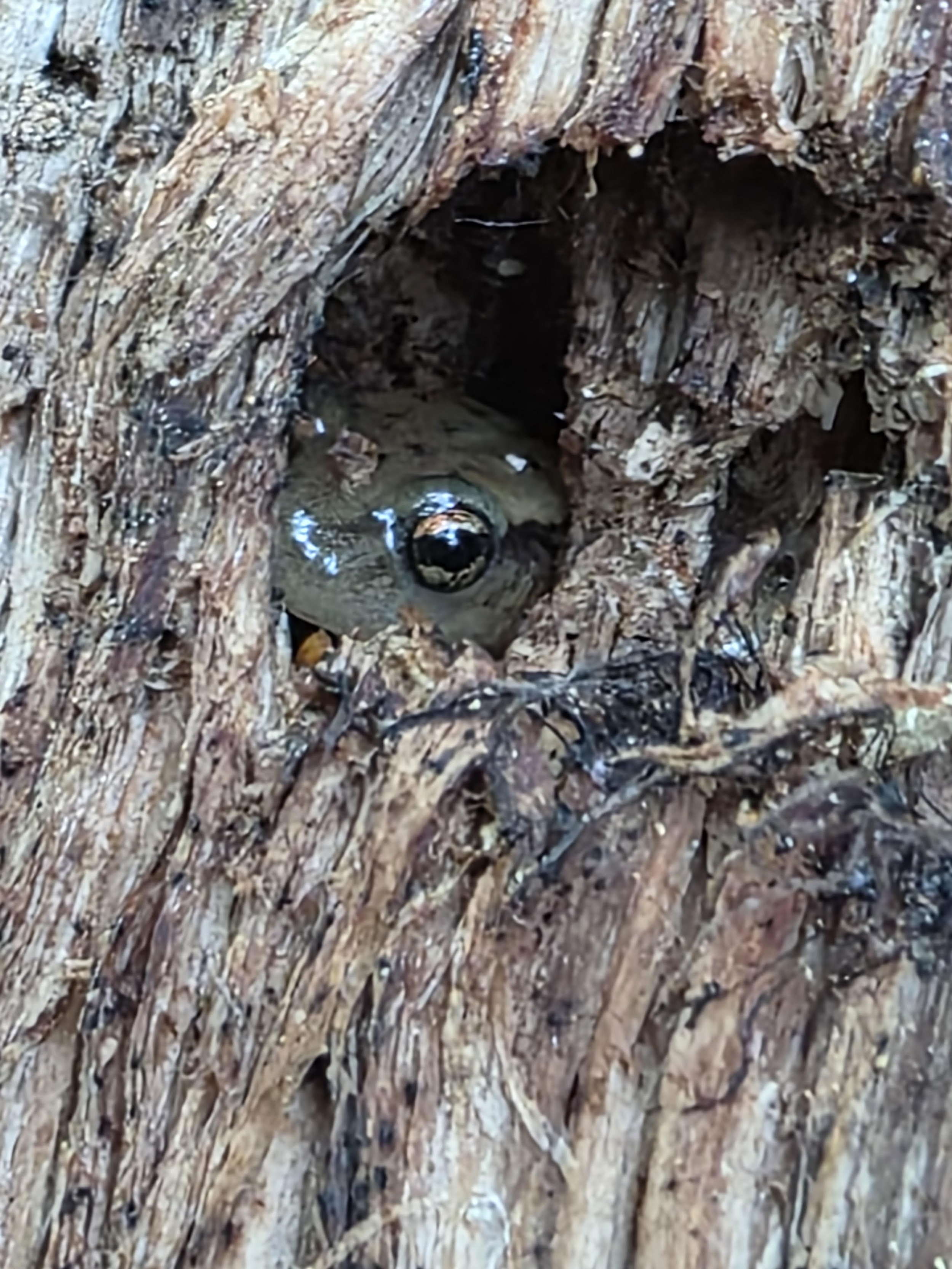
A salamander peers out at conference attendees. Photo © Vicki Brown
We were taught. We were delighted. And that was just an appetizer in the feast for the imagination to come in our three-day gathering.
The conference, themed Wildlands and Old-Growth Forests: A Vision for the Future, convened at the Middlebury College Bread Loaf campus in Ripton, Vermont, from September 17–20, and drew nearly 300 attendees—from around the region, online, and beyond. Ours was a celebration and exploration of forests and their many gifts and mysteries. In poetry; scientific explanation; and literary, spiritual, and personal reveals, we delved and considered, examined and questioned what we know, wonder about, and still seek to understand about old-growth forests.
Lead sponsors Highstead and NEWT and a host of organizers, including Wildlands, Woodlands, Farmlands & Communities and the Old Growth Forest Network, gathered us in all our diversity: more than 50 speakers, presenters, workshop leaders and field trip guides. We were scientists, Indigenous leaders, policymakers, artists, writers, poets, naturalists and forest keepers, and questers of every stripe. In field trips, forest walks, readings, and some 20 talks, we covered everything from ecology to policy for rewilding and preserving our forests that remain, to celebrating the wonder of these forests in poetry and reflection.
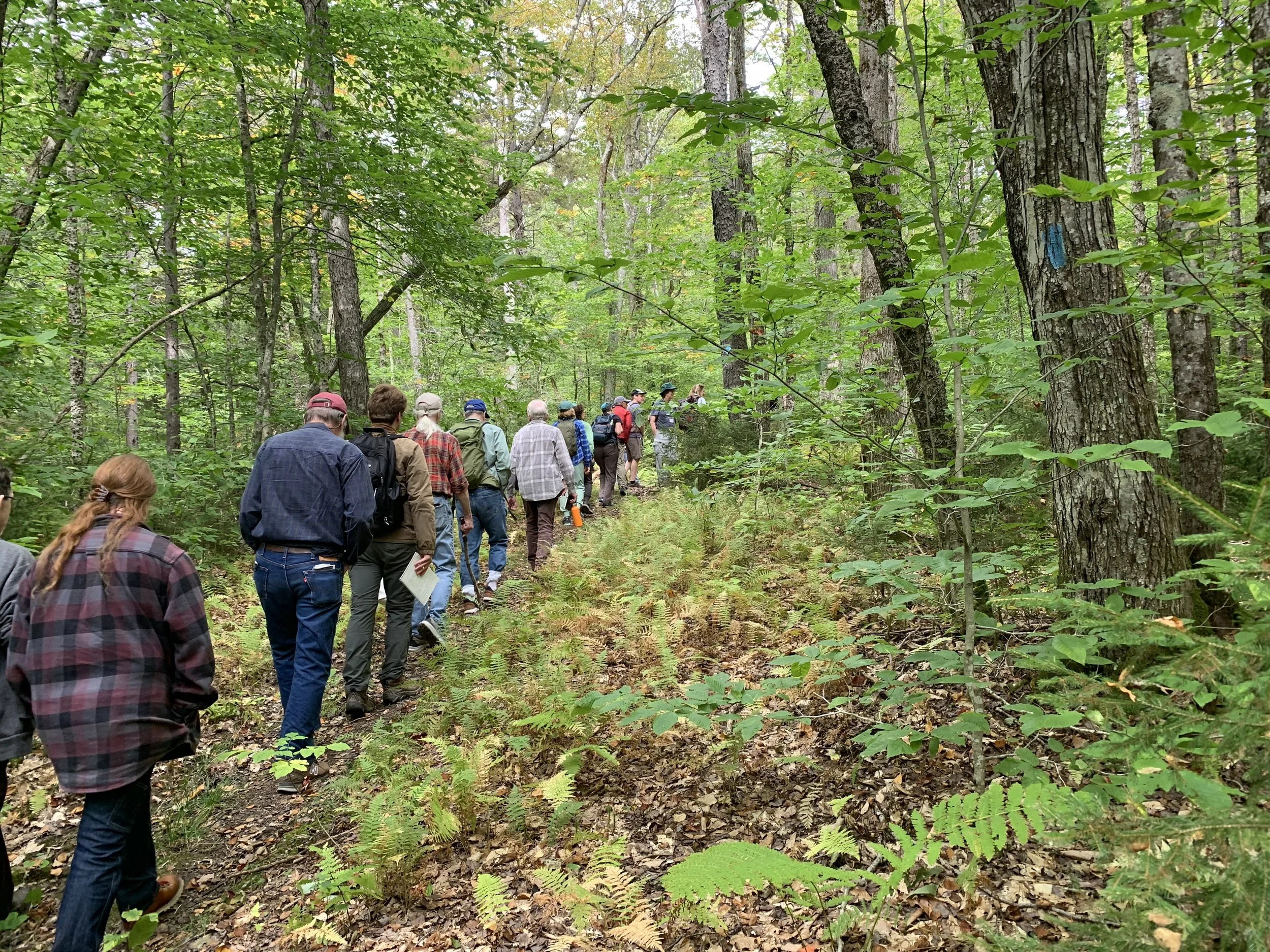
Conferees got things off to a good start with a walk in the woods, where we marveled at the extraordinary biodiversity living its life in rotted logs. Photo © Lynda Mapes
Best of all, though, was the passion for forests and the chance to share it together. To study, think, connect, inspire, feast together, and egg each other on in what can seem at times a lonely if not quixotic quest to understand and protect these forests, so under siege from bugs, fire, development, climate warming, and all the rest. It was a time to gather to face facts, yes, but also to feel hope for a resurgence of wild places and wild lands.
“We were taught. We were delighted. And that was just an appetizer in the feast for the imagination to come in our three-day gathering.”
Here was Bob Leverett, with his sugared Appalachian drawl, mellow as syrup on pancakes, Co-Founder of the Native Tree Society, letting us in on the secrets of not just how to measure big trees, but how to let them take your measure. Let them thrill you, put your life in perspective, recalibrate what matters. “It’s not just about the big trees,” he reminded us. “There is a feeling that you have when you are in these places.”
“Old-growth forests do that, they have an elixir that people express and feel in their own ways.” Those are feelings to be heeded, Leverett told us, as is a calling to protect and love these places. “Folks, I didn’t plan any of this, it was meant to happen. As events are unfolding, don’t question it. Do what you are called to do.” This, from the man whose work would help inspire people, agencies, NGOs and others gathering for these conferences since the first he helped launch in 1993—when, as Leverett put it, old-growth forests were considered just “geriatric homes for old trees.”
That changed, as scientists began to understand and reveal the unique properties of old growth—and why these forests must be protected. Tom Spies, Emeritus Scientist with the USDA Forest Service Pacific Northwest Research Station, served up hard-to-find data in carefully constructed context about the biggest old-growth rescue of all, in the Northwest Forest Plan that preserved millions of acres of old growth on federal lands of the Pacific Northwest in 1994. He also explained the limitations and successes of that work.
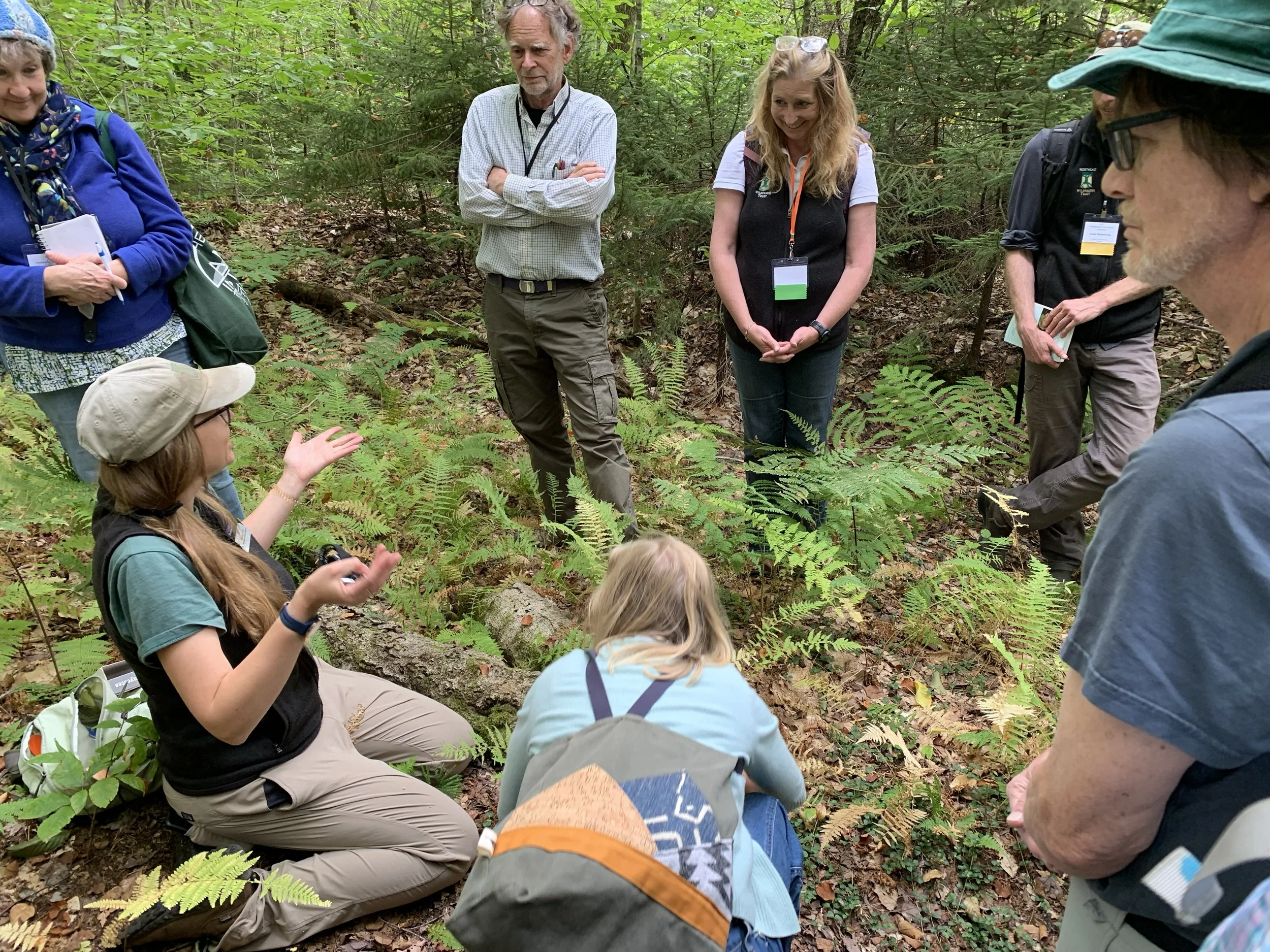
Shelby Perry of NEWT enthralled conferees on a forest walk with the wonder of slime molds. Photo © Lynda Mapes
But it’s not only old growth that matters, it’s also resurgent second growth—New England’s second-chance forests, as David Foster, former Director of the Harvard Forest, and Jon Leibowitz, NEWT President and CEO, told us in their plenary talk. Recapping the history of New England forests today, they recounted how these forests have come back after extensive clearing, and today are providing the essential potential for Wildlands preservation, as well as working forests. “The potential is extraordinary, and yet we continue to assault it,” Foster stated, noting that after steady recovery, a gradual decline in forest cover is once again biting down everywhere, and the intensity of harvesting, especially in Maine, is relentless. While the New England landscape to the casual observer looks extensively wooded and unchanging, “we actually are cutting away at it,” said Foster.
“The vision is to halt the relentless deforestation and modification of the land,” Foster said. As set forth in the Wildlands, Woodlands, Farmlands & Communities vision, 80 percent of the landscape in New England would be conserved, including 60 percent of it in managed forests, 7 percent in farmland and at least 10 percent in natural wildlands by 2060. That would be a big change: Today only 25 percent of New England land is protected from development.
Zack Porter, Executive Director and Co-Founder of the NGO Standing Trees, called for preservation of “the blank spots on the map,” and a renewed activism to protect them. “It will take a lot more concerted effort than to date. There is no such thing as too much wildlands.” Public land, he reminded us, is scarce in New England, “and right now we are losing ground.” From rescission of the Roadless Rule in national forests by the Trump Administration, and a call by the president to up the cut nationwide on federal forests, the nation’s precious “blank spots” that actually are home to everything that matters, ecologically, are at risk, Porter warned.
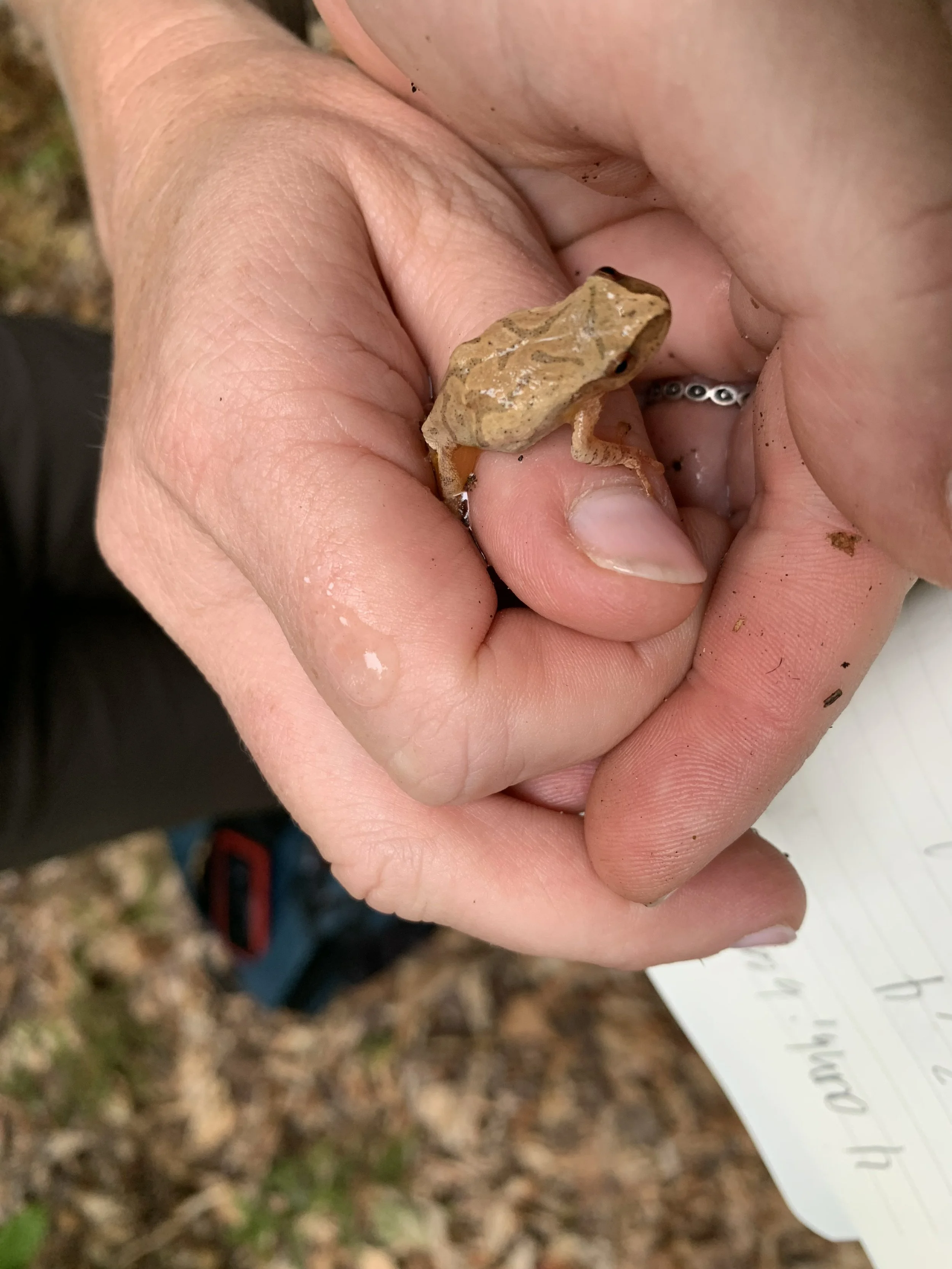
The light touch of a peeper, briefly held, was a reminder that we humans are just one of many beings in the forest. Photo © Lynda Mapes
Indigenous leader Leslie Jonas of the Mashpee Wampanoag Tribe in her plenary address recounted her history working for Wildlands preservation, beginning at the New Alchemy Institute to today speaking out for forests as a defense against catastrophic climate warming—yet humans, she reminded us, have destroyed one third of our forests, globally, with deforestation for agriculture the leading cause. “We are still losing large amounts of primary forests, we are continuing the assaults,” she noted, especially in the Amazon. She called for kinship with our forests, and the power of relationality to these places. In her culture, when a person needs to calm down and reground themselves, standing against a big white pine offers a way to re-center, she noted, “They come with a lot of medicine.” How we view our old-growth forests is vital to our future, she reminded us. “They are our elders.”
“We were scientists, Indigenous leaders, policymakers, artists, writers, poets, naturalists and forest keepers, and questers of every stripe.”
Middlebury College Professor John Elder in his plenary address invited a new beginning, born in grief of loss of so much that matters. “Sometimes when we come to the end of collapse, we have an opportunity for new thinking, a portal, a gateway to the next world, to walk through lightly, with little luggage, ready to greet a new world,” Elder said. Now is not a time for complaint, but a resurgence of energy toward opportunity, and commitment, he urged. “It is a privilege to be alive now in this great turning.”
In this precious time taken to be with one another, turning toward this new thinking felt possible, even probable, and certainly necessary. To let forests unspool their long stories, uninterrupted by us. And in so doing, let forests heal our wounded world—and hearts.
In his session, perhaps poet Sean Prentiss in his poem “Natural Climate Solution” said it best:
Natural Climate Solution
by Sean Prentiss
The maturing forests of
Woodbury Mountain clutch
five hundred thousand tons
of carbon within heartwood
otherwise to be chainsawed
back into our atmosphere if
we only dreamed in log length.
Instead, if we dream this forest
into forever-wild, another
six hundred thousand tons of
carbon will be inhaled by
matured forests. A natural climate
solution requiring nothing more
than for you and you and me
to step back, do nothing, allow
this mountain preserve, these
trees, to age into old growth.
Presentation from the Northeastern Old Growth Conference 2025
September 17-21, 2025 | Middlebury College - Bread Loaf campus | Ripton, Vermont
View all recorded presentations from the conference.
Lynda Mapes was a keynote speaker at the recent Northeastern Old Growth Conference and is the author of six books on the natural and cultural history of the Pacific Northwest. Lynda has been awarded the Washington State Book Award; the National Outdoor Book Award; and the Kavli Gold Award for Science Writing by the American Association for the Advancement of Science, one of the world’s most prestigious science writing awards. For 27 years she covered environmental news, nature and Native cultures and governments at the Seattle Times. Lynda’s newest book, The Trees are Speaking: Dispatches from the Salmon Forests, is published by the University of Washington Press.