
Defining, Describing, and Protecting the Oldest Forests
Editor’s Note: The recent conference on old-growth forests and Wildlands at the Bread Loaf campus of Middlebury College brought diverse groups of people together for many rich conversations. One of the more intriguing formal discussions engaged three long-standing experts on the conference topic to discuss the essence of that topic. Liz Thompson effectively shares the insights that emerged and the questions that linger. – David Foster
The people who gathered recently for the 2025 Northeastern Old Growth Conference, surrounded by the glorious fall forest of the Green Mountains, had one shared goal: to learn more about Wildlands and old-growth forests.
Some came to learn how to measure trees. Some came to hear about new technologies for discovering old forests. Some came to hear how Indigenous people relate to the forested landscape. Some came to find out what they could do to protect Wildlands and old-growth forests in a time when public policies seem to be stripping protections away. Some came to hang out with like-minded people in a beautiful setting. Most came for all of these things.
But before we could even begin talking about tools to find, measure, and protect old-growth forests, we needed to ask, as we’ve done at all the previous conferences, what is an old-growth forest?
We needed a definition.
And then we needed a description. How do we know when we’re in an old-growth forest?
And then we needed strategies. How can we protect old-growth forests?
Scientists have talked about all of these things for many years, but we had some new and refreshing conversations about them in September. I’ll address these three questions in turn, as we talked about them at the conference.
1. Definitions: What Is an Old-Growth Forest?
The answer could be as simple as this: an old-growth forest is a forest that has grown old.
But ecologists know that life is not simple, and definitions are not that easy to come by. How old? And how do we know that a forest is old? What does an old-growth forest look like?
To explore these questions, David Foster convened a panel discussion with three other forest ecologists: Charlie Cogbill, Neil Pederson, and Bill Keeton.
Let’s start with Charlie Cogbill. Here’s some of what he said, edited for clarity:
My first job was as an intern for the Maine Critical Areas program in 1981. I’d been asked to study and inventory old growth in Maine. But what was old growth? What was the definition? I’ve been working on that ever since.
In 1994 there was a workshop at Harvard Forest that brought together contemporary experts. We talked about several old growth concepts and criteria—age, dynamics, appearance, history, structure, composition.
And out of that came absolutely no consensus. There was no emergent report. There was no real common denominator. But from that I continued the process I had started in 1981, collecting what I call the Thesaurus of Old Growth Concepts.
Cogbill’s Thesaurus of Old Growth Concepts. Image courtesy of Charlie Cogbill
Charlie Cogbill at East Mountain Old-Growth Forest, Vermont. Photo © Alexandra Kosiba
There’s something here for everyone. For the poets—forest primeval, murmuring pines and hemlocks. For the ecologists—primary, climax, autogenic, steady-state, multi-layered. And for the foresters—overmature, terminal, uneven-aged.
You don’t see the term “self-willed” here, a term we’ve heard at this conference, related to Wildlands. I’d say the ecologist’s synonym is autogenic, meaning that change comes from within, as opposed to anthropogenic (where change comes from humans) or allogenic (where change comes from outside forces). And those are the three universes we’re dealing with, an autogenic universe, an anthropogenic universe, and an allogenic universe. And it’s a Venn diagram.
Cogbill concluded with what he called a “revisionist definition.” An old-growth forest is defined by process, not by characteristics. As he’s said before, it is continuity of process through time. He was and is talking about natural processes, mostly of the autogenic or self-willed type. An old-growth forest is one that changes through internal processes—local disturbance, tree growth, environmental stress, tree death, tree fall, tree decay, fungal growth, nematode activity, seedling establishment, tree growth. A cycle with no beginning and no end.
But how much time do we mean? Centuries, says Cogbill. Many use the time of European settlement as a benchmark. If a forest has not been disturbed by humans in a significant way since that time, many consider it to be old growth.
Are outside forces part of old growth? This is still unclear to Cogbill and others. If an outside force like a hurricane or a tornado blows down all the ancient trees in a forest, is the forest still old growth? Some at the conference said yes, and others said no.
In his plenary address, David Foster made a compelling case for yes, when he talked about Harvard’s Pisgah Forest in New Hampshire, an iconic old-growth forest that blew over in the great hurricane of 1938. All the huge, ancient trees were toppled. What should be done? Should the wood be salvaged? The director of Harvard Forest at the time made the prudent decision to do nothing, to see how nature’s forces would play out, to learn from this natural experiment.
Is Pisgah an old-growth forest? If natural disturbance, even of broad geographic extent, is considered part of continuity of process through time, then the answer is a resounding yes. If one believes that only the processes that begin and end within the forest count, then perhaps no.
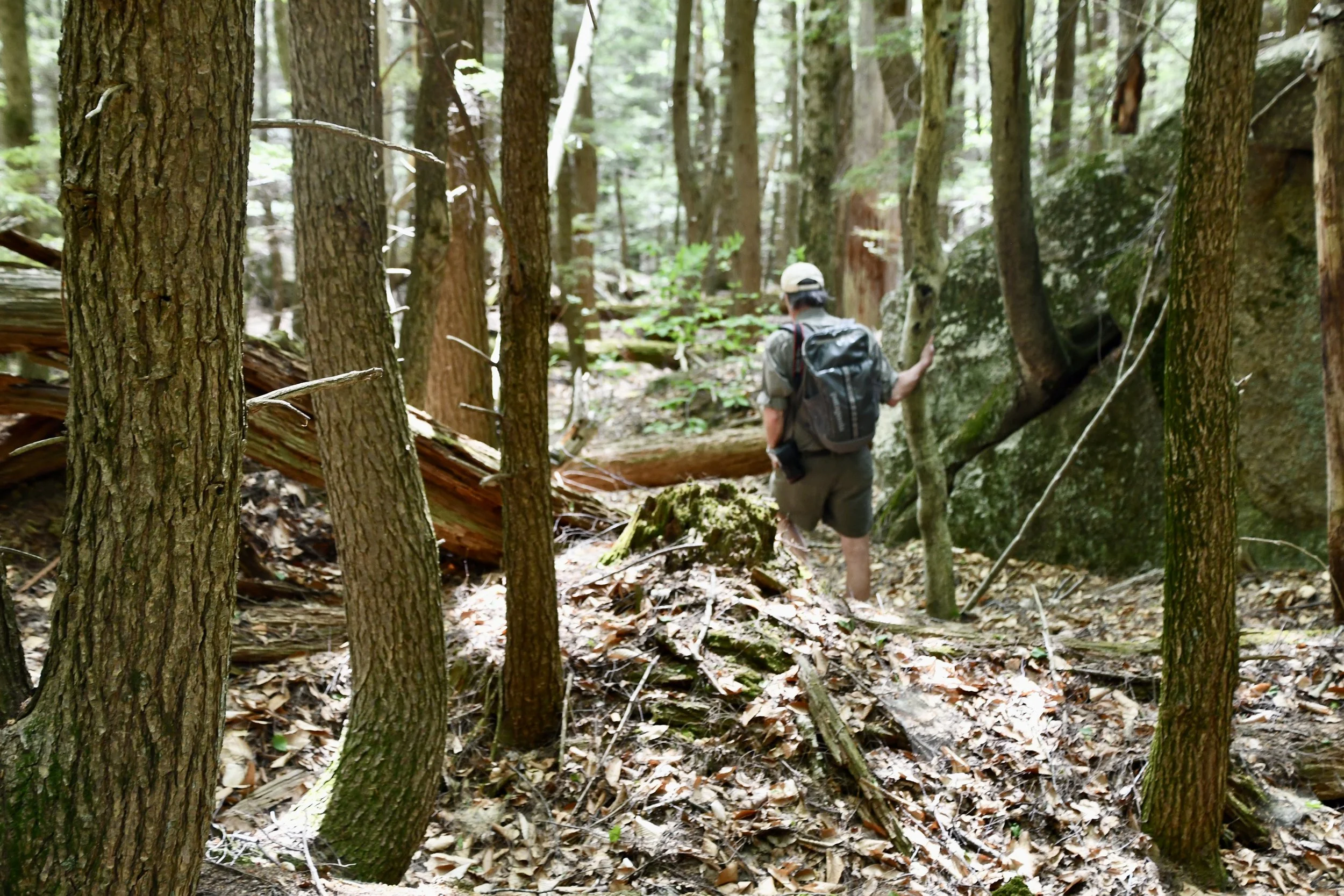
David Foster walks among young hemlocks in Pisgah Forest in 2021. Photo © Liz Thompson
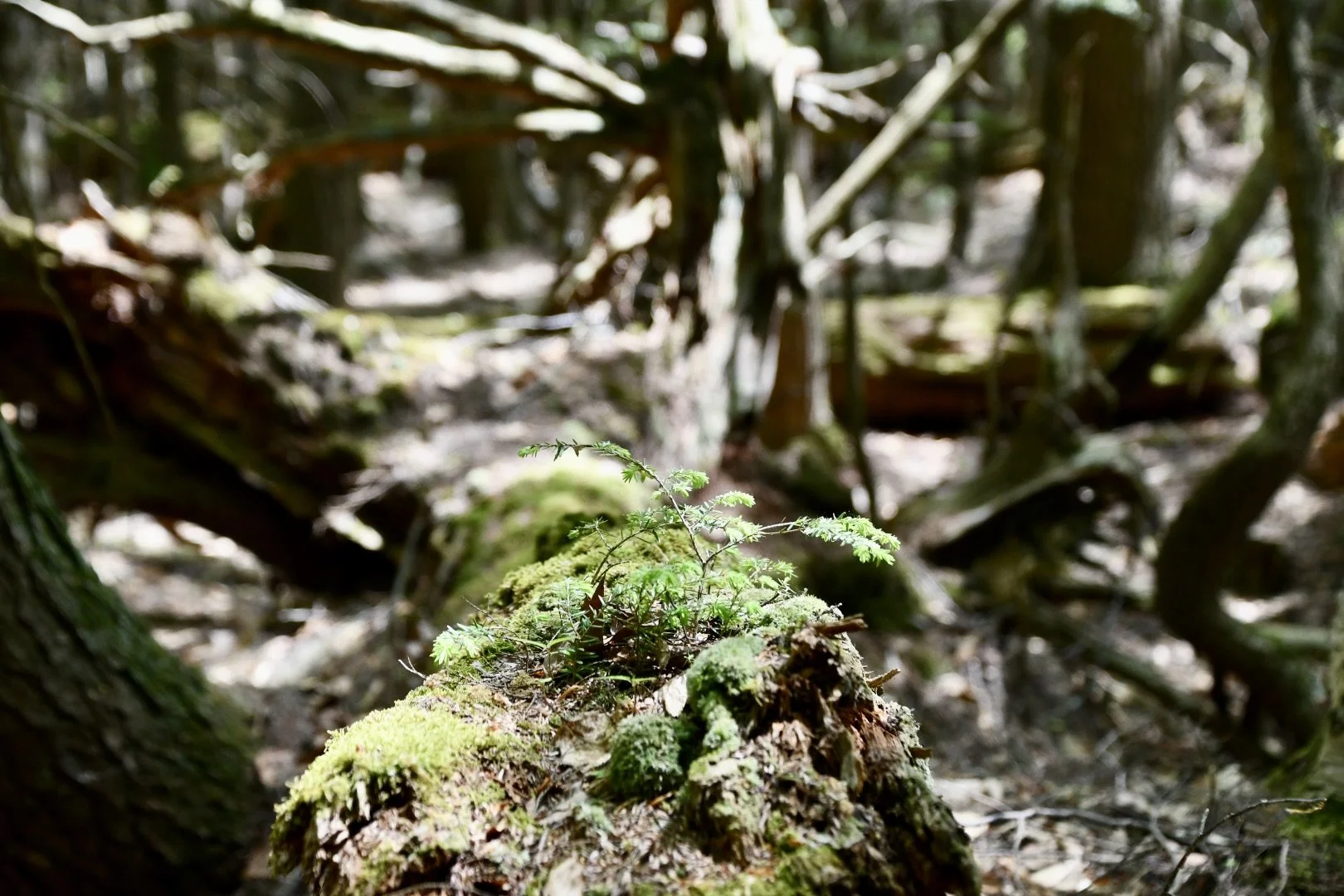
Life from death: A young hemlock grows on a dead tree in Pisgah Forest. Photo © Liz Thompson
And what about Indigenous use of the forest? The Northeast has been a peopled region for millennia, and humans have long been present in the forest. We consider most historical Indigenous use to be compatible with our concepts of old growth and Wildlands. Some places, near settlements, may have been significantly changed by Indigenous use and activity, but these places are rare across the region.
Now let’s hear from Neil Pederson. He spoke eloquently in this panel, and I interviewed him subsequently to gather more insight. He’s also featured in this article in the Adirondack Explorer.
Here are some words from Neil, both from his address and from our subsequent conversation:
My objective isn’t actually to give you a definition. I’m moving beyond definitions.
In the past, I would have been focused on the formula or rubric. I would need to see pit-and-mound topography. I would need to see a lot of deadwood. Snags are helpful. Big trees, old trees are helpful. You know, all the classic things we associate with old growth.
I buy [Charlie’s definition] for the emphasis on process. And if you accept the processes, then you have to accept that sometimes there isn’t much disturbance, and sometimes there might not be much dead wood.
Neil also raised the increasingly challenging question of invasive pests and pathogens, some of which were introduced by human activity. How do we address those? Neil:
This is the other conundrum. There are invasive, exotic pests and pathogens that are totally devastating these forests, and that’s an anthropogenic disturbance.
We’re significantly altering our forests through exotic pests and pathogens and other things. But the processes are still there. Look at the Smokies or other places in the southern Appalachians where the American chestnuts are completely gone due to chestnut blight. We’re still going to call those old-growth forests.
I’ve heard others say that once there’s an invasive tree species in a forest, it’s not old growth anymore. I don’t want Paulownia (a non-native tree) invading our wonderful ecosystems in the Southeast, but they’re there, and they’re not going to go away. We’re not going to control them.
“An old-growth forest is defined by process, not by characteristics. As he’s said before, it is continuity of process through time.”
Other scientists have raised this question and will continue to ask it. It’s a conundrum that will be increasingly common in discussions of old growth, but I’ll leave it there for now, as a conundrum.
Meanwhile, let me summarize with this proposed definition of old-growth forest:
An old-growth forest is one that has been shaped primarily by natural ecological processes for several centuries. These processes include but are not limited to single tree death and decay, wind, fire, flooding, pests and pathogens, and ice and snow loading. Human influence has been, and remains, minimal.
2. Descriptions: How Do We Know We Are in an Old-Growth Forest?
Neil’s comments bring us to the next topic. Many definitions of old growth, those based on lists of characteristics (the “rubrics” he mentioned), are actually not definitions at all, but descriptions. These lists of characteristics help us to detect whether we are in an old-growth forest. David Orwig described this well in his talk. He said that many, but not all, old-growth forests have some combination of:
Gnarled, beat-up canopies and sinuous stems;
Abundant standing snags;
Bark that is much different than that of younger trees;
Abundant downed woody material;
Tip-up mounds; and
Old trees in a wide variety of size classes.
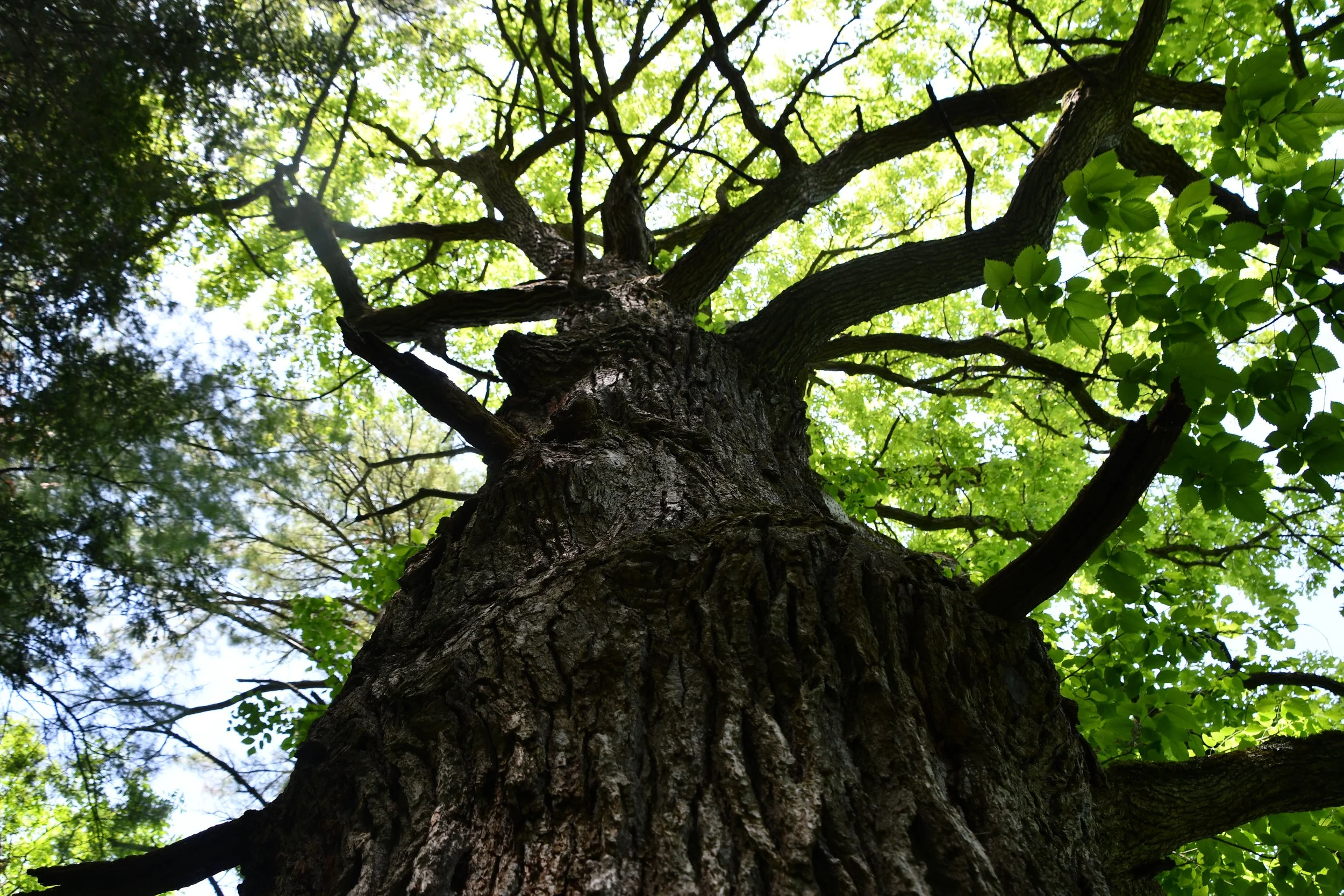
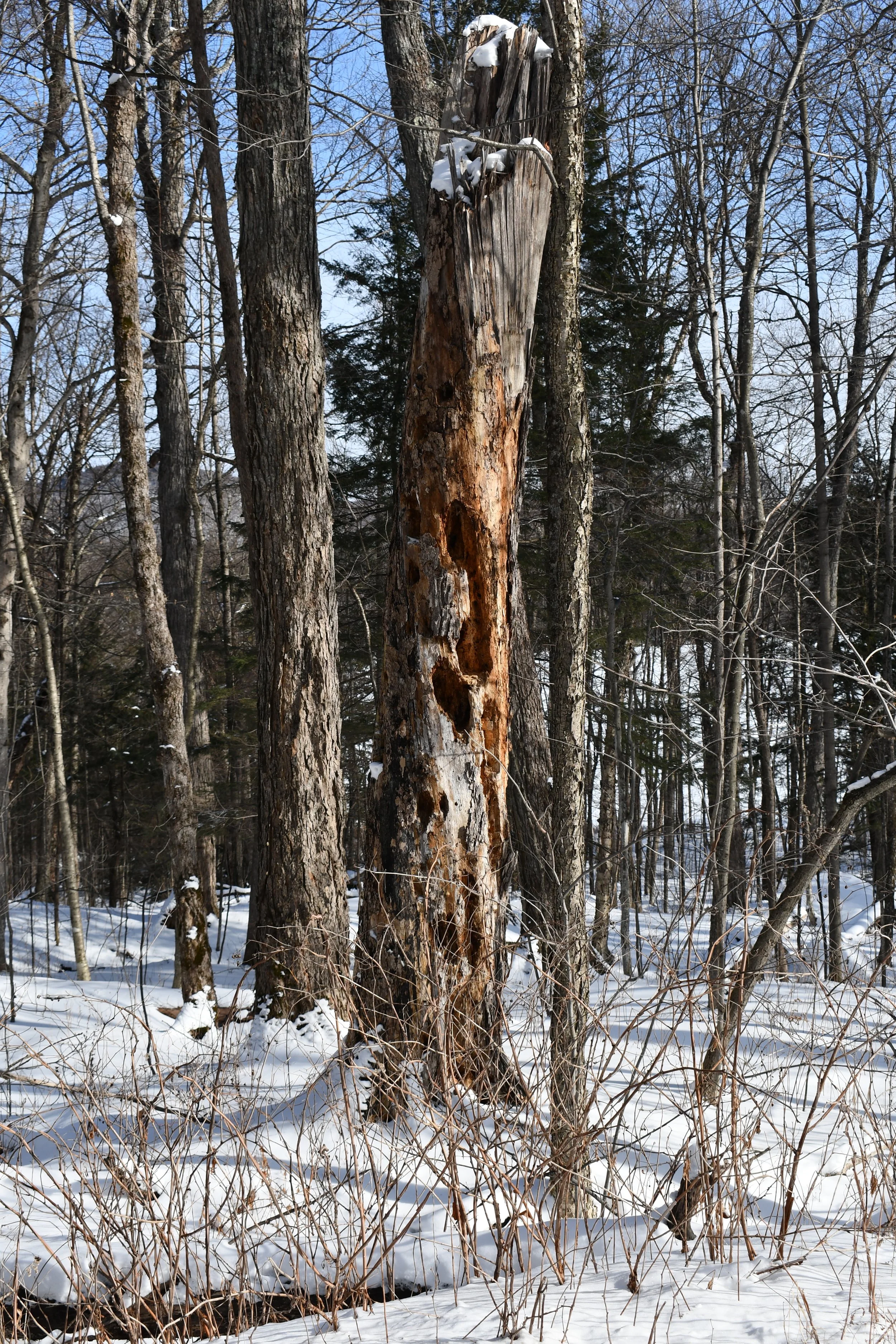
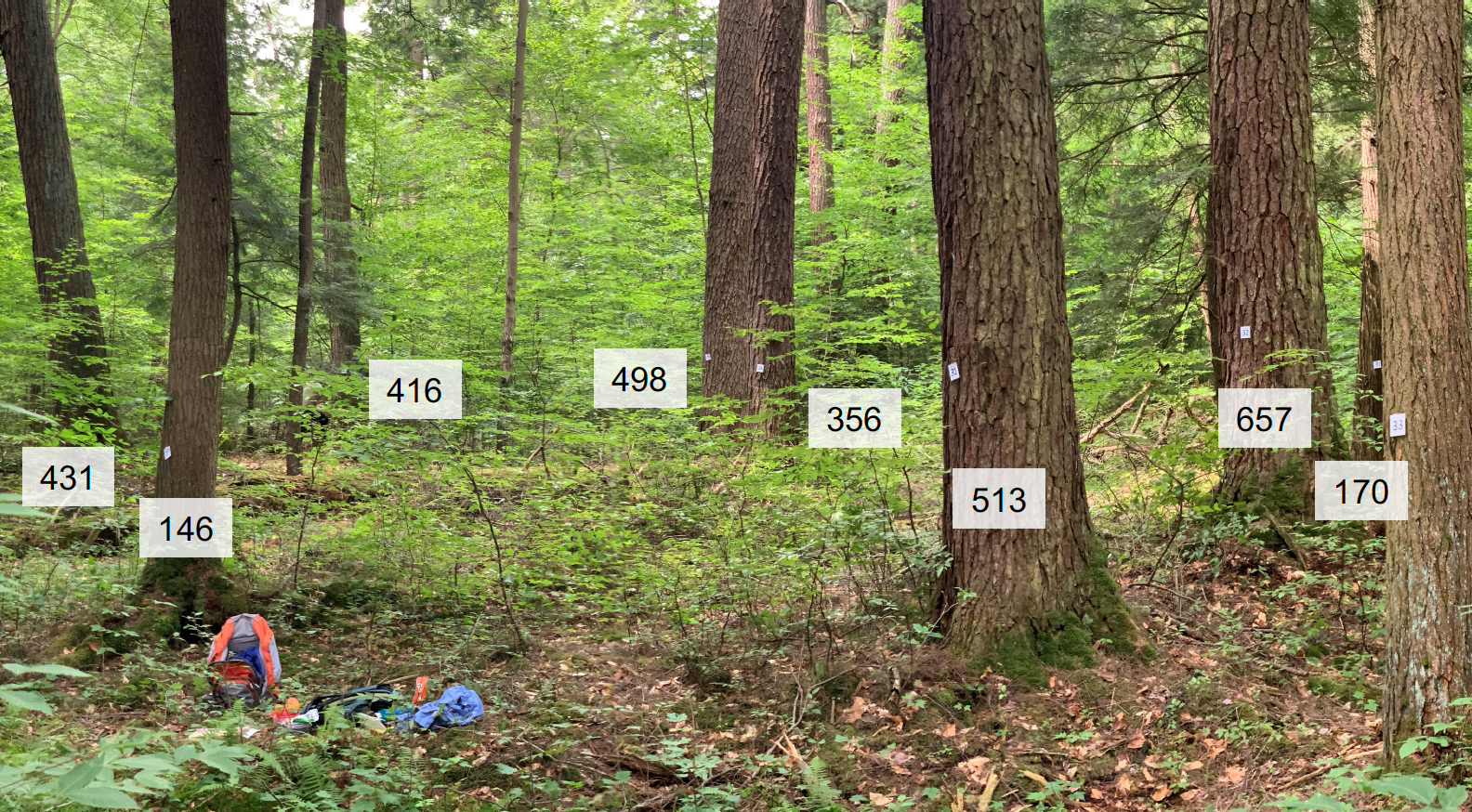
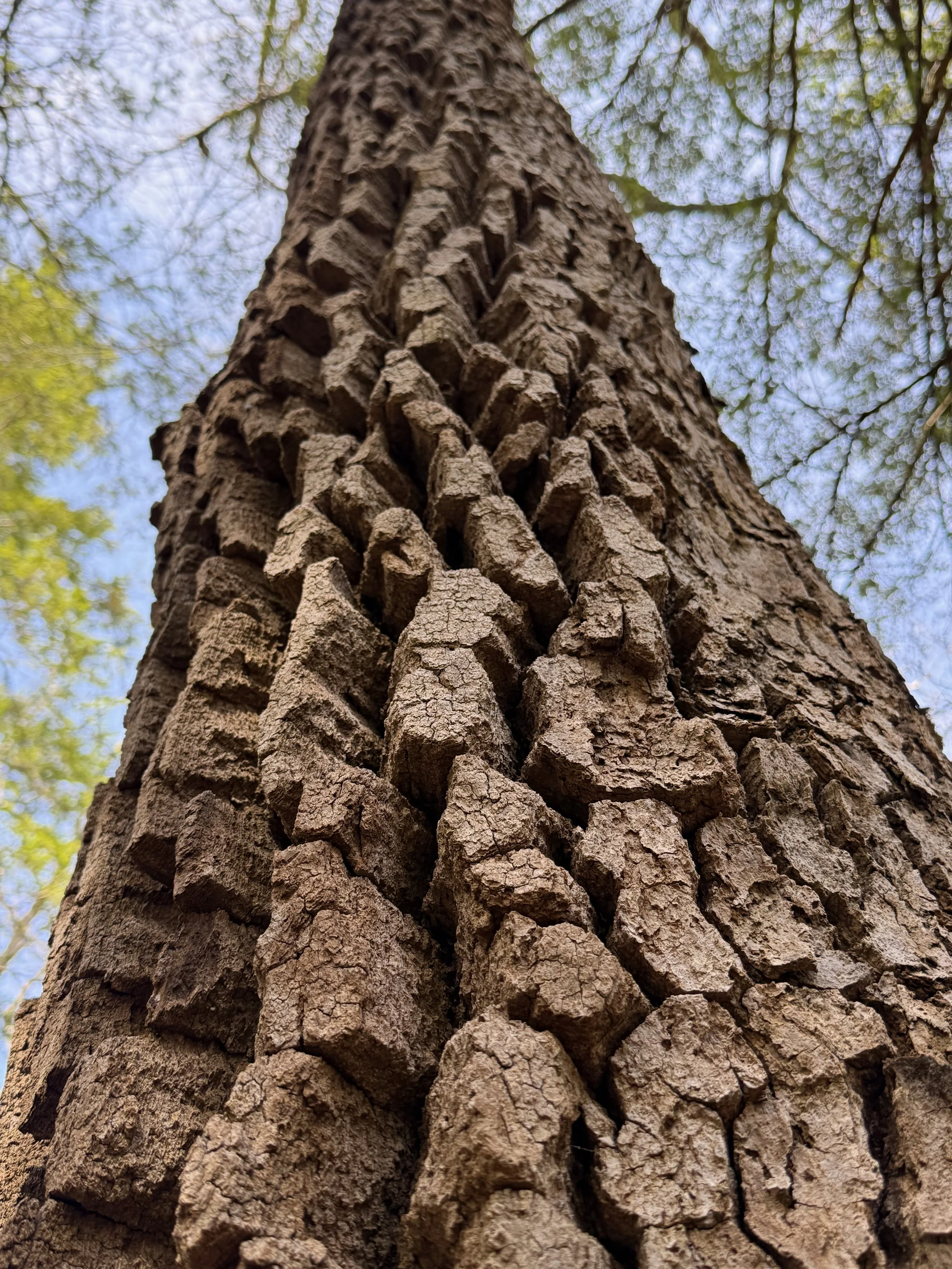
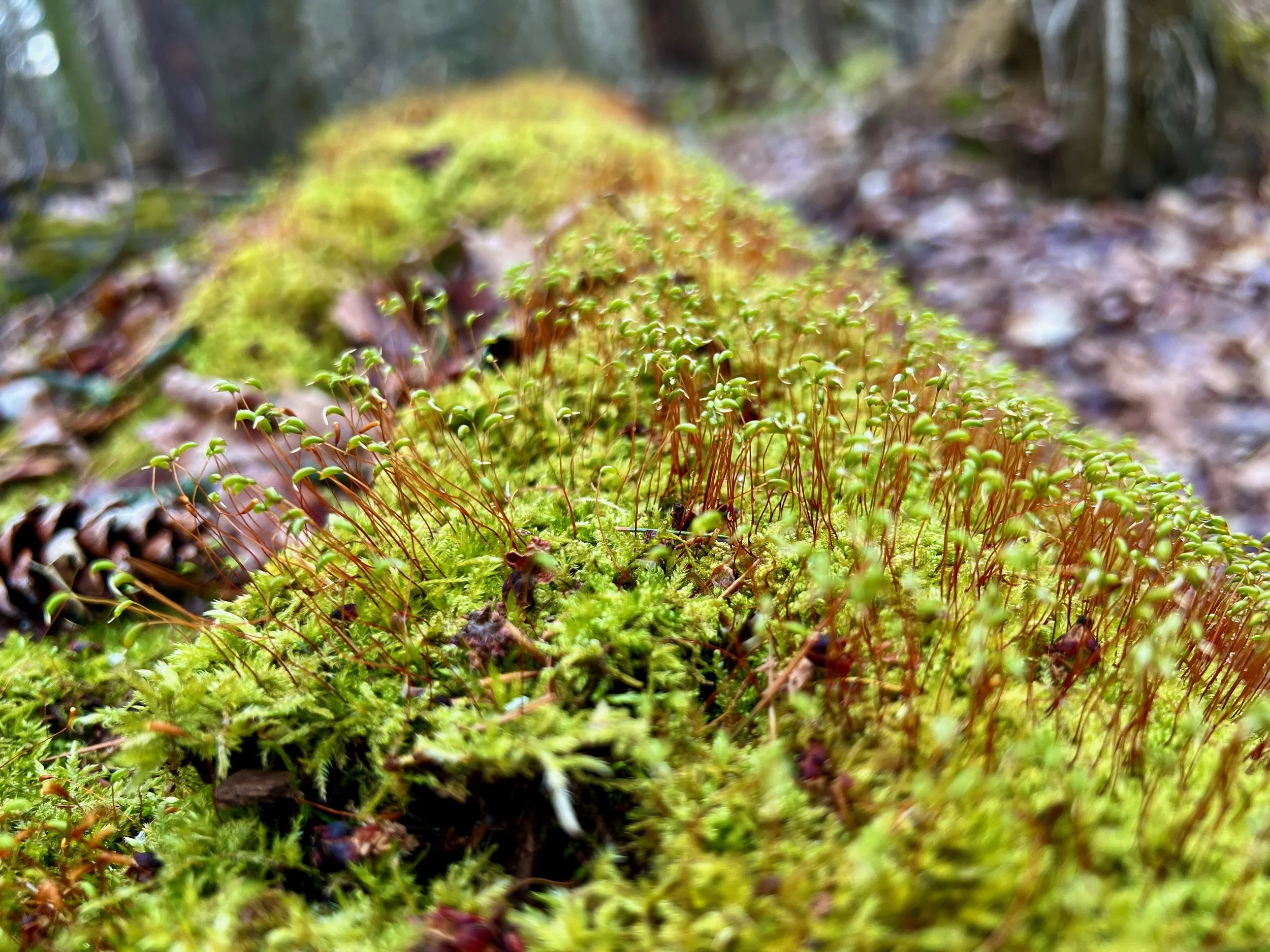
Orwig describes, in his article in this issue, an example of a place that does not show all of these characteristics—a place that was hidden from detection because of that.
Similarly, the northern white cedar forests along limestone cliffs in the northern part of our region can have very old trees, and long histories of lack of human disturbance, yet have only small-diameter trees, no down wood (it all falls off the cliff!), and few tip-up mounds.
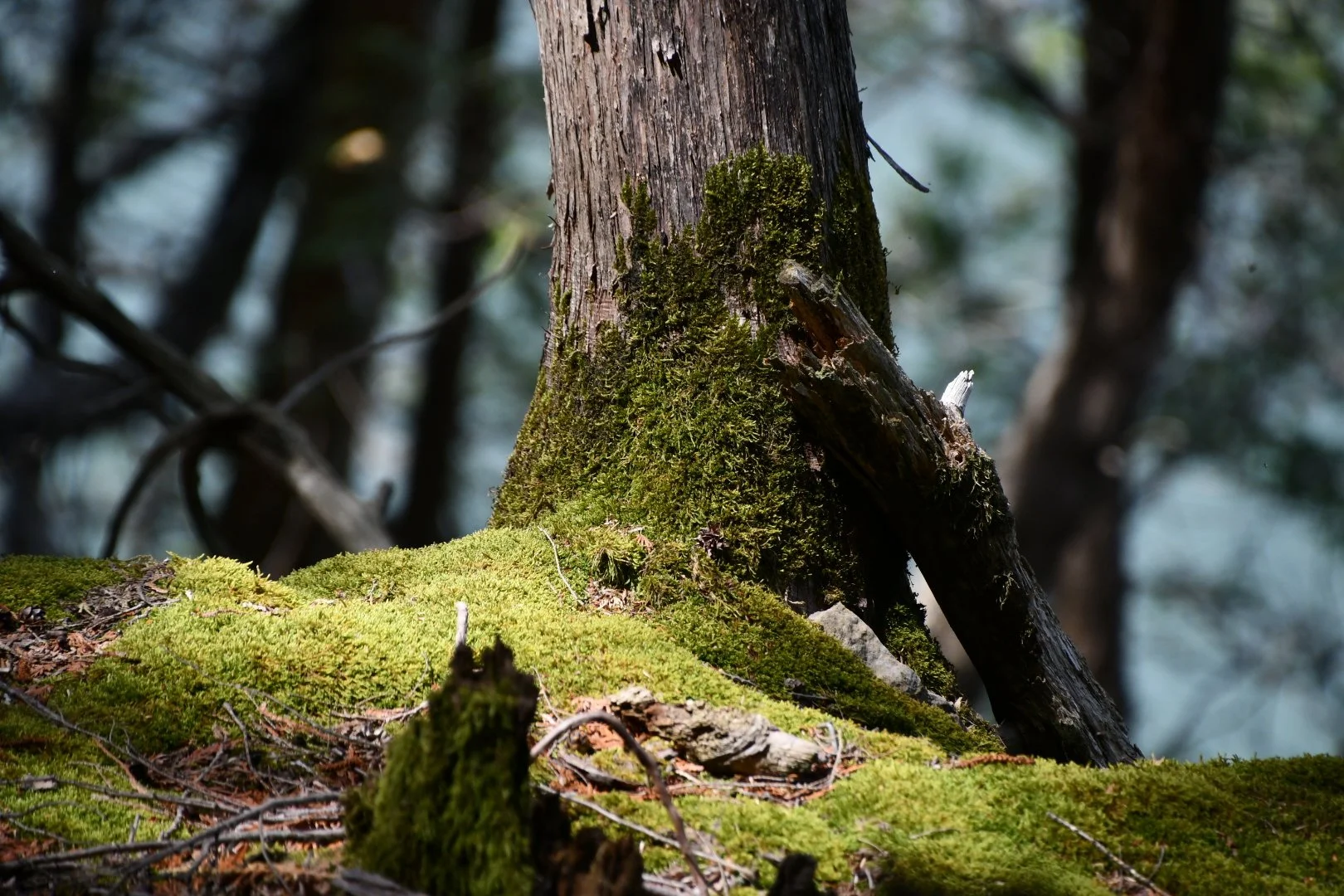
Old-growth northern white cedar forest on Lake Champlain, Vermont. Photo © Liz Thompson
So, while it is helpful to describe what old-growth forests may look like, these attributes don’t define them.
3. Strategies: How Can We Protect the Functions of Old-Growth Forests?
Knowing, then, that time is what defines an old-growth forest, and that there is no one-size-fits-all description of old growth, how do we know what to protect? How can we create legislation, for example, or regulations, or guidelines for land trusts, that help them detect old growth so that they can protect it?
Bill Keeton, in his remarks, chose to focus not on definitions but on functions. Here’s what he said:
I want to make a pitch for a functional approach for defining and mapping old-growth forests. At the end of the day, what I care about is how forests function. How do they regulate the climate, how do they provide habitats for biodiversity? How do they regulate hydrology and control flooding? This frames my whole approach to old growth, thinking about the different functions that old forests can provide, even though their structural characteristics and their histories and their disturbance regimes may vary considerably.
I couldn’t agree more that continuity is important and it’s interesting, and that it can influence forest development. But I’m also a big believer in the idea that secondary forests can also redevelop old forest characteristics, and we’re already seeing that play out across the landscape. So again, there’s no need to bind ourselves into an overly rigid definition. We don’t have to be purists. Rather, we need a broader definition of old forest that recognizes the importance of continuity as one possibility, but also the potential to redevelop old forest structure and function in secondary forests.
So for some agencies, the concept of “old forest” has become useful. Rather than worrying about whether a forest has been free of significant human disturbance for a number of centuries, they are looking at function. Does the forest have the things that old growth offers? Carbon storage? Biological diversity? Hydrological regulation?
Vermont Conservation Design defines old forests simply as “biologically mature forests, generally with trees exceeding 150 years in age.”
The Vermont Use Value Appraisal Program describes old forests as those that “contain significant numbers of large living trees and dead trees, both standing and fallen. They have a mix of species that corresponds to their natural community type, and a structure made up of trees of multiple ages.”
“An old-growth forest is one that has been shaped primarily by natural ecological processes for several centuries. These processes include but are not limited to single tree death and decay, wind, fire, flooding, pests and pathogens, and ice and snow loading. Human influence has been, and remains, minimal.”
They further note that these attributes can be achieved through either passive or active management, citing the publication Restoring Old-Growth Characteristics, by Anthony D’Amato and Paul Catanzaro, which describes the range of approaches to achieving the functional attributes of old growth. Bill Keeton has written recently about this, too, for the New England Society of American Foresters.
With all of these considerations in mind, where protecting old growth and its functions is our aim, I suggest a hierarchy of actions:
Protect all known and documented old-growth forests, ones that meet our definition above.
Protect Wildlands to create a future for old growth. Protect them in all biophysical regions—from the highest, coldest mountains to the lowest, most fertile valleys—so that they represent the greatest biodiversity possible. Protect large Wildlands and small ones, and let natural ecological processes prevail in these places.
Protect existing old forests—places that have old-growth characteristics and functions, but that may not be fully free of human disturbance. Let these forests develop under natural ecological processes.
In actively managed forests, promote old-growth characteristics through ecological forestry, as described in Restoring Old-Growth Characteristics. Protect existing or developing features such as down wood, standing snags, and complex structure. Remember that these actions will not create old-growth forests—only time can do that—but they can create some of the functional features of old growth.
Finally, invite people into old forests. Tell your neighbors and friends where they are, if they are on public land. Let children experience them. Walk in them yourself, every day if you can. Take in the softness of the ground, the moisture, the fragrance of decaying wood. Let those experiences guide you in all you do.
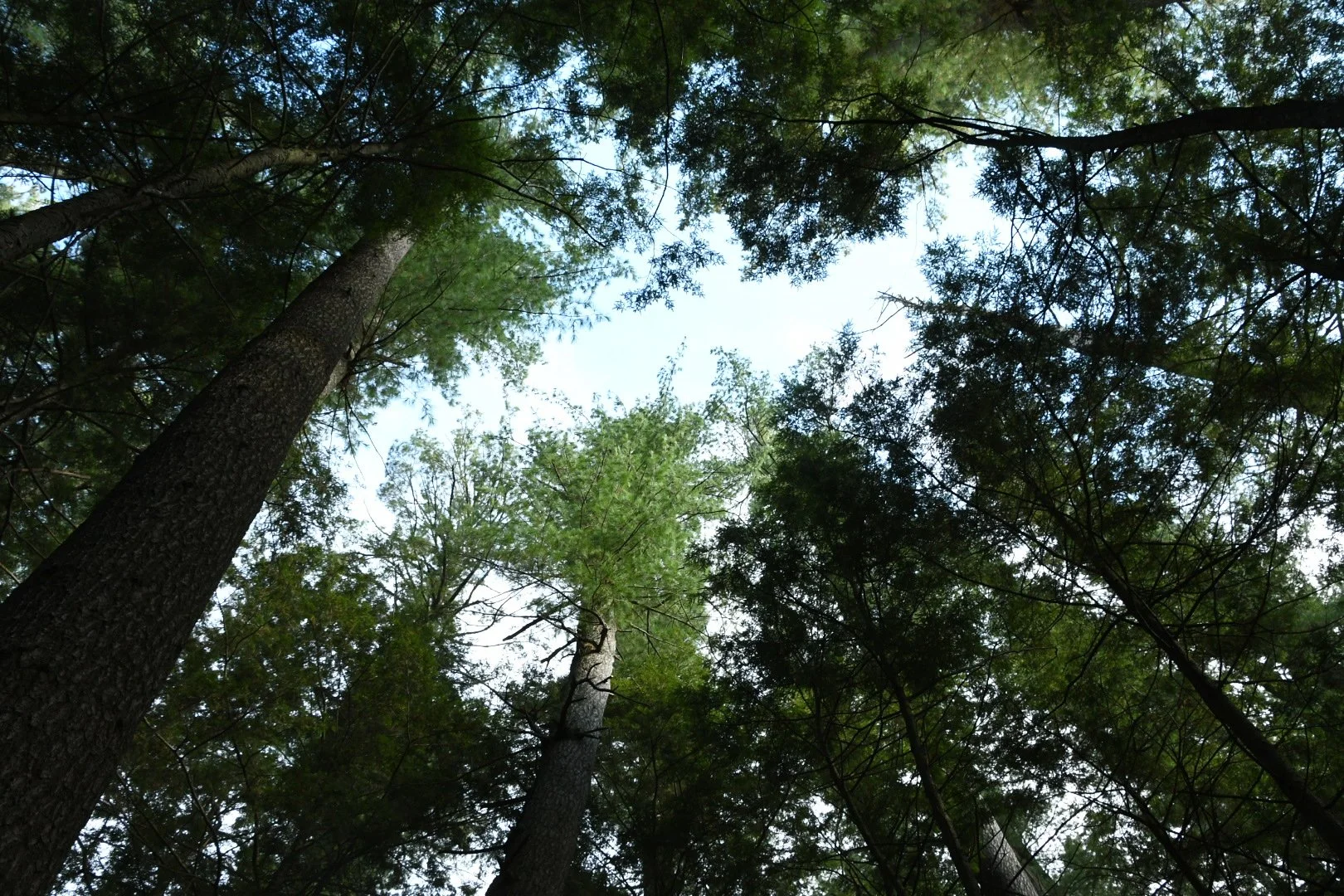
Photo © Liz Thompson
Presentation from the Northeastern Old Growth Conference 2025
September 17-21, 2025 | Middlebury College - Bread Loaf campus | Ripton, Vermont
View all recorded presentations from the conference.
Liz Thompson, Managing Editor of From the Ground Up, has spent her career studying, conserving, and teaching about the natural world. She has worked with The Nature Conservancy, Vermont Land Trust, Vermont Natural Heritage Inventory, and the University of Vermont’s Field Naturalist Program. She co-authored Wetland, Woodland, Wildland: A Guide to the Natural Communities of Vermont and has written and lectured extensively on natural communities. She serves on the steering committee for Wildlands, Woodlands, Farmlands, and Communities, and the board of Northeast Wilderness Trust. She coordinated the 2025 Northeastern Old Growth Conference.