
Tending Your Forest: A Guide to Ecological Forest Stewardship in the Eastern and Central United States by Paul Catanzaro and Anthony D’Amato
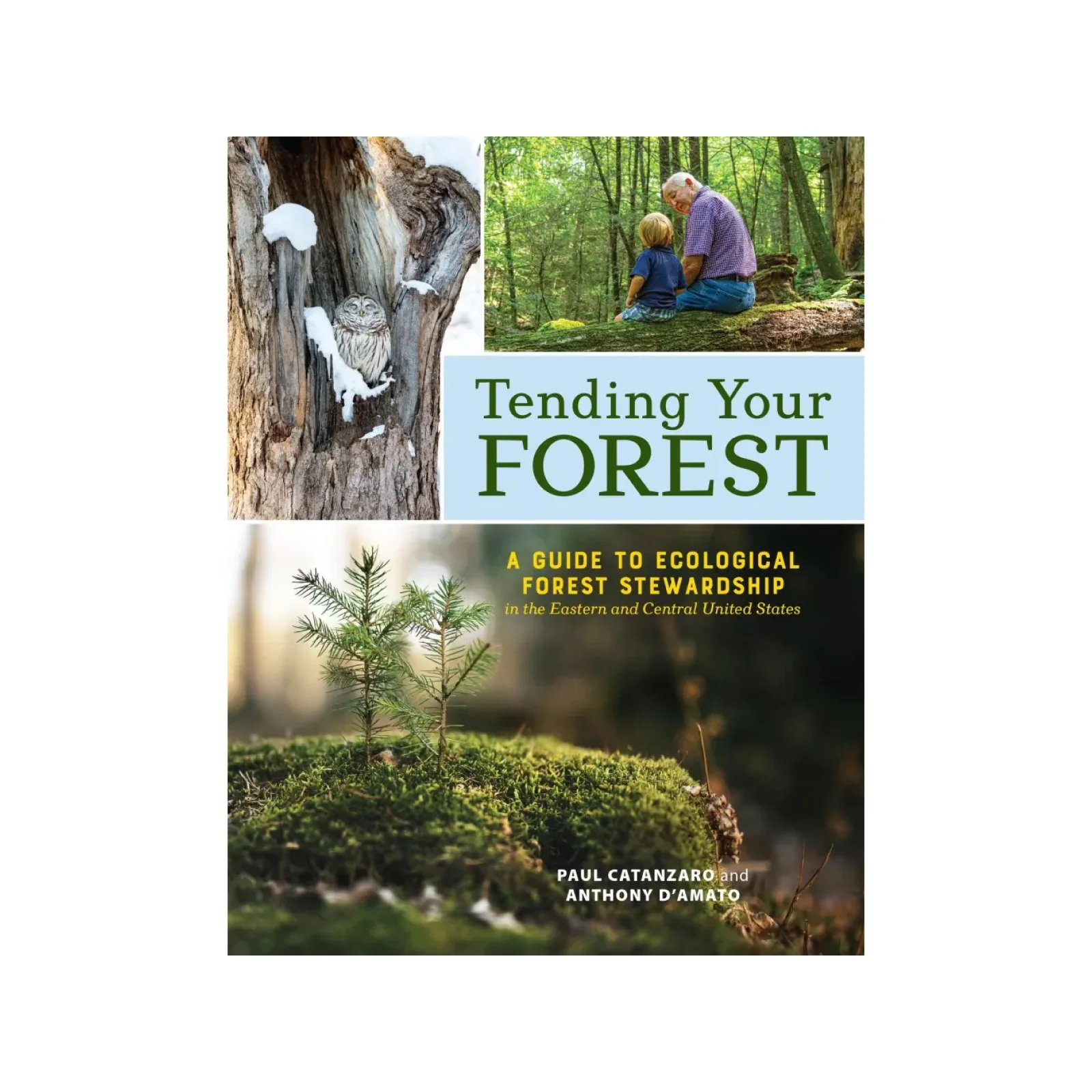
Let me get right to the point. If you are a forest landowner, get yourself a copy of Tending Your Forest: A Guide to Ecological Stewardship. Actually, if you are anyone who loves the woods, whether you walk there or simply enjoy it from afar, you should have this book. You will learn so much.
Tending Your Forest fills a real need in the world of forest management and forest conservation. We need a book about forests that is comprehensive, well-researched, understandable, practical, and beautiful. Tending Your Forest is all of those things. Its reach is broad, both in information and geography—from Maine to Minnesota to Missouri to Virginia—and its message is both inspiring and practical.
Paul Catanzaro and Anthony (Tony) D’Amato have a long history—as Paul describes in his introduction to the book—of working together to teach forest landowners about ecological management. They are both scholars. They are both very effective communicators. And both care deeply about forests.
Individually and as a team, Tony and Paul have written and/or edited dozens of pamphlets, books, and peer-reviewed articles. Tending Your Forest brings all of that work together in one accessible and beautifully laid out volume. The writing is clear and the reading is easy. All the facts and details are there—nothing is dumbed down—but the concepts are presented in a way that any thoughtful landowner or naturalist can easily understand.
The authors start with an invitation to form a relationship with your forest, a relationship of reciprocity—a land ethic that honors the forest. This philosophy pervades the remainder of the book, which is divided into two main sections.
Part One is “Understanding Your Forest,” with chapters on forest history and forest ecology. Part Two is “Practicing Ecological Forestry.” Here the authors do something that stands out to me. They offer landowners a full range of approaches—from passive management, or allowing natural ecological processes to manage the forest—to active ecological management that yields forest products while still protecting ecological values. This approach is in contrast to others (with which I disagree) that propose that all forests need our active management.
Topics addressed in Part Two include restoring old growth characteristics, mitigating climate change, diversifying wildlife habitat, planning a harvest, and leaving a legacy through conservation and estate planning. Each of the chapters ends with a one-page summary with four points: continuity; complexity and diversity; timing; and context. The messages are consistent: Managing a vibrant and healthy forest takes persistence; requires an embrace of complexity; demands careful timing of activities; and always asks us to consider what we are doing in the context of our land ethic, our neighbors, and the broader landscape.
If you are familiar with Paul and Tony’s previous work, or even if you’ve only heard of it secondhand, you are probably familiar with some of the diagrams they’ve developed to illustrate important concepts. You’ve likely seen talks and presentations that include their passive-to-active management diagrams, their successional clocks, and their beautiful and instructive photos.
I’m delighted to see all of Paul and Tony’s great work expanded on and presented in such an accessible manner, all in one attractive volume. Like I said, get this book.
Learn more and purchase the book at Storey Publishing, LLC.
Recommended by Liz Thompson