
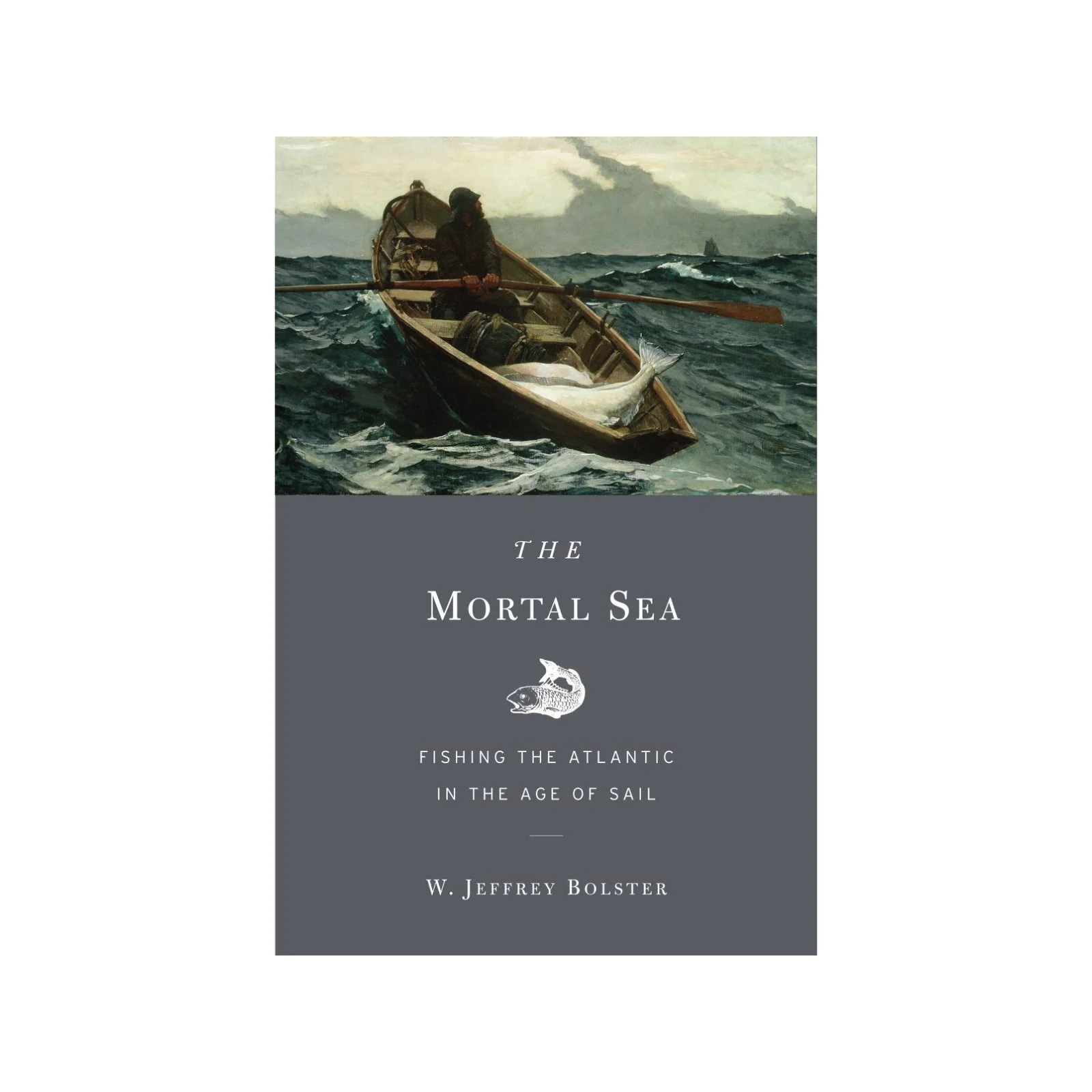
This issue of From the Ground Up would not be complete without Jeffery Bolster’s magnificent history The Mortal Sea. Published in 2012 and winner of several prizes, the book showcases years of collaboration between environmental historians and marine ecologists at the University of New Hampshire—but also Bolster’s craft in telling a big story, based on lots of data, through many appealing smaller stories.
There are several eye-openers in this book. The first is the mind-boggling abundance of life in northwest Atlantic marine ecosystems when Europeans—who were coming from home waters that were already heavily fished—first encountered them. The sea, rivers, and estuaries were crowded with fish, shellfish, birds, and mammals—mostly species the Europeans knew, but in astonishing numbers.
Second, as Bolster describes, the newcomers relentlessly depleted these abundant fisheries, first to supply hungry markets back in Europe and around the Atlantic trade world; and then, in the nineteenth century, to supply the rapidly expanding American domestic market. Much of this degradation was accomplished before the rise of the “modern technology” we often blame for decimating fish stocks: yes, the great factory ships finally crushed the cod fishery in the late twentieth century, but Bolster shows that cod had already been greatly depleted during the late nineteenth century by an earlier technology: swarms of dories deployed from schooners to set “long lines” with hundreds of hooks, replacing hand lines of a few hooks hauled up over the rail.
Third, in the nineteenth century it was often fishermen themselves who warned of overfishing and called for regulation. This was often because they had fished a lifetime with a certain kind of gear and could see that the stocks they could catch that way were disappearing. What they generally opposed was the advent of new technologies that would take far more fish at a younger age—gill nets replacing long lines, for example. But commercial pressure drove the more efficient methods, and fishermen had to go along or get out. Early fisheries scientists, meanwhile, did not fight for a more cautious approach to harvest, but instead believed they could increase stocks through propagation. By the twentieth century, these roles had reversed, with scientists urging restraint and the fishing industry steaming ahead.
Today, a reasonable regulatory framework is in place, but many of the key ecological elements of the system—most notably cod and other larger predatory fish—are still missing, while many fishermen have lost their livelihoods. The issue, according to Bolster, is not just “sustainably” fishing what is left. The issue is working to rebuild some semblance of the robust, diverse ecosystems and the incredible abundance that once was, and to harvest from that in a restrained, precautionary way.
Learn more and purchase the book at Harvard University Press.
Recommended by Brian Donahue