
Call Them by Their Names
Envisioning a Sustainable Future through the Joy of Birds
Editor’s Note: Jeff Ritterson first called me a few years ago about bobolinks—the beginning of an ongoing collaboration with American Farmland Trust and others about how to better support grassland birds on farms. But Jeff’s main job at Mass Audubon is running the Foresters for the Birds program. In this article, Jeff explores how active management of the woodlands portion of the Wildlands and Woodlands landscape matrix can help provide a more complete range of habitat for birds, given the current state of the slowly recovering New England forest. – Brian Donahue
As an ornithologist, I often ponder the tendency of humans to categorize things, especially when it comes to the natural world. Take birds. A huge amount of energy goes into gathering evidence and debating whether a single species should be split into several, or which lineage a group of birds belongs in—not to mention appropriately naming each species. And yet, the birds don’t care. Or rather, they are completely unaware. Each is driven to survive and reproduce, regardless of how they’re named. Some species even readily hybridize with each other.
That said, categorizing the natural world helps us to make sense of what is around us and, more importantly, to make connections. Whether you call it a chewink, a ground-robin, or Pipilo erythrophthalmus, by naming it you have already established a personal connection with the eastern towhee. The more descriptive the name, the more it deepens your understanding of the species. For example, the colloquial name “chewink” refers to the frequent call that towhees give, often while scratching around in the leaf litter looking for food, hence the name “ground-robin.”
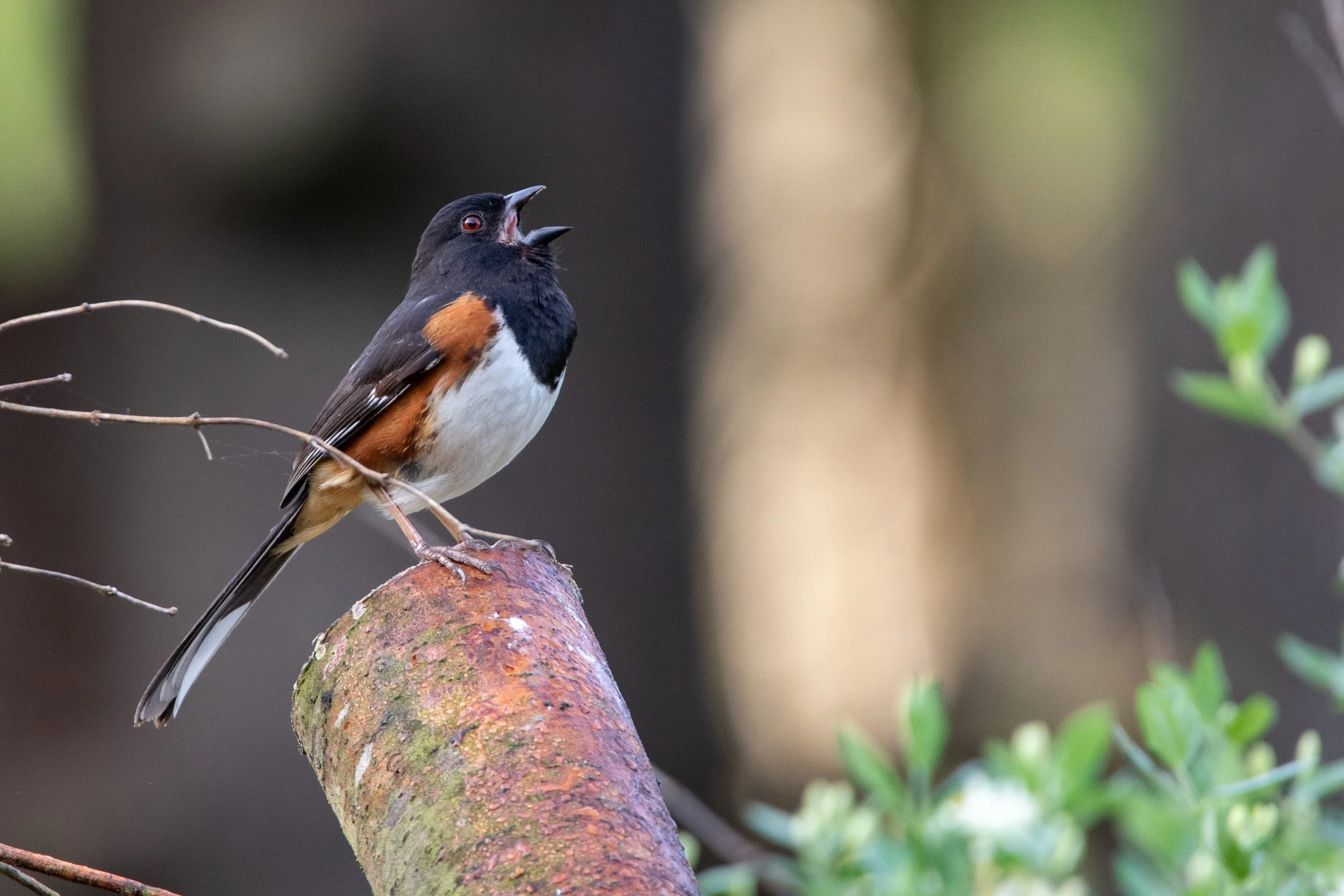
Eastern Towhee habitat is characterized by a dense cover of shrubs and saplings with open-canopy conditions, such as those often resulting from timber harvesting. Photo © Kent McFarland
Being able to call each species by name, knowing them by appearance and song, and ultimately by habit and habitat, is a lifelong process, and also a joy. While walking in the deep woods, I relish the moment I hear a towhee in the distance, announcing that I will soon emerge into an opening with little canopy cover, but dense with shrubs and saplings. I’m excited to see what else I will encounter—these areas are usually full of other birds associated with this habitat, as well as interesting communities of insects, plants, and other life.
The flute-like song of a wood thrush means I will soon be back in the shade, under a tall canopy of mostly hardwoods, but with a well-developed layer of trees in the midstory. A black-throated blue warbler may sing nearby, indicating a dense understory of vegetation, perhaps where a few trees recently fell. Finally, the bubbly, robotic song of a Bobolink means grassland habitat is near, likely an active farm, with tree swallows swooping overhead and cows mooing in the background.
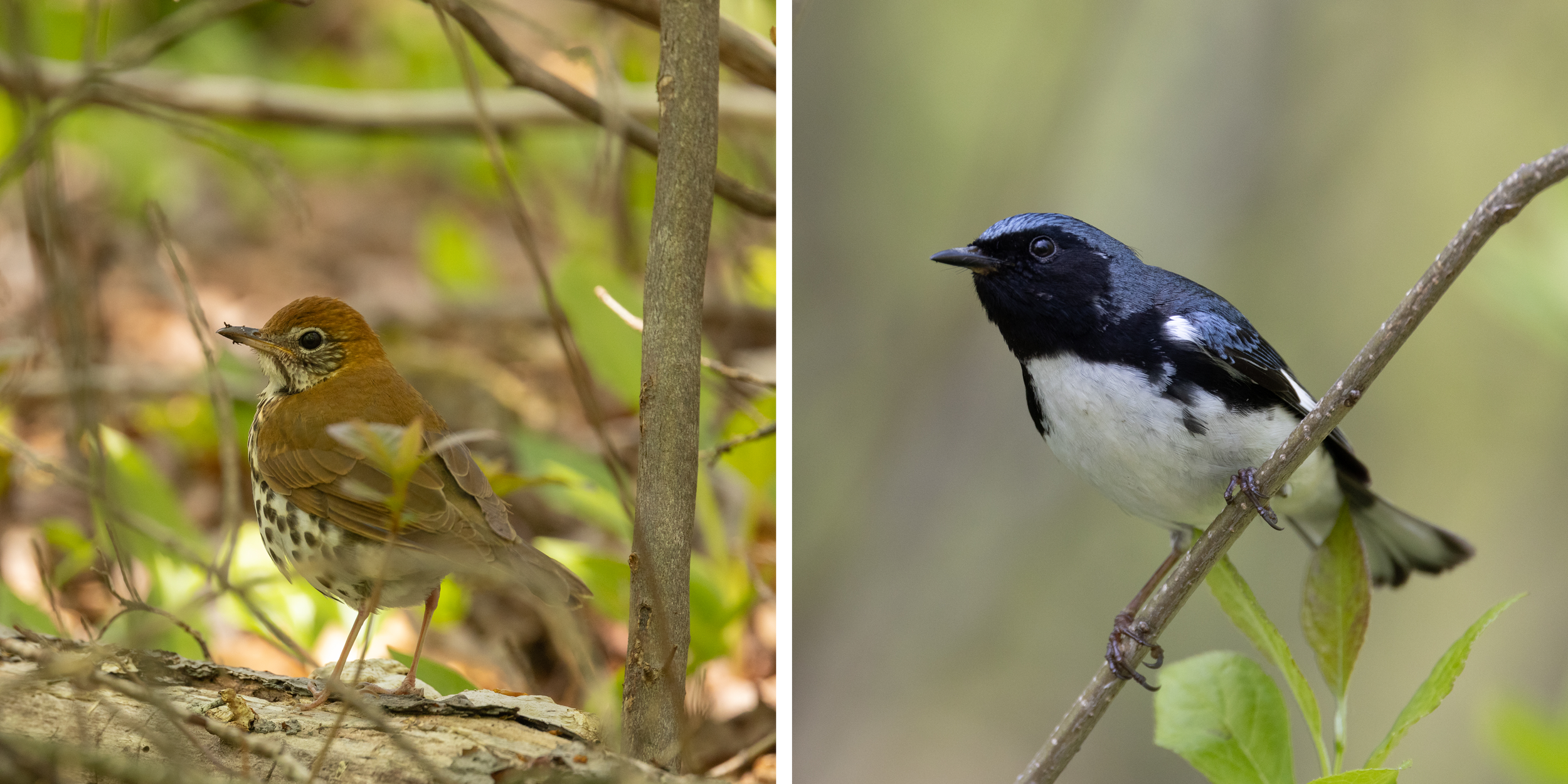
Wood Thrush (left) nest about eight feet high in the midstory, generally in the fork of a horizontal tree limb; whereas Black-throated Blue Warblers (right) build a cup-like nest close to the ground, typically below knee level. Photos courtesy of Mass Audubon
Encountering new habitats along a trail in the woods is exciting and provides variety during an excursion. This same variety is key to supporting a higher level of biodiversity across the landscape.
A landmark study published in 2019, Decline of the North American Avifauna, found that there were nearly three billion fewer birds today than in 1970, a loss of about 29 percent. Eastern forest birds are called out, with declines of about 17 percent. Where once there were 10 wood thrushes, now there are four. Grassland birds are among the species with the highest losses, with 53 percent fewer birds. However, it’s not all bad news. For example, waterfowl have greatly recovered since 1970, in large part thanks to measures to protect wetlands. Conservation works.
When it comes to the conservation of New England’s forest birds and grassland birds, it is tempting to look at the historical record for reference landscapes. While this can provide some insight, things get muddy rather quickly. Precolonial landscapes were certainly overwhelmingly wooded, but the proportions of young and old forests remain unclear. Grassland habitats were much more limited in extent, existing as coastal sandplains, heathlands, and beaver meadows. Forest birds surely took a big hit during the height of colonial agriculture in the mid- to late-nineteenth century, but grassland birds became plentiful. As farms were abandoned in the early 1900s our forests began to regrow, a boon for young forest birds like the aforementioned Eastern Towhee, which likely peaked in regional abundance. Birds requiring older forests, like the Wood Thrush, had to bide their time.
Today’s landscapes are highly altered, and we are unable to replicate the past, no matter what baseline we choose. A better approach to setting conservation targets is to be informed by the past but rooted in the present, taking stock of current conditions and setting a vision for the future—one that respects the land and considers all that we ask of it.
The first step in securing bird populations is to protect land from development, including large blocks of forest and our remaining farmland, as habitat loss and fragmentation are strong drivers of decline. The Wildlands, Woodlands, Farmlands & Communities (WWF&C) vision sets a goal of 80 percent of New England protected by the year 2060—a bold goal that is achievable if we quicken our pace. Specifically, the vision calls for at least 60 percent of the region protected as managed forest (Woodlands), 10 percent as Wildlands, and 7 percent as farmland. At Mass Audubon, we launched the $75 million Catalyst Fund in 2024 to accelerate land protection in Massachusetts. Protected Wildlands will naturally develop into old forests over many years.
However, the opportunity to urgently address the decline of forest birds lies in the productive Woodlands. Disturbances in the forest serve to create or enhance habitat, and that includes those created by timber harvesting. Large stand-replacing events, where most of the forest canopy is removed, create habitat for young forest birds, which have declined sharply in recent decades, in step with the loss of young forest. Small-scale disturbances, such as the selective harvest of single trees or small groups, create features that support old forest birds. These include layers of vegetation below the canopy, where many species nest and forage. That is, these events enhance the structural complexity that is characteristic of old-growth forests, but that is often lacking in the relatively young, or shall we say middle-aged, 80–120-year-old forests that dominate the New England landscape. Protecting large blocks of forest and developing structural complexity will help create favorable conditions for Wood Thrush and other old forest species.
“A better approach to setting conservation targets is to be informed by the past but rooted in the present, taking stock of current conditions and setting a vision for the future—one that respects the land and considers all that we ask of it.”
Emulating both large- and small-scale forest disturbances has a place in growing timber, in enhancing the resilience of our forests, and in conserving biodiversity. Our lack of young and old forests, as well as the simplified, structurally homogeneous conditions found in our middle-aged forests, is largely due to past and current land-use choices. The past is gone. However, producing and using New England-grown timber is a choice we can make, one that helps sustain our birds and helps create a sustainable future, as pointed out in publications such as Beyond the Illusion of Preservation.
That said, not all forestry is conducted to the same standard. In my work as an ornithologist at Mass Audubon, I direct the Foresters for the Birds program in partnership with the Department of Conservation and Recreation and the Mass Woodlands Institute. We work to equip foresters with an understanding of bird habitat and with actions that can protect or enhance that habitat while also meeting timber production and other goals. A sister program, called Climate Forestry, empowers foresters to consider climate resiliency in their work. Similar programs exist in states across New England to raise the standard of forestry work and habitat management projects, ensuring ecologically sound approaches by properly sizing and siting projects, retaining features like cavity trees, recruiting structures like understory shrubs, and planning for desired outcomes that consider the quality of what is left behind.
Our approach to grassland birds is similar to our approach in productive forests. Active farms, specifically hayfields and pastures, provide the vast majority of habitat in the region. While the loss of farmland has driven bird declines, so has agricultural intensification. The modern ability to harvest hay several times per season renders it nearly impossible for bobolinks and other species to fledge their young. At Mass Audubon, I also work with partners on The Bobolink Project, which provides financial support and technical assistance to farmers in accommodating grassland birds on their farms. There is much work to be done, but as in the woods, this represents an initial step in keeping farms viable and producing food for our communities, while also supporting birds.
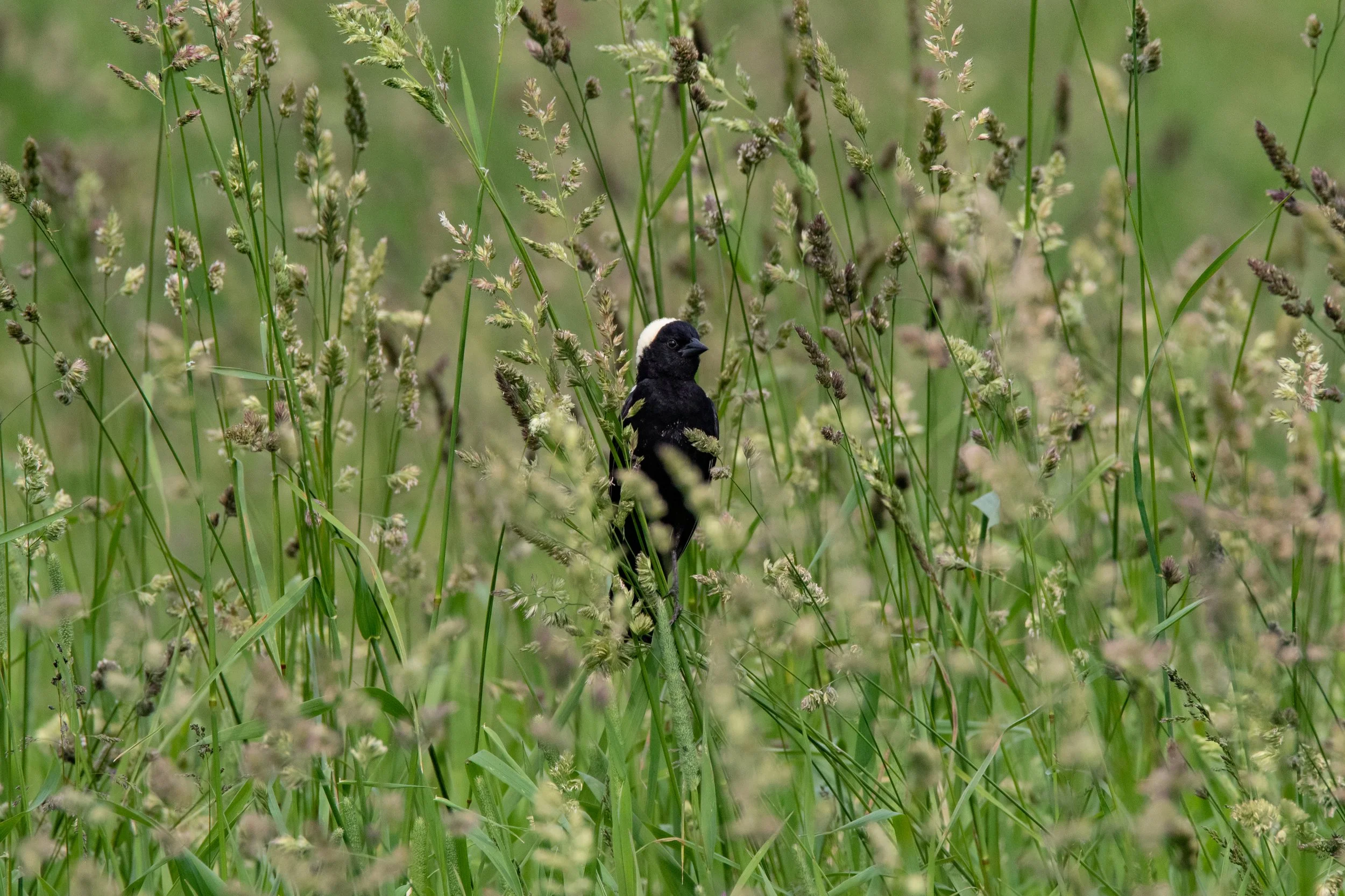
Bobolinks nest in fields with a mixture of grasses and forbs, as often found in the hayfields of New England. Photo © Kent P. McFarland
Birds exist on every continent and in virtually every habitat, and they serve as indicators of ecological health. They are also quite conspicuous, which is what makes birdwatching so much fun. Enjoy them. Categorize them. Learn their songs. Call them by their names and learn their habits. Set goals and achieve a vision. Help birds to prosper, and we all prosper.
Jeff Ritterson is a Field Ornithologist at Mass Audubon, where he is responsible for landbird conservation with an emphasis on private land and working landscapes. This includes work with The Bobolink Project to conserve breeding grassland birds throughout New England, as well as directing the Massachusetts Foresters for the Birds program and conducting research on Wood Thrush in Belize to advance the conservation of forest birds.