
Food and Farming Research Update
Editor’s Note: I’ve known Molly for years and have worked on projects with her throughout her career at Tufts, Oxfam, College of the Atlantic, Middlebury, and University of Vermont. She was instrumental in developing Food Solutions New England and in writing A New England Food Vision. She is both a passionate activist for sustainable farming and food justice, and a rigorous scholar. Who better to bring us a quarterly update on interesting and important recent research in food and farming? – Brian Donahue
Global Water Bankruptcy: Living Beyond Our Hydrological Means
In our age of polycrises, it is often difficult to know which problems are most acute. A recent report from the UN University Institute for Water, Environment and Health, Global Water Bankruptcy, describes global water shortages, which of course are connected with climate change as the world heats up and many areas no longer have reliable rainfall and snowmelt. Humans can live a few weeks without food, but for only about three days without water. The lack of fresh water already threatens several major cities, such as Cape Town, Los Angeles, Phoenix, Tehran, and Cairo. In fact, half the world’s 100 largest cities are experiencing high levels of water stress, with 38 of these sitting in regions of “extremely high water stress.” Nearly three-quarters of the world’s population lives in countries classified as water-insecure or critically water-insecure, and parts of the water ecosystem have been degraded beyond prospects of recovery. This report explains the governance and management issues that have contributed to overuse of water, where water availability is most threatened, and how the planet can best adjust use to be more just and to avoid conflicts.
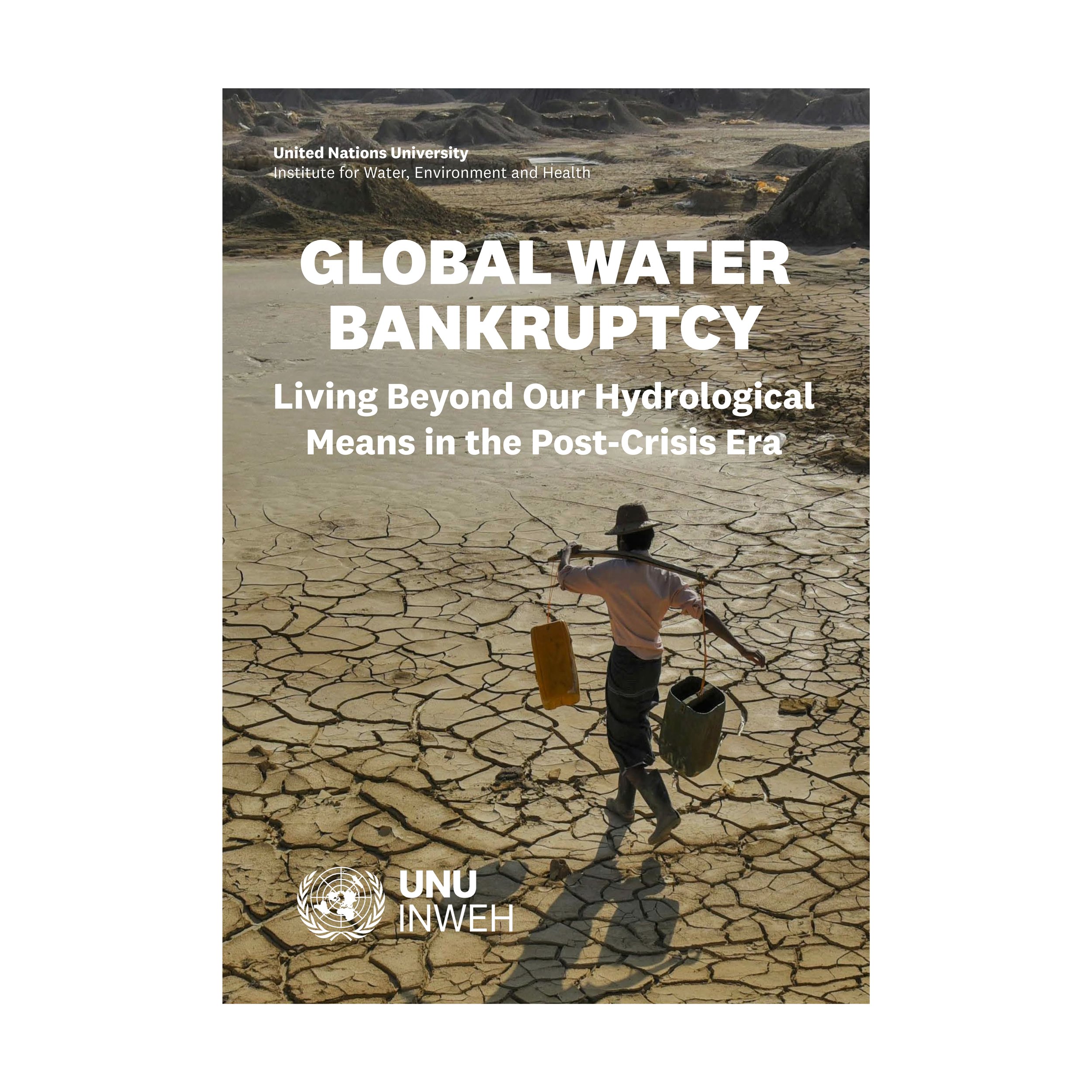
Photo courtesy of UN University Institute for Water, Environment, and Health
Drought Leads to Human-Wildlife Conflict
Closer to home, an article in Science Advances shows that human-wildlife conflict in California increases with drought conditions, which are becoming more prevalent with climate change. Of particular concern are reports of conflicts with carnivores. Coyotes, black bears, and mountain lions often expand their ranges during drought and may prey on livestock or raid crops. Rising antagonism from ranchers creates pressure on these apex predators, whose populations may already be threatened.
New Regenerable Water Remediation Platform
Parts of the United States are included in areas of chronic overuse of water, but other places are more concerned about pollution. Given the health problems associated with PFAS (per- and polyfluoroalkyl substances), a recent article, “Regenerable Water Remediation,” is of great interest. Over the last five years, PFAS have been the target of several lawsuits against the manufacturers 3M, DuPont, and Chemours. Discovered in 1938 in a lab accident, these “forever chemicals” are now ubiquitous in non-stick cookware, firefighting gear, waterproof clothing, stain-resistant carpeting, and many other products. Their toxicity was unknown until the 1990s. Now we know that they do not break down in the environment, and exposure can lead to some cancers, infertility, and damage to the immune system. In agriculture, PFAS come from sewage sludge applied to land, from industrial sites ejecting PFAS in waste water, and from contaminated pesticides and feed. PFAS lead to food safety risks, sometimes necessitating herd destruction. There is no universally accepted safe level of PFAS in livestock feed.
The article suggests an effective integrated ultrafast capture-thermal destruction-recycling (CTR) process for treating PFAS-contaminated water. Although it still needs to be tested for widespread applicability, this process shows promise of making “forever chemicals” a thing of the past.
Molly Anderson is the William R. Kenan Jr. Professor of Food Studies Emerita at Middlebury College in Vermont, where she directed the academic program in food studies and taught classes for 10 years. She is also a Research Associate Professor at the Institute for Agroecology at University of Vermont, working on regional food governance, international collaborations, and education for agroecology. She is a member of the International Panel of Experts in Sustainable Food Systems and on the board of the local food relocalization organization in her county. She published Transforming Food Systems: Narratives of Power in 2024.