
Diversity in Deadwood
An Interview with Forest Ecologist Dr. Shawn Fraver
Editor’s Note: Shawn Fraver is an icon in the world of forest ecology. He is widely published and has inspired many students and peers with his deep knowledge of forest ecology. Of particular note is his collaboration with several scientists in Sweden, Norway, and Finland, where the study of forests is aided by a commitment to detail—to knowing the organisms that live on a particular species of tree or in a certain age of decaying wood. Dr. Fraver spoke on some of these topics recently, and he opened my eyes to the great biodiversity that is known from European old forests. In Fennoscandia as a whole, a full 7,000 species are known to rely on deadwood. And one-third of Sweden’s red-listed species depend on deadwood. These are astounding numbers—how do they even know all these species? I asked Dr. Fraver to talk with me a bit more about those findings and how we can learn from what is known in Europe. The interview has been edited for brevity and clarity. – Liz Thompson
Liz Thompson (LT): How do you define biodiversity?
Shawn Fraver (SF): Quite simply, it is the variety of all living things, which can be expressed at different scales. I’m focused on the “bio”—the living parts as opposed to the structural or functional components of diversity, which are sometimes included. So biodiversity can be expressed as genetics within a population, or species within a stand, or species within a landscape, or species within an ecosystem. But to me it is really focused on the living components.
LT: Are old-growth forests important to the conservation of biodiversity?
SF: Yes, I think they are. As forests become older they generally become more structurally diverse. Greater structural diversity means more physical niches that support individual species. It’s everything from small things like bark fissures to bigger things like standing dead trees. As trees get larger the bark fissures get deeper, and that creates microhabitats for certain lichens that seem to prefer that microhabitat. And there are other obvious structures, like the variety of tree diameters, the variety of tree heights, the variety of tree ages, coarse woody debris in different states of decomposition—that are extremely important. So again, to me the importance of old forests is related to species, but it’s a function of the structure that develops over time.
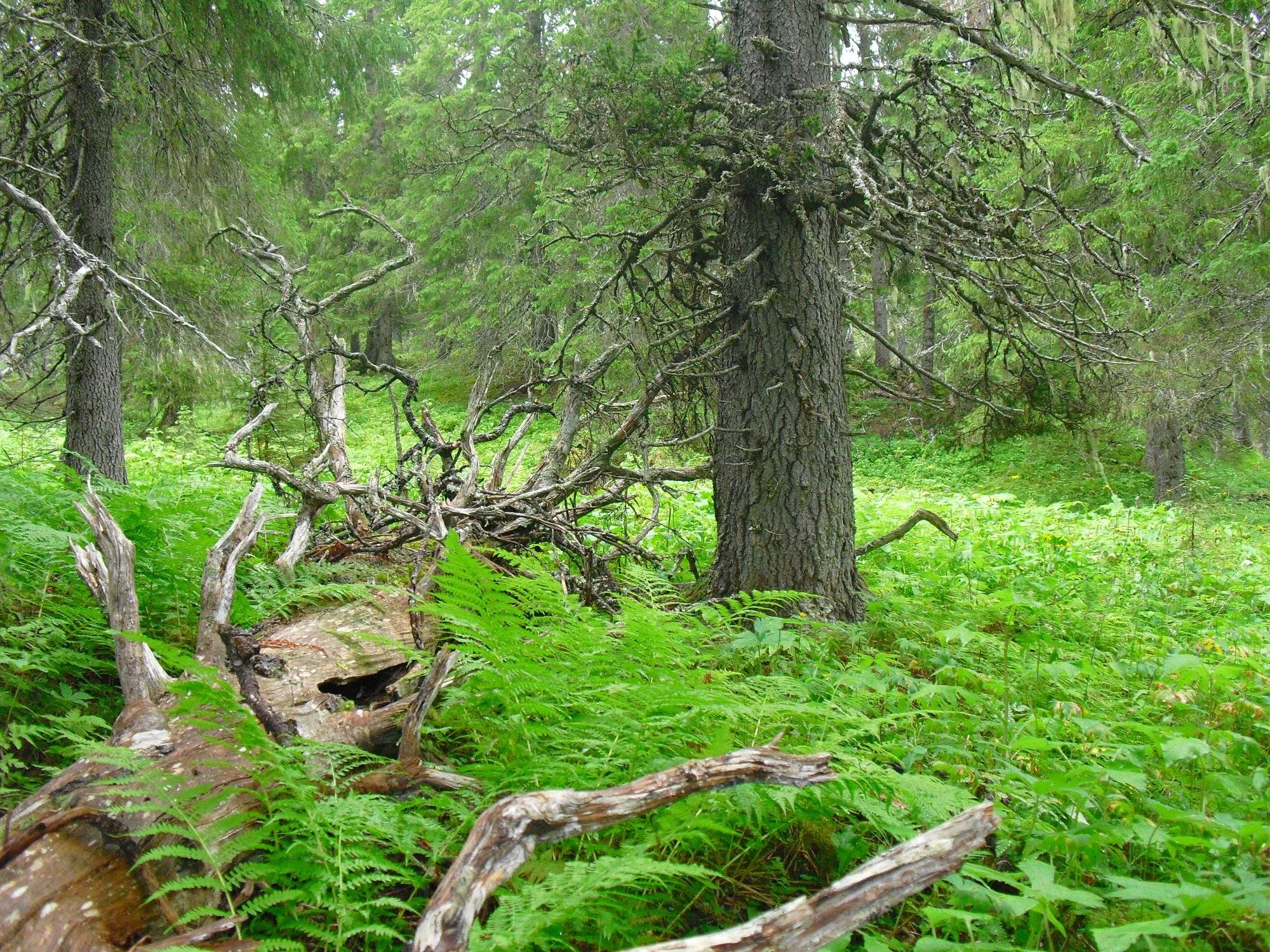
Typical structure of old-growth Norway spruce forests of the Gardfjället Reserve in northern Sweden. Photo © Shawn Fraver
LT: You gave a fabulous talk for the Northeast Wilderness Trust recently, and you also spoke in 2023 at the Northeastern Old Growth Conference on old-growth forests and their importance for biodiversity. These talks were so enlightening with regard to what you have learned from your colleagues in Scandinavia. Can you offer some highlights of those lessons? I was especially struck by what they know about biodiversity in deadwood—all laid out in a fascinating book that you mentioned.
SF: Where do I start? First of all, let’s talk about the term “old growth.” In Sweden, most scientists don’t get hung up on that term. I think it’s an unfortunate term for several reasons. It implies we know the ages of trees, but we often don’t. And the term generates a lot of opinions and emotions, both positive and negative. In Sweden, what they focus on, rather than “old growth,” is biodiversity. They focus on preserving and protecting forests of high conservation value, regardless of a perceived age. So if they do an inventory of a forest stand and find that it supports a high amount of biodiversity, there is an incentive to protect it, regardless of how we would characterize it in terms of age. And I think that’s a really refreshing view, rather than focusing on that controversial term, “old growth.” But they can do that because they’re very good at field inventory—of things like lichens, mosses, fungi, beetles—and we are very limited in that capacity.
LT: Perhaps that explains a bit why we use old growth as a proxy for biodiversity, because we don’t really know the species, particularly the fungi, invertebrates, and soil microorganisms.
SF: Yes, it is a proxy, and it’s not a terrible proxy. Mac Hunter and Bob Seymour wrote about the coarse filter approach to protecting biodiversity. The idea is that if we protect a variety of habitats and structures, we will protect a diversity of species, many of which are unknown to us.
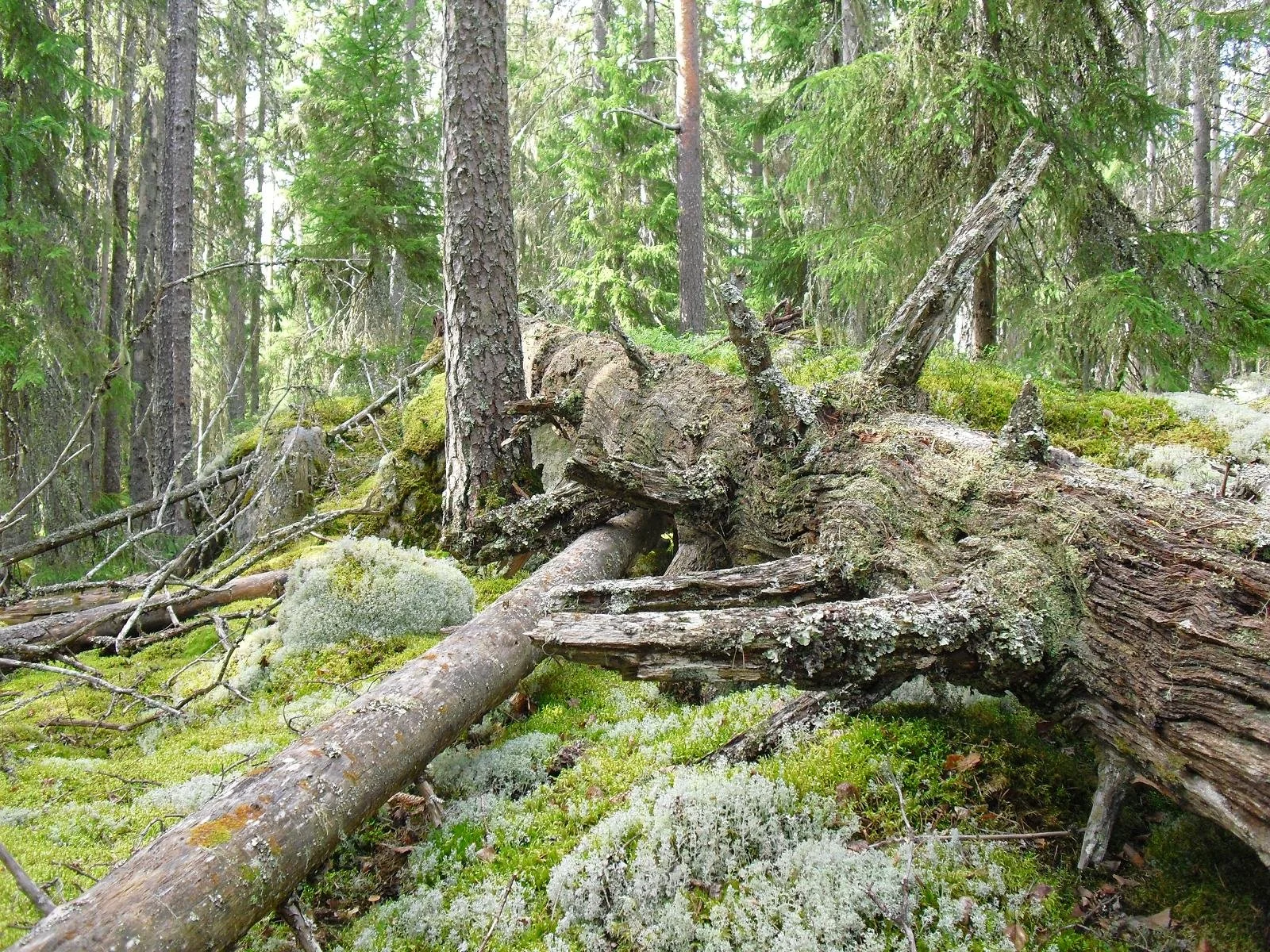
A mix of coarse woody debris species, sizes, and decay states promotes biodiversity of wood-inhabiting fungi and beetles. Photo © Shawn Fraver
LT: Would you suggest a different term to replace “old growth”?
SF: Some years ago Lee Frelich wrote a paper suggesting we refer to these as “primary forests”—primary as opposed to secondary. This means forests that have not been harvested. He suggested we adopt that term instead of “old growth,” but it never caught on. There are a lot of terms I would not use.
LT: What terms would you not use?
SF: I would not use other controversial terms like “primeval” or “virgin.”
LT: How about “ancient forest?”
SF: In Great Britain they use the term ”ancient woodland,” which refers to sites that have been continuously wooded since 1600. That seems to work for them but, confusingly, it still implies some age.
“Let’s talk about the term “old growth”... In Sweden, what they focus on, rather than “old growth,” is biodiversity. They focus on preserving and protecting forests of high conservation value, regardless of a perceived age.”
LT: George Peterken, a British ecologist, wrote about all of these terms and the confusions surrounding them in his 1996 book Natural Woodland, and again more recently in a chapter in the 2023 book Ancient Woods, Trees, and Forests. The concept was meant to describe longevity of forest cover, not the age of the trees.
SF: Yes, Peterken is an important contributor on this topic.
LT: What about the term “LSOG,” or “late successional and old growth.” Is that helpful at all?
SF: That term is more inclusive, though it too has been controversial. The thing I like about that LSOG index is that it includes both structure and species through inventory—for example of bark lichens and mosses as well as tree diameters—so that it includes both biodiversity elements and structural elements.
LT: Back to your northern European colleagues—how can we learn from their work? I’d love to be able to say that someday we’ll know as much as they do. Should we just start looking more?
SF: The reason they are so good at what they do is that they can identify species. They have a strong emphasis on taxonomy and identification. We don’t have that in North America. In general, Swedes, Norwegians, and Finns are really good at field taxonomy. And I think there’s a lesson to be learned there, but there’s also a flip side to that. I think here in North America we are much better at understanding ecological processes. These are cultural differences that have developed over decades or centuries.
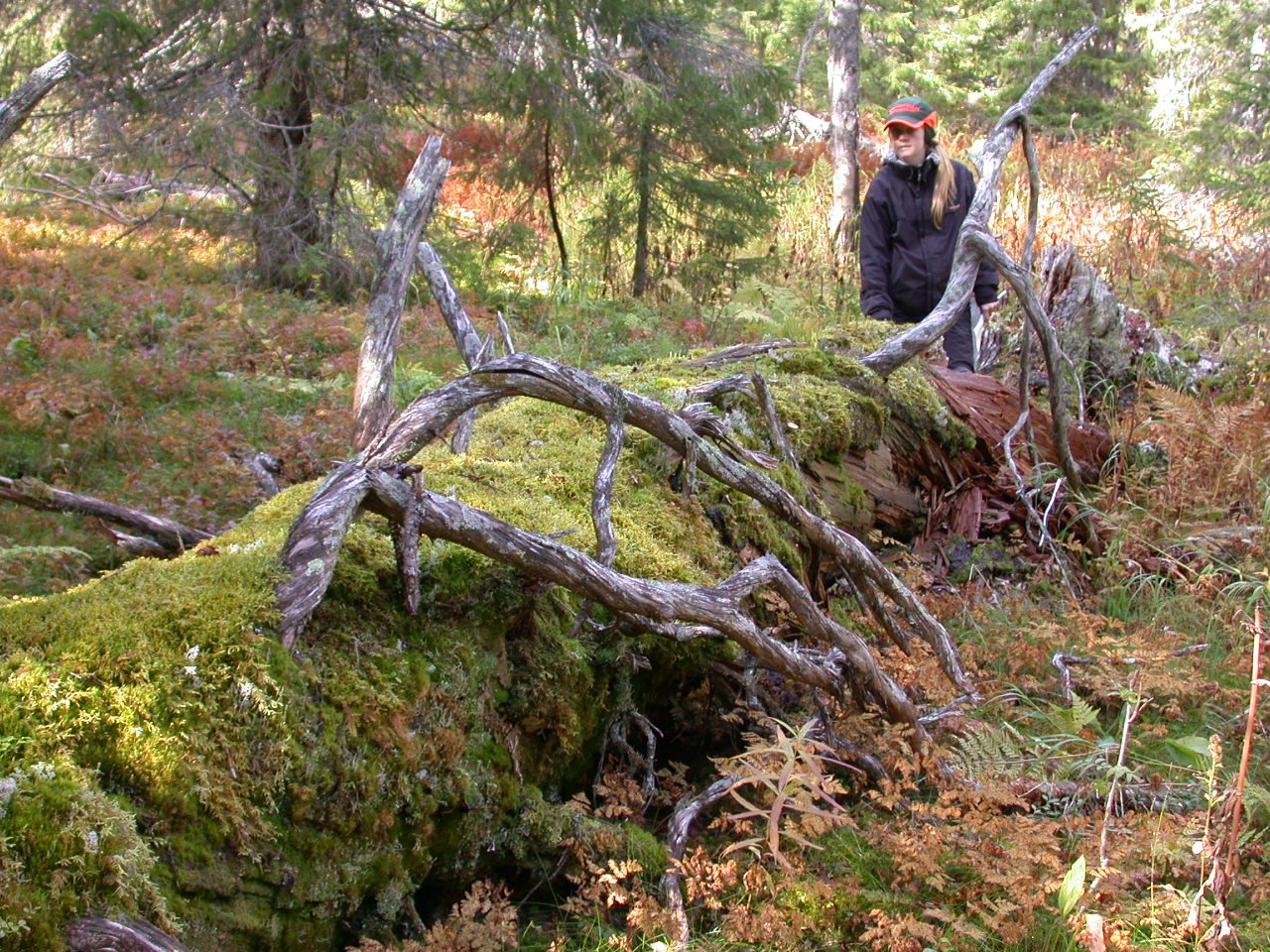
Collaborator Mari Jönsson admires a large, moderately decayed Norway spruce log in northern Sweden. It may take centuries for structures like this to develop, as trees must attain this large size (growth is rather slow at this high latitude), fall, then gradually reach this stage of decay (decay is also rather slow). Photo © Shawn Fraver
Related to that, one thing that really strikes me about my experience in Sweden is that to protect biodiversity associated with deadwood, we need a range of tree species, a range of tree diameters, and a range of decay stages. And getting an appropriate mix of those on one particular landscape is really a challenge. So I think that is something we often overlook because when I hear people talk about woody debris, they often say we need this much volume, or this much mass. But it’s a lot more nuanced than that. There is no simple measure.
So, those are some lessons from Sweden.
LT: And then what about the underground deadwood? You talked about wood underground. What have you learned about that, and what can we learn?
SF: Some refer to it as “buried wood,” another unfortunate term. We’re referring to downed deadwood that is overgrown by ground vegetation, appearing as a lump on the forest floor. What we know is that it is not accounted for in typical forest inventories. Its decay rate appears to be slower than that of wood above ground, so it would store carbon for a much longer time. And it’s completely missing from typical inventories, at least in northern systems.
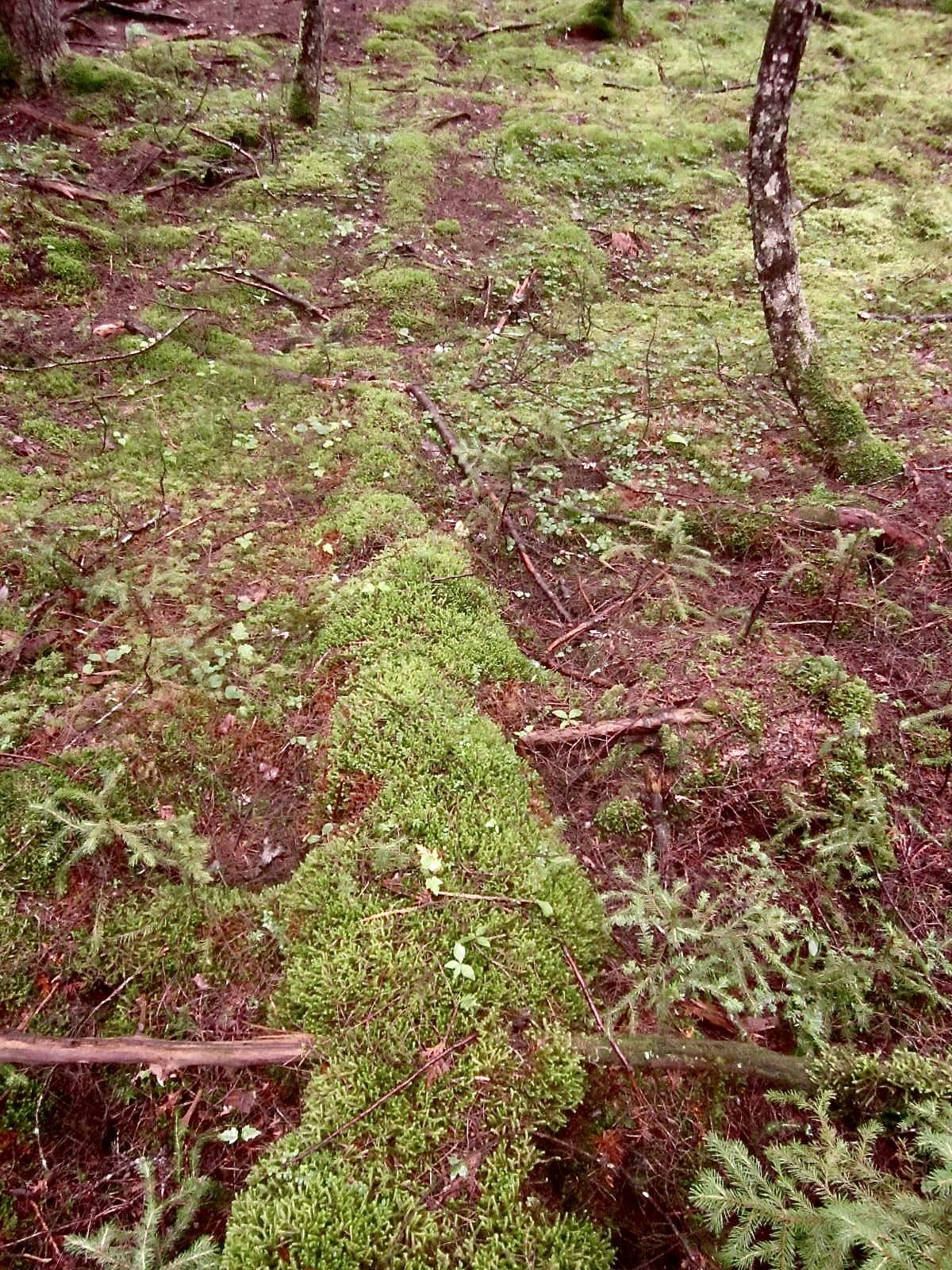
Coarse woody debris in this “buried” state (that is, overgrown by ground-layer vegetation) is rather common in unmanaged northern conifer forests like this one at the Howland Research Forest of Maine. These logs are not included in most woody debris inventories, although they may represent a substantial proportion (43 percent at Howland) of the total coarse woody debris volume. Photo © Shawn Fraver
LT: And yet the Europeans do inventory it?
SF: I don’t know that they do, but I suspect that they do. It’s a challenge to inventory and quantify.
The other thing to emphasize is the importance of a range of species and decay classes.
I have a story about that. I was hiking in Sweden with a friend of mine, Håkan Berglund, who’s an excellent field ecologist. It will sound like I am making this up, but I’m not. We were hiking and he said, “Shawn, stop—do you smell that?” I didn’t smell anything. I asked, “What do you smell?” He told me that it was the odor of the fruiting body of a particular fungal species (he named the species) that is found only on Norway spruce compression wood, that is, the contorted branches of that species. We looked around and sure enough, we found it, on the contorted branches of Norway spruce! And it is a rare species.
So if we want to protect that species of fungus, we need to protect contorted branches of Norway spruce, probably in a certain stage of decay. That’s just incredible.
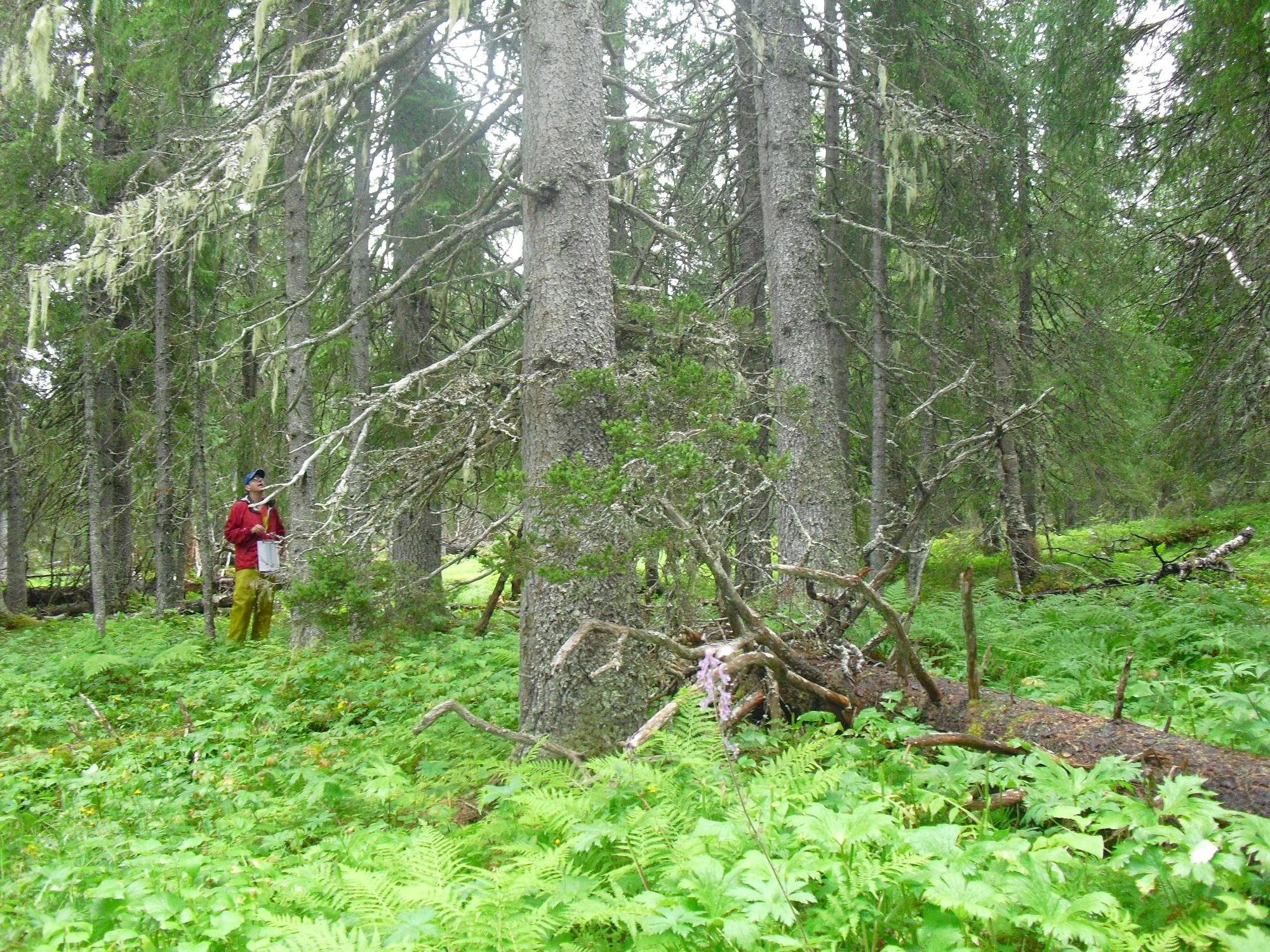
Shawn Fraver collecting canopy information in an old-growth Norway spruce forest of the Gardfjället Reserve in northern Sweden. Photo © Mari Jönsson
LT: That is amazing. And that’s a great way to close—with a story of the value of observing carefully, and really looking for things with all of our senses. Thank you so much, Shawn. I could listen to you talk all day, but I won’t keep you!
Dr. Shawn Fraver is a Forest Ecologist at the University of Maine’s School of Forest Resources. Before taking his current position in 2013, Dr. Fraver was a Research Ecologist with the US Forest Service Northern Research Station (Minnesota) and a Post-Doctoral Associate at Mid-Sweden University (Sundsvall, Sweden). Dr. Fraver’s research is field- and laboratory-based and covers a broad range of topics, including old-growth forest attributes, forest response to disturbances, forest carbon cycle, and woody debris dynamics. Much of this work relies on dendrochronology (tree-ring analysis) as a tool. Dr. Fraver has over 125 peer-reviewed publications, including those in top-ranked journals.