
The Last of the Least and the Best of the Rest
An Interview with Larry Master
Editor’s Note: I met Larry Master in 1984, when I began working for the newly formed Vermont Natural Heritage Program. Larry oversaw all the Heritage Program operations in the Northeast at that time, and so was my ultimate supervisor and a thoughtful guide as we navigated the new territory of running a state biodiversity inventory. A zoologist by training, he was passionate about birds, mammals, and all other organisms. In his retirement, he has inspired me with his fabulous photography and his staunch support of conservation. I sent several questions to Larry ahead of our interview. He replied ahead of time to a question about the history of the Heritage Program Network, now known as NatureServe, by pointing me to other sources on that rich history. This article therefore starts with a brief recap of the history before going into the interview proper, which was edited for brevity and clarity. See several other stories in this issue about finding and documenting biodiversity using Heritage methodology. – Liz Thompson
Introduction: A Brief History of NatureServe
In 1951, The Nature Conservancy boldly branched out from the Ecologists Union—itself an offshoot of the Ecological Society of America—and began operations as a nonprofit organization dedicated to protecting nature through land acquisition. How was it to protect nature? Where to start? In the early days, it relied on various scientists to recommend places to protect, but it soon became clear that a more systematic approach was needed.

Bob Jenkins, architect of the natural heritage network, in 1962. Photo © Jack Lynn
This is where Dr. Robert Jenkins comes in. Bob Jenkins, who joined the Conservancy in the early 1970s as its first Science Director, oversaw the development of a methodology to gather and record data on imperiled species and ecological communities. He saw the importance of creating individual state programs that could tap into existing knowledge, programs, and personnel, while still using a standardized methodology and ranking system. The first state natural heritage programs, in South Carolina and Mississippi, were established in 1974, and many other state and provincial programs came online after that, now covering every U.S. state and Canadian province and territory.
Although still supported by The Nature Conservancy, in 1994 the network of programs formed a new nonprofit called the Association for Biodiversity Information (ABI). In 2000 the Conservancy spun off its Science Division as the independent ABI, soon renamed to NatureServe, as the supporting hub of over 60 conservation organizations, the Natural Heritage Network, throughout the Americas. NatureServe Explorer now offers the public access to the NatureServe Network’s vast databases on U.S. and Canadian species and ecosystems.
Larry Master has been there for most of this history. In 1981 he established the Northeast Heritage Task Force, whose goal was to support state natural heritage programs throughout a 13-state northeastern region and to start new state heritage programs where none existed. Most of the programs that exist in New England are a legacy of Larry’s work.
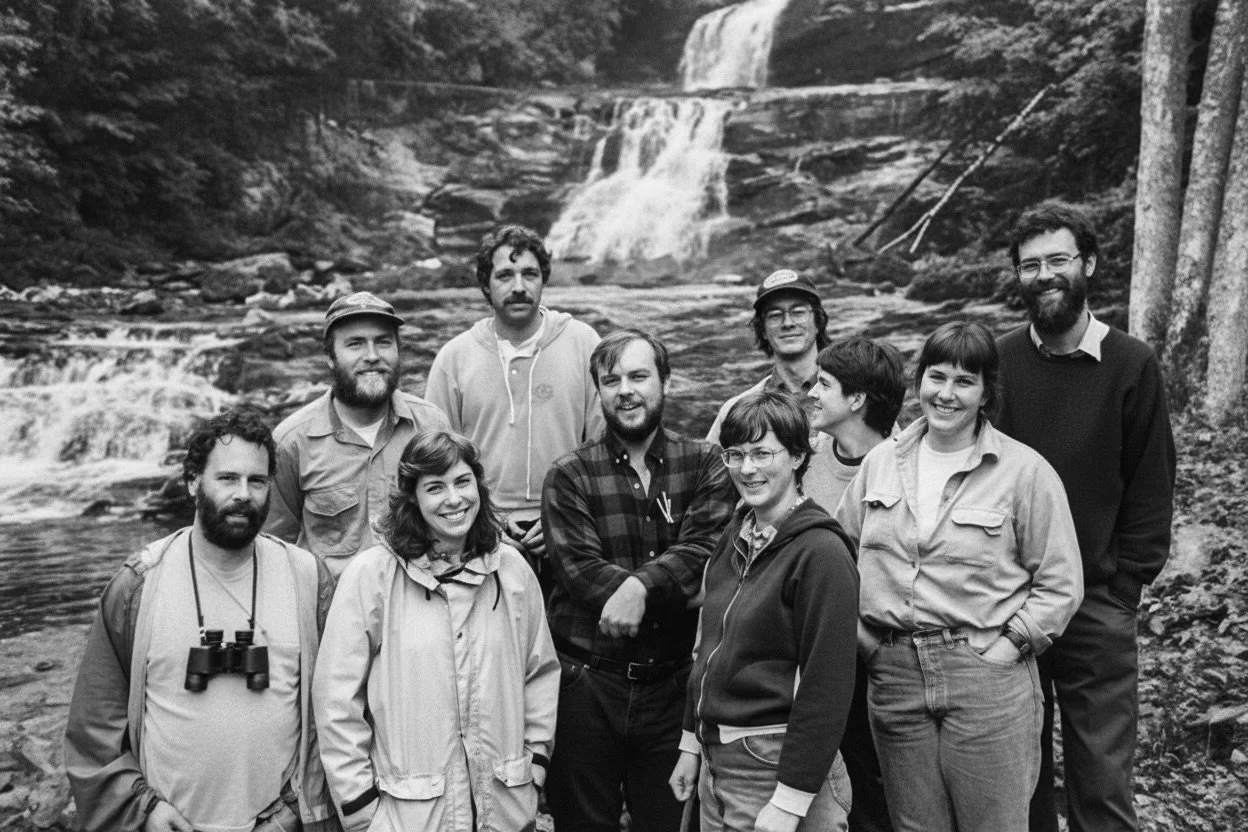
A group of northeastern heritage ecologists in 1985. Ecologists from the region met informally but regularly in the field to share ideas and knowledge, a practice that continues to this day through more formal conferences and field trips. Photographer unknown.
Interview with Larry Master
Liz Thompson (LT): How do you define biodiversity?
Larry Master (LM): I think of biodiversity as the variety of all living things on earth. I include ecosystems, species, and genetic diversity.
LT: Some definitions talk about the biodiversity of a specific place, such as a town, a state, or a particular wetland. What is the right scale for thinking about biodiversity?
LM: To assess biodiversity in a particular place, and especially to set goals for increasing that diversity, can be counter to conserving biodiversity at large. Trying to protect the biodiversity of a town, for example, may be counterproductive to conserving biodiversity regionally or globally. I am most concerned with global biodiversity.
I remember once comparing the rare species lists of Vermont and New Hampshire. They are completely different, because the geology is different—granite in New Hampshire, limestone in Vermont. This is an example of why it is most important to focus on global biodiversity rather than state-level biodiversity. Both sets of rare species are important, but it’s the global view that’s most important.
Many people talk about the “utility of biodiversity,” and I always kept a file with notes on that—medicines, foods, and other products useful to humans that came from nature. And it’s important to have those facts in your back pocket, because it’s the only language some people understand.
But as far as I’m concerned, the most important thing is that it is just not right to allow species to go extinct. We need to do everything we can to prevent that. As Ed Wilson has written, the loss of biodiversity is the thing for which our descendants will least forgive us.
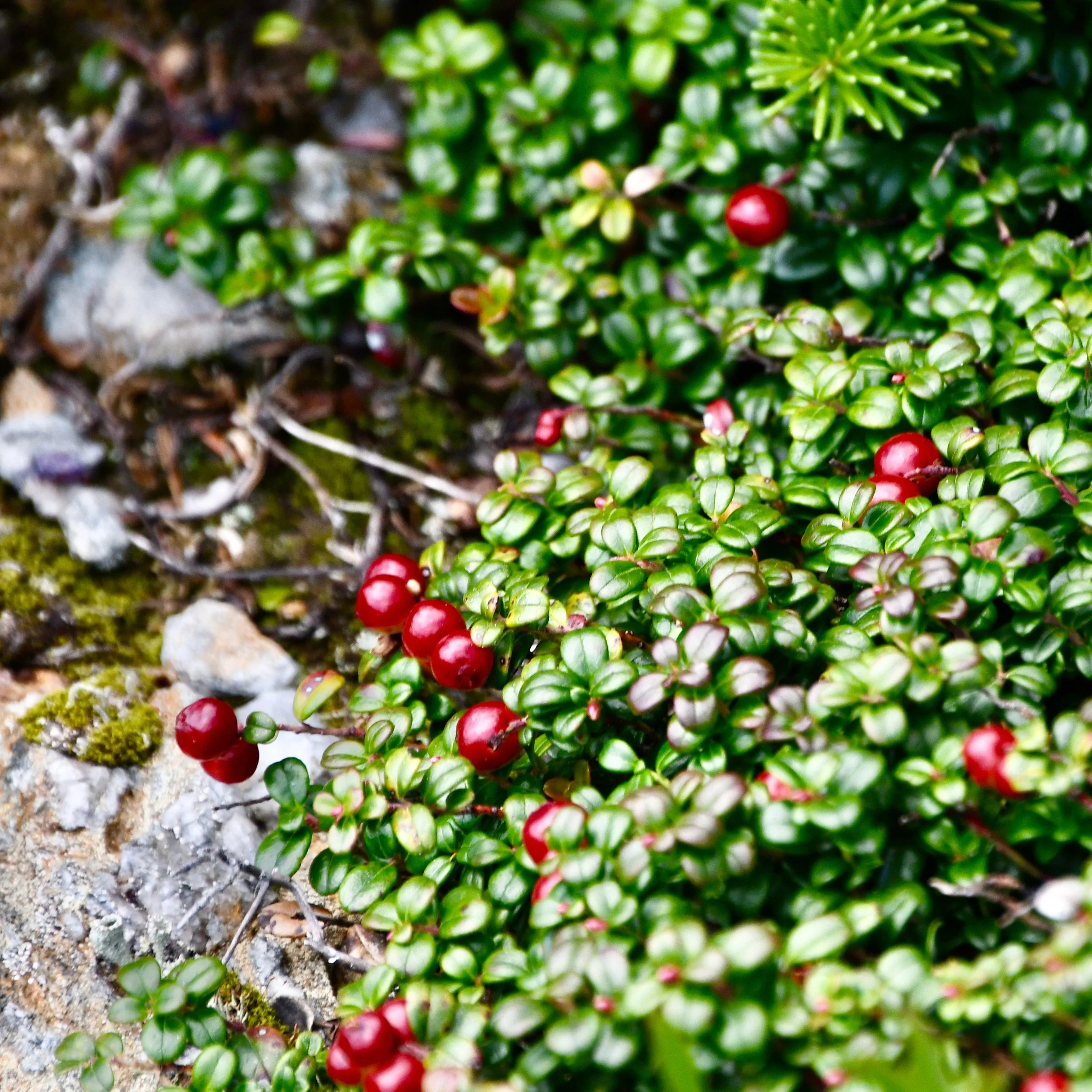
Mountain cranberry (Vaccinium vitis-idaea) is common in New Hampshire but rare in Vermont. Photo © Liz Thompson
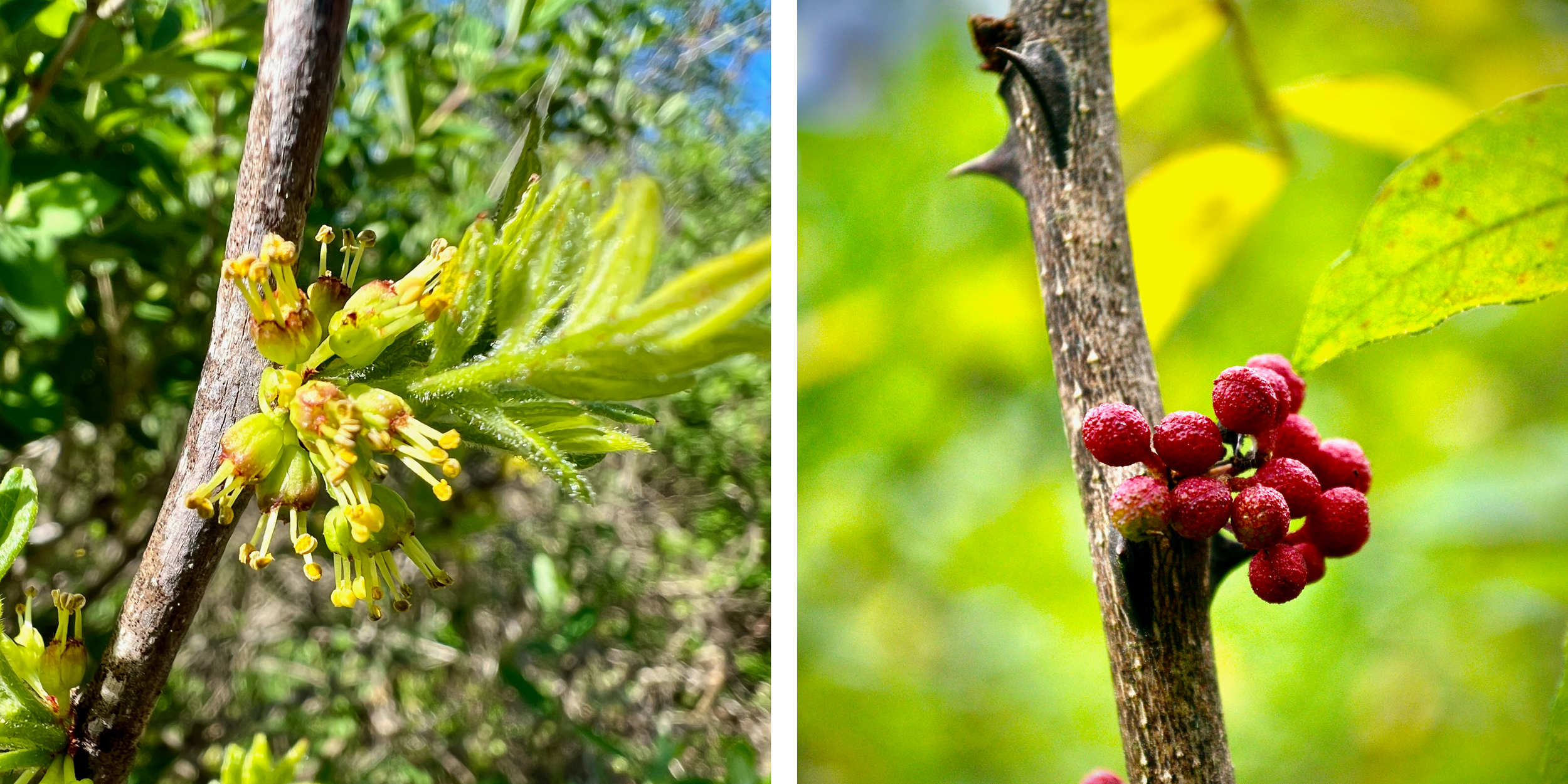
Prickly ash (Zanthoxylem americanum) is listed as Endangered in New Hampshire but is common, and even regarded as a pest in places, in Vermont. Flowers on left, fruit on right. This plant is in the citrus family and its red fruits are like tiny, hard oranges. Photo © Liz Thompson
LT: What is the value of keeping track of biodiversity?
LM: If we know what’s at risk of extirpation or extinction, precisely where it occurs, and how it is doing, we can help it—we can develop strategies to conserve it. I am really a proponent of “The Last of the Least and the Best of the Rest.” This refers to a strategic philosophy used by The Nature Conservancy (TNC) and Dr. Robert Jenkins to prioritize conservation. It focuses on protecting the most imperiled species (last of the least) and the most intact, functional ecosystems (best of the rest) to maximize biodiversity impact.
It’s important to protect imperiled species, but in addition, if you protect the best examples of all ecosystems, you might protect 80 percent of the biodiversity, including the species we don’t know about. This is referred to as the “coarse filter/fine filter” approach to biodiversity conservation, which Bob Jenkins introduced and many others have adopted.
LT: As the Heritage network was launched and grew, what were some of the challenges along the way?
LM: Getting it up and running was a miracle—getting every state and province to adopt the same methodology and operating procedures. Bob Jenkins invented and sustained it, and it was unbelievable. Funding was a perennial issue, right from the start, but at the beginning the federal Land and Water Conservation Fund (LWCF) was critical for many state program start-ups.
Keeping it going was challenging. We really needed to establish strong partnerships and get the programs firmly established in state and provincial governments. Amazingly, we’ve been able to do that.
Many Fish and Game departments tended to be controlled by hunting and fishing interests at that time, and to some extent that is still true. It was hard to convince some states that rare plants and other non-game organisms were important. But over time many Fish and Wildlife agencies now have much broader goals, including the protection of rare, threatened, and endangered species and ecological communities.
“As far as I’m concerned, the most important thing is that it is just not right to allow species to go extinct. We need to do everything we can to prevent that. As Ed Wilson has written, the loss of biodiversity is the thing for which our descendants will least forgive us.”
LT: Tell me a bit about the methods used to keep track of rare species and natural communities.
LM: Again, Bob Jenkins was the mastermind of this. He developed the concept of “elements” of biodiversity, and then “element occurrences,” or specific places where each of those elements occurred. “EO” is the insider lingo for this. The EO was the basic tracking tool, and it remains so. Each element is ranked at the global, state, and provincial levels, and each EO is ranked, and these ranks help set conservation priorities. The ranking is a rigorous process and ranks are updated regularly,
I am currently consulting with NatureServe on taxonomy standards and updated standards for conservation status assessments. I can’t seem to stop doing this work!
LT: When did you begin doing this work?
LM: My real start was in fourth grade. By that time I knew I wanted to be a biologist and to work in the field, and I worked hard to achieve that goal. I started working with TNC on Earth Day, 1980. I began in Michigan, starting the Michigan Natural Features Inventory, and then soon came to New England to start the Eastern Heritage Task Force, whose goal was to ensure that every northeastern state had fully staffed and supported state natural heritage programs. We were a small staff working out of Boston starting in 1982. It was Tom Rawinski, Jan Cassin, Frankie Brackley, Tom French, and me. After Tom French and Jan left for other opportunities, we were joined by Geoff Hammerson, Dale Schweitzer, and Margaret Ormes. Margaret is still working for NatureServe and may be the longest-serving member of the Network at this point.
Unfortunately, as my leadership role grew, the time I spent in the field diminished to almost none. [Ed. note: see a rare occurrence of Larry in the field during this period in Brian Donahue’s article in this issue.]
LT: These days, you seem to be in the field a great deal, with your camera. I’m delighted that you have shared several of your images of species of concern with us here. And I want to point readers to this wonderful short video where you explain why you photograph, and why you so generously give your photos.
How did you get your start in photography?
LM: When I was a kid, just as I was discovering biology, and birds in particular, my parents gave me a Brownie camera. I had a window feeder, and I could take pictures of the birds without a telephoto lens. Besides birds, I was first attracted to reptiles and amphibians, then mammals, and then to invertebrates—especially freshwater mussels, the most endangered species as a group in the country. After my kids went to college, I started traveling to photograph. My website holds about 12,000 images, and I have tens of thousands more that are unprocessed.
LT: Does photography advance your goals of protecting biodiversity? How?
LM: I want to inspire people to love nature as much as I do—to love and respect it and seek to protect it. I grew up watching nature movies and got inspired to be a biologist and to photograph nature. These days, I always have a camera with telephoto and macro lenses nearby.
I am fortunate to be able to travel. I’ve been to Africa, South America, Southeast Asia, and the polar regions to photograph polar bears—really all over the world. I don’t sell my photos. Instead, I give them to conservation groups and others.
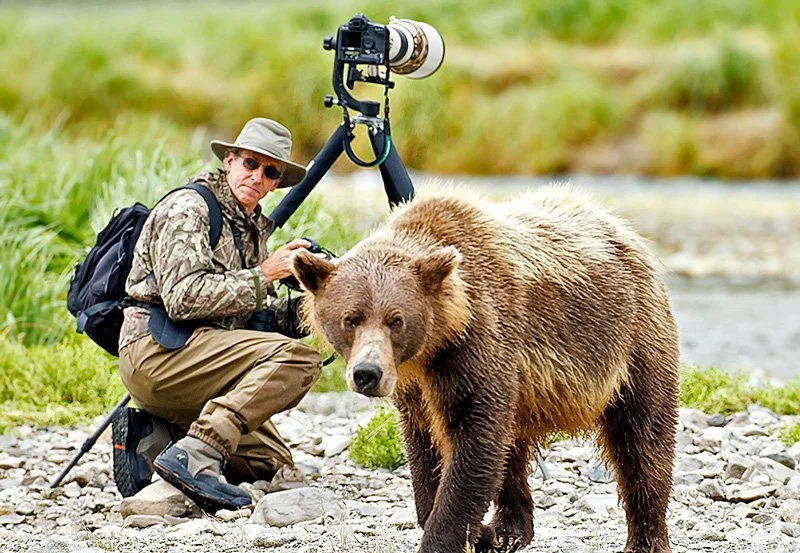
Larry Master with brown bear, Katmai, Alaska. Photo © Mike Goldhamer
I give myself challenges. Right now, I have a goal of photographing all the small mammals in the Adirondacks. Some are a challenge to find!
LT: What advice can you give to young people just beginning careers in biodiversity conservation?
LM: Even before someone begins high school or college, I suggest that they choose a person they look up to. Ask if they have an internship. Follow them. Work for free. Carry their gear. Be useful while you observe and learn. It’s important to find out what your passions are and then find people who are out there doing what you want to be doing.
LT: Is there anything else you would like our readers to know?
LM: People have no idea what we are losing. I’m not sure that people who haven’t been around very long understand what is happening—the huge amount of habitat destruction and loss of biodiversity that has happened over the last century and especially more recently. We need to understand what is happening—the losses and their causes, and we must work to stop the losses of biodiversity. Our future depends on this.
LT: Thank you so much, Larry, for your time and for your generosity in sharing your deep knowledge of animals, plants, and all of biodiversity.
Larry Master is a conservation biologist, a zoologist, and, in his retirement, a conservation photographer. He has been photographing wildlife and natural history subjects for more than 70 years. After doctoral and postdoctoral studies at the University of Michigan, Larry spent 20 years with The Nature Conservancy (TNC) and six years with NatureServe, most of that time as their Lead Zoologist. Read more about Larry and his work at his artist profile. Larry resides in Keene, New York, and West Cornwall, Connecticut.