
Food Farming in the Sea
An Interview with Mussel and Oyster Farmer Carter Newell
Editor’s/Author’s Note: My first job out of college had me living on the rocky coast of Downeast Maine for three summers running. Much of my food came from the intertidal zone right outside my cabin door. There were succulent vegetables like orach, sea lettuce, and glasswort. My protein came from periwinkles (“wrinkles” to the locals) and delectable blue mussels, which clung to the rocks in great abundance. Gathering dinner was a five-minute task. Years later, I learned that those once lush mussel beds were now gone. Overharvesting? Disease? Predation? Climate change? I didn’t know why. But since that time, farming mussels, oysters, and other marine edibles has become a sustainable way to provide them for people’s dinner tables. Carter Newell, an old music friend from my Maine days, is one of the pioneers in that field. We had a long conversation recently in which he answered many of my questions about farming in the sea, and you can read more in this Scientific American article. His words are edited lightly for clarity. – Liz Thompson
Carter Newell, Founder and President of both Pemaquid Mussel Farms and Pemaquid Oyster Company, knows how to raise shellfish in the ocean. He brings his scientist’s mind to the enterprise, always gathering data and looking for ways to improve the process. I sent him a number of questions about his path and his passion, and over an hour-long conversation, we talked in depth about the challenges and rewards of this work.
I asked Newell about his background; about why shellfish farming is important as a replacement for wild harvesting; about the threats to wild and farmed populations of these species; and about the importance of shellfish farming as the climate continues to change.
Here is what Newell said about his background and early career:
I’ve always been an ecologist—I’ve always liked to be in the woods. My family used to go to Cape Cod for a couple of weeks every summer, and I really like to be on the water. I’ve always been interested in science, but when I went to Colby College in Maine, I started out as a pre-med student. I worked in a hospital operating room for one summer, and I said, “No, this isn’t for me.”
So, I moved toward my interests in invertebrate biology and marine ecology. I did a National Science Foundation internship in Cobscook Bay for a summer and really got interested in doing field marine ecology research. I used that work to develop a Watson Fellowship, and ended up spending a year in Wales on that fellowship. I was studying snails in Wales!
While I was there, I went to a marine lab in Wales where they were doing aquaculture, growing oysters and a bunch of other things. And it made me realize, wow, this is something where I could do what I like to do, but it also might have some job applicability. I asked, “Where would be a good place to study this?” And they said, “Maine.”
So I went back to Maine! I ended up getting a master’s at the University of Maine, with a grant through the Sea Grant program, to study the farming of soft-shell clams. In that work, I realized that there was kind of a quandary, because it’s a tragedy of the commons, where the municipalities basically manage the intertidal zone, and then there’s some local property rights. So farming soft-shell clams in the intertidal zone wasn’t feasible.
Carter Newell. Photo © Heather Perry Photography
With this limitation in mind, Newell began pondering the idea of farming shellfish offshore, outside of the area of municipal jurisdiction or private property concerns. He described the cautions he heard, and what he learned from people who had attempted this type of shellfish aquaculture previously:
Some of the grad students I worked with said, “Don’t get into aquaculture, or you’ll lose your shirt.” There were about 10 other companies who had all tried, but they didn’t have the elements that—I’ve found over the years—you need: the right species, in the right environment, the right culture technique, and a profitable business model. And then I would add (a focus on) sustainability also. So they might have had the right environment, but the wrong species, or they might have had the right environment, the right species, but the wrong culture technique, or they might have done all of those and not had an effective business model. And they all went out of business.
At that point, I started dabbling in it with a retired school teacher up the Damariscotta River, launching off of her house with a little aluminum skiff. I put a few American oysters out there. And they grew pretty well, until Japanese oyster drills (a non-native snail) ate them all.
So I moved downriver a little bit, where there was less supportive habitat for invasive snails, and tried again in front of another friend’s house. The oysters did better there. I wanted to form a business with this friend and some others, but they said, “Well, we just want to have a few for cocktail hour, we don’t really want to have a business.”
I contacted my buddies from Colby and some people I played music with, and we each put 2,000 bucks in, and we formed Pemaquid Oyster Company. It took us 20 years to figure out how to grow them and make money at it, but we did.
With this success, and with an interest in growing mussels as well, Newell joined Great Eastern Mussel Company, which he described as:
…a pretty large force, in terms of marketing. They were the first company in the Boston Seafood Show to market mussels. I became their farm manager and mussel quality control. And then, after working with them and growing millions of pounds of mussels with them, I realized it was unsustainable because they were dragging up wild mussels and seed mussels from all these different places and disturbing the marine ecology. It was basically an exploitation model, where you exploit the ocean, and then wonder why there isn’t anything left out there.
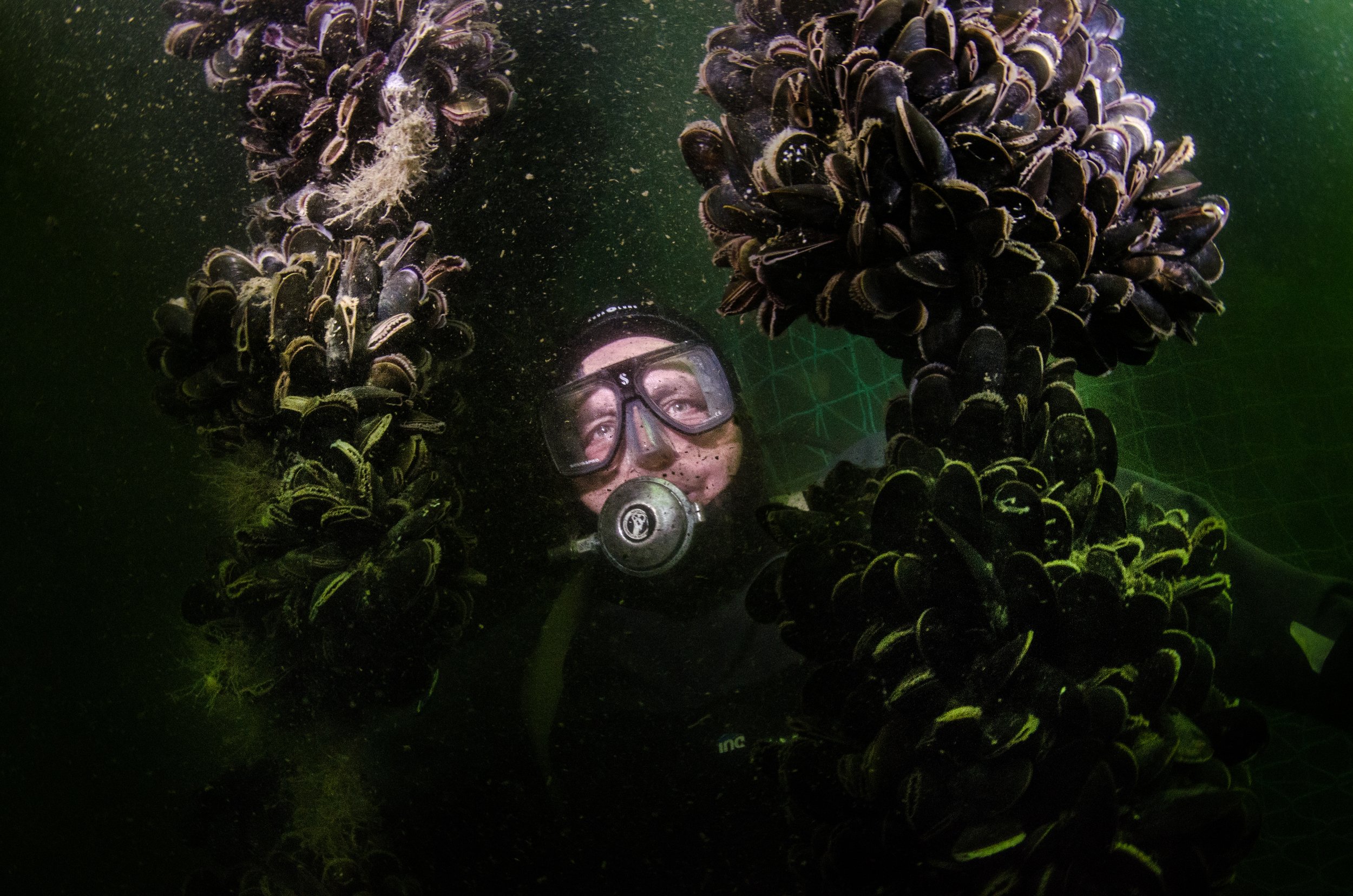
So I decided to come up with a method to grow them in a sustainable way, hanging on ropes. I learned that in the ocean you just put ropes out, and the larvae are swimming around, and although only a small percentage of them will land on your ropes and grow, there are so many that soon you have a good population.
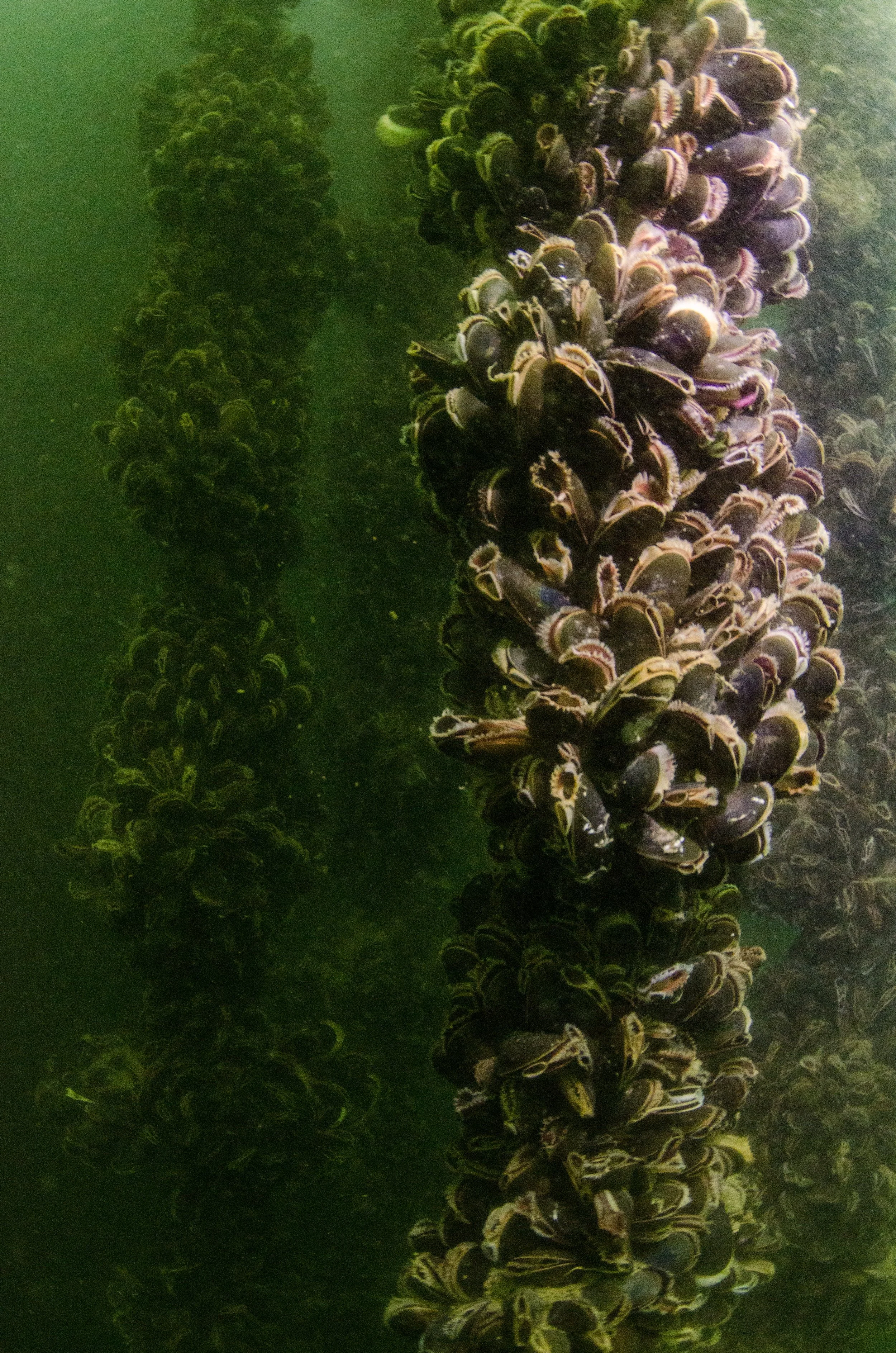
Photo © Heather Perry Photography
Ultimately, Great Eastern went out of business and Newell, with his crew and mussel farmers, bought out their equipment and formed Pemaquid Mussel Farms. With the MAIC mussel working group, a bunch of growers figured out how to farm mussels in deep waters from rafts, and Newell went on to produce the rafts and design and patent a new 60 ton submersible raft design currently in use by Pemaquid. This development resulted in four substantial companies producing millions of pounds of mussels each year.
It’s been a long ride with much experimentation, learning, and adapting along the way, but the work has proved sustainable, both financially and environmentally.
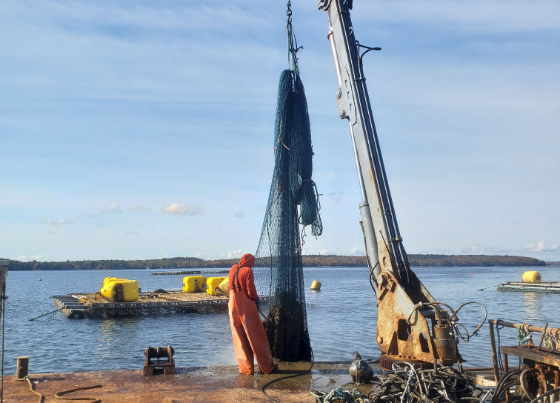
Photo © Carter Newell
Newell had answered part of my question about why shellfish farming is important for the health of the marine and intertidal ecosystems. But I still wondered—What had happened to the lush mussel beds I had known in the late 1970s?
He offered these reflections:
I was talking with oceanographer Roger Mann, at the Virginia Institute of Marine Sciences. He said, “If you look at landscape ecology on the scale of a millimeter, or a quarter of a millimeter, when the larvae are settling, there’s a lot going on there. And there’s probably a lot of dynamics where there’s predation and other things which can relate to whether there’s survival, with introduced species, and other things like that.”
Newell also talked about some recent research on Swans Island in Maine:
They found that the temperature is definitely getting warmer, and for a cold water species like mussels, it’s a little bit harder for them. And then there are also other predators, like green crabs and other things that are coming in and eating them more.
If you look back, in the 1940s there were some surveys done by researchers named Scattergood and Taylor, and they had these big beds, what they called index beds, of mussels all along the coast—big, thriving mussel banks, all the way from Casco Bay to the Canadian border. And…right in front of all of those beds were eelgrass beds, eelgrass meadows. And of course, there’s been eelgrass wasting disease, and then loss of habitat for eelgrass.
When I was doing some work around the Mount Desert Narrows area in the 1990s, there were big mussel populations all around. I was just out in my skiff, and I happened to pull up an eelgrass blade, and there were 5,000 mussels on it—little tiny, tiny baby mussels. So we had a grad student do some studies on that, and we found out that, because the eelgrass is sticking up in the water, it acts as a big baffle and it slows the water down. And then it concentrates the larvae. So, eelgrass is an important part of the mussel’s life cycle.
So, warmer waters. Eelgrass wasting disease. Overharvesting. Predation by green crabs. Ocean acidification. These things, some related to climate change, some related to human greed, at least partially explain the loss of the thriving natural mussel beds, which is a trend being seen worldwide..
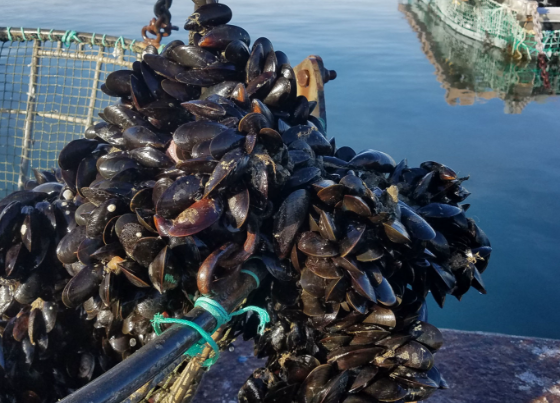
Photo © Carter Newell
They also point to the importance of shellfish farming, and to the importance of dedicated people like Carter Newell and his team, in helping to allow natural systems to restore themselves while also providing the food that humans want—mussels, oysters, and other marine organisms—in an environmentally sustainable way. Carter said that once you have thriving farms, their spawn and larvae help restore wild mussel beds which have been overharvested, or can provide some wild oysters for clam diggers. And he added “the farms are like artificial reefs, attracting everything from shrimp to worms to fish to ducks to harbor porpoises, and they improve water quality,”
Next time I order a plate of mussels, or a half-dozen oysters on the half shell, I’m going to ask where they came from. Farmed or wild harvested? I’m going with farmed.
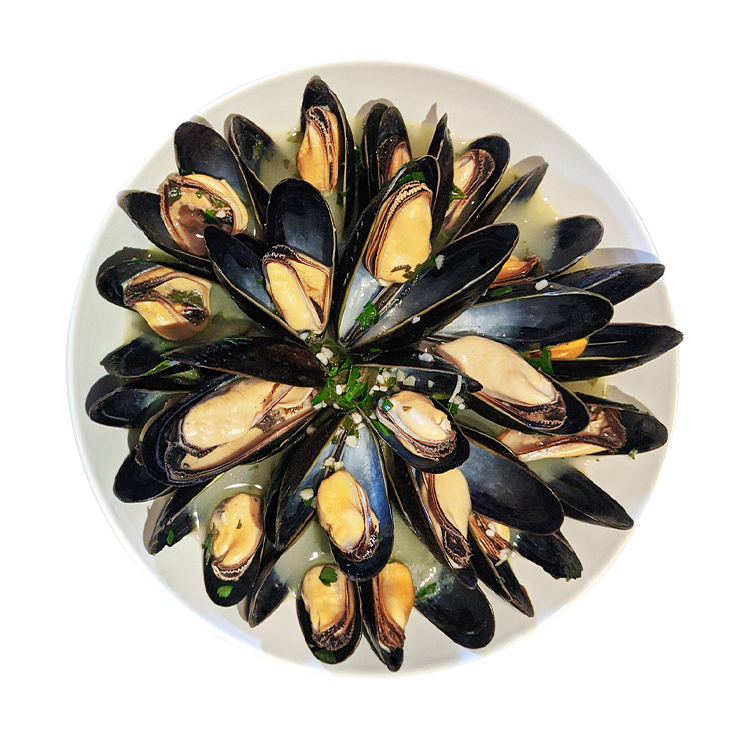
Photo © Carter Newell
Carter Newell has been farming shellfish since 1982, founded Pemaquid Mussel Farms and Pemaquid Oyster Company, and has an MS in oceanography and a PhD in marine biology. In addition to being the captain of the mussel barge Mumbles and the Oyster Girl 2, he is active studying estuaries, modeling bivalve growth, developing aquaculture GIS systems, scuba diving, and playing the fiddle.
Liz Thompson is Managing Editor of From the Ground Up. She is an ecologist whose early training included summers on the Maine coast.