
Editor’s Note: Chelsea Steinauer-Scudder has contributed to these pages before, and we recently reviewed her fabulous new book, which I recommend to anyone who cares about the world we live in. As she said in her introduction, “We are living in a time of ecological collapse. There is no way around it. But there is, I think, a way through. Perhaps the best we can do is to keep renewing the world and our love for it.” Each chapter in the book is a story and a lesson in itself. The chapter reprinted here says so much about renewing the world and our love for it, and is a fitting complement to the other pieces in this issue, pieces that celebrate the beauty and fragility of our marine and intertidal systems. – Liz Thompson
Reprinted from Steinauer-Scudder, Chelsea. Mother, Creature, Kin: What We Learn from Nature's Mothers in a Time of Unraveling (pp. 183-188).
It’s the day after the summer solstice, and the dock at Wells Harbor is vibrating with summer energy. A man in khaki shorts is hosing down a charter fishing boat in much the same motion as a mother is spraying her daughter with sunscreen. Floppy-hatted tourists make their way to the beach.
I meet Rachel Stearns, a biological science technician for the Rachel Carson National Wildlife Refuge, at the mouth of the Webhannet River. The refuge runs along fifty miles of Maine’s southern coast, from Kittery to Scarborough, and includes roughly three thousand acres of tidal salt marsh. Rachel is close to my age with a frizz of curly brown hair sticking out from beneath her hat and the unselfconscious authority of someone who has been doing her job well for many a field season. She and an intern, Sam, are both dressed the way I suddenly wish I were: long-sleeve, high-necked shirts for sun and bug protection; fast-drying pants; tall wading boots. I’m wearing some of Andrew’s old hiking pants with a fly zipper that keeps falling down and rain boots that barely reach my ankle and have at least one major leak. I join the two of them aboard a small, open boat. We motor carefully along the shallows of low tide. Today we’ll be measuring salt marsh edge erosion.
The questions I’m holding with me: What does a healthy salt marsh look like? What are the complex functions of such ecological margins? If liminal ecosystems can teach us about inhabiting and navigating constant change, if they can reveal new ways of embracing our wild edges as mothers, then what do the integrity and resilience of such edges look like? And, conversely, what happens if these in-between places erode, vanish, into the sea?
* * *
Tidal salt marshes are among the most productive of Earth’s ecosystems, frequently cited alongside coral reefs and tropical forests. They are meadows of salt-adapted grasses that smell sweet and briny in hot sun, set above the sea on platforms of peat. In the salt marsh meadows of New England, saltmarsh sparrows lay their eggs in grass-woven nests. Indigenous peoples—among them members of the tribes of the Wabanaki Confederacy in Maine—gather sweetgrass along the marshes’ landward borders. Great blue herons stalk the pools. Muddy banks are home to mussels and to barnacles that spray water as the tide comes in. Estuaries wind through the meadows, draining and filling twice daily, feeding and growing the fish—the migratory striped bass, for example, which have, in turn, long fed and grown people, bald eagles, osprey.
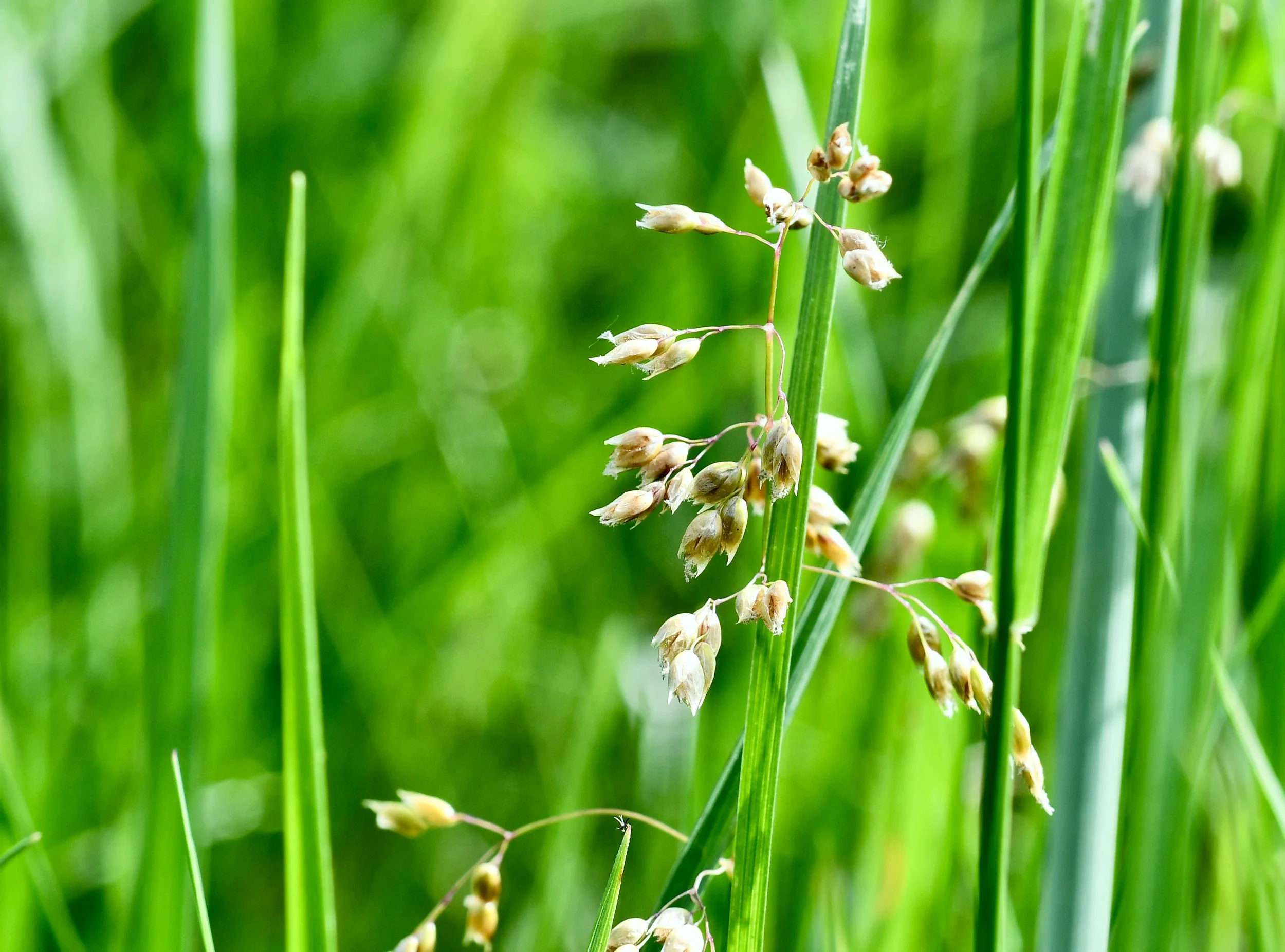
Sweetgrass. Photo © Liz Thompson
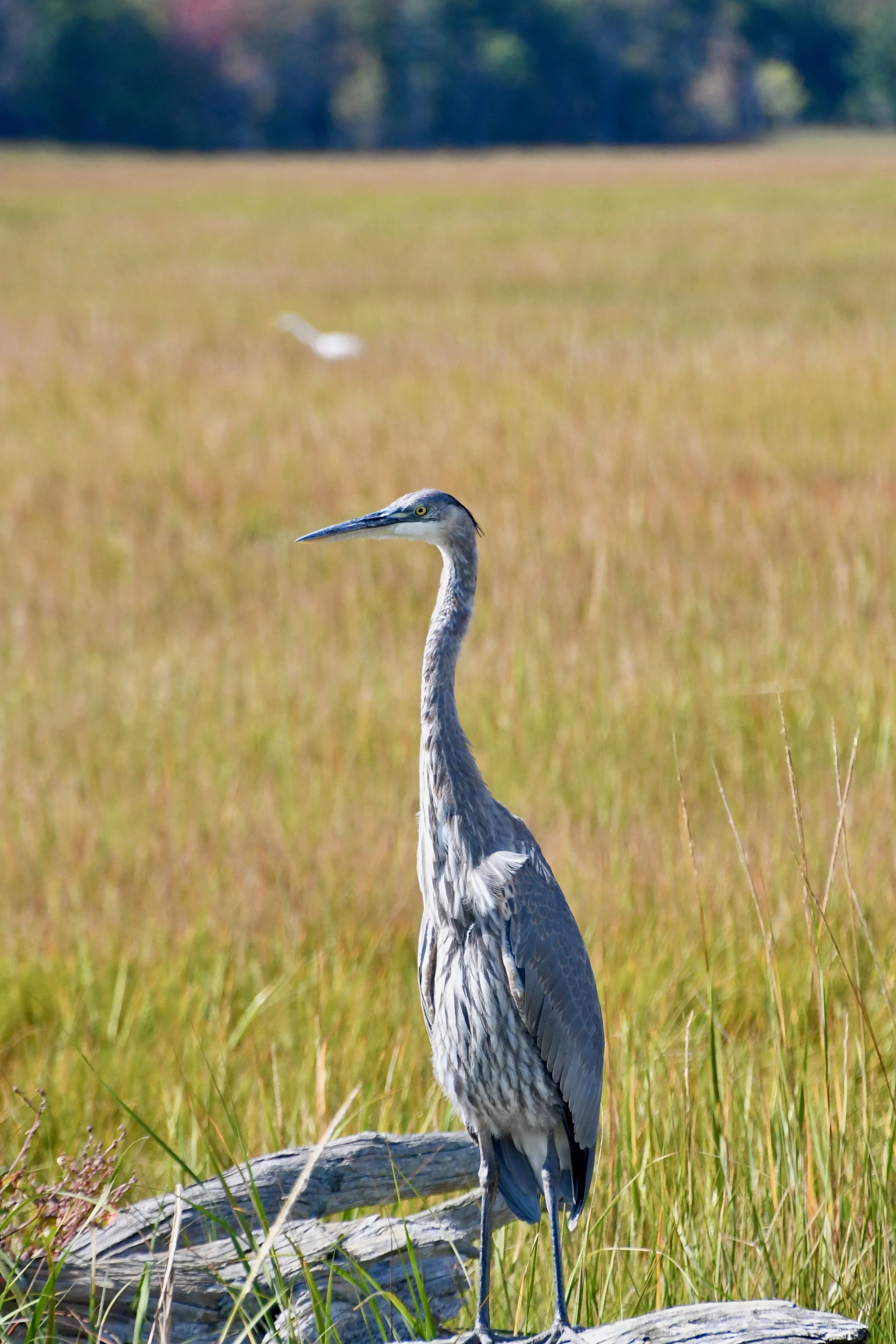
Great blue heron and egret. Photo © Liz Thompson
These marshes are wave absorbers, carbon storers, sediment trappers, toxin filterers. They are a wild sort of edge: not carefully delineated, but the homes of the in-between. They are shaped by the constant flux of the tides and, therefore, by the moon. They have the infinite sea on one side, the land that climbs up and away on the other.
Salt marshes are places where natural disturbances are routine, expected, and, by and large, necessary to the marsh’s resilience and ability to respond and adapt to change.
Such an adaptive, resilient, ever-changing edge has come to serve as the defining symbol to me of an ecological motherhood. As I come further into my understanding of salt marshes, two things have occurred: I’ve grown increasingly invested in their well-being as inherently valuable landscapes that are, first and foremost, literal, physical, living places. And I’ve met more and more faces of the archetypal edges of mothering.
* * *
It is their adaptation to the tides that make salt marshes unique ecosystems. The oldest existing salt marshes in the United States date back to around five thousand years ago, formed by running meltwater that came together in streams and rivers, which eroded the foundations of forests and carried the soil, made up of rock flour and sand, down to the end of the land. The soils settled and mixed with mud at the cusp of land and sea, creating a fertile environment for vegetation. Birds arrived along shorelines, carrying seeds. Grasses and forbs took to the soil.
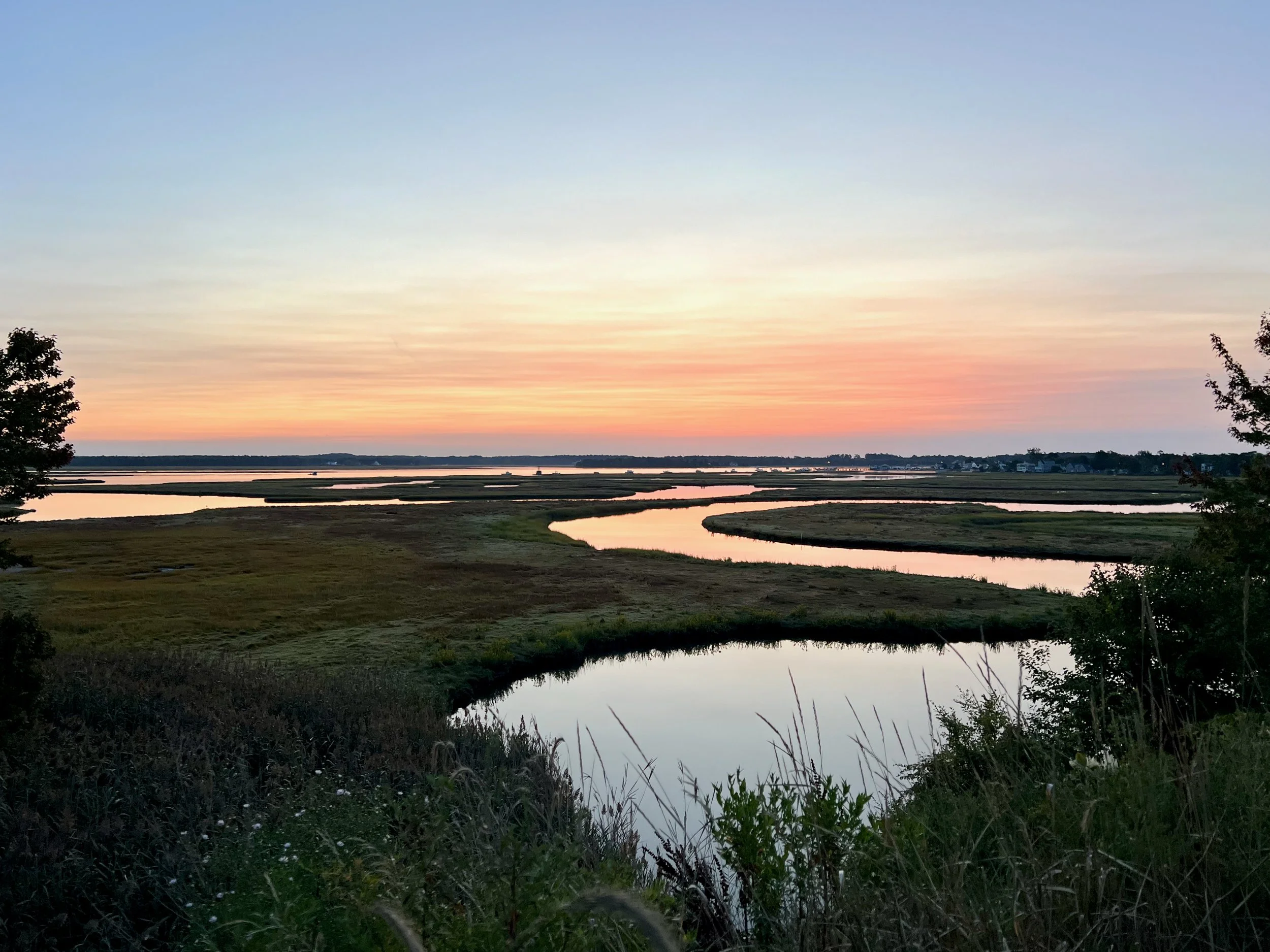
Photo © Liz Thompson
Salt marsh vegetation is dominated by grasses. Spartina alterniflora, smooth cordgrass, is found between high and low tide lines across the East Coast marshes of North America, from Newfoundland to southern Florida, and around the Gulf of Mexico to Texas. Here in New England, smooth cordgrass grows most often on the seaward edge of marshes. It has broad, flat leaves that taper to a fine point. If you run your fingers along a blade of cordgrass and then along your tongue, you taste salt secreted from the grass’s cells. Spartina patens, salt hay, tends to blanket the mid and higher elevations of the marsh in thin blades of grass that grow thick and soft, forming windswept cowlicks over the marsh platform.
“Tidal salt marshes are among the most productive of Earth’s ecosystems, frequently cited alongside coral reefs and tropical forests.”
Salt marsh resilience is, in part, a function of both accretion and migration—both made possible by their resident plants, the Spartina grasses in particular. Even as sea levels have historically risen and continue to rise, salt marshes can often keep up with these changes through vertical accretion. As organic plant matter decomposes, the roots of the grasses bind it together, continually forming it into new layers of peat. Marshes also gain elevation as suspended sediment flows in and out on the flooding tide, and as freshwater enters the marsh on the landward side via rivers, streams, and creeks. In both of these movements of water, the plants trap silt, sand, and clay. These sediments settle into the soil, lifting the marsh platform further.
And then there is marsh migration. As sea levels rise, or as powerful storms blow saltwater inland, the seaward edges of a salt marsh may erode or drown (even the highly salt-tolerant cordgrass cannot survive sustained submergence in saltwater). But if given enough time, the rhizomes of the Spartina grasses will retreat from sites of increasing salinity and send new shoots uphill to drier ground. In this way, a marsh will start to take root farther inland.
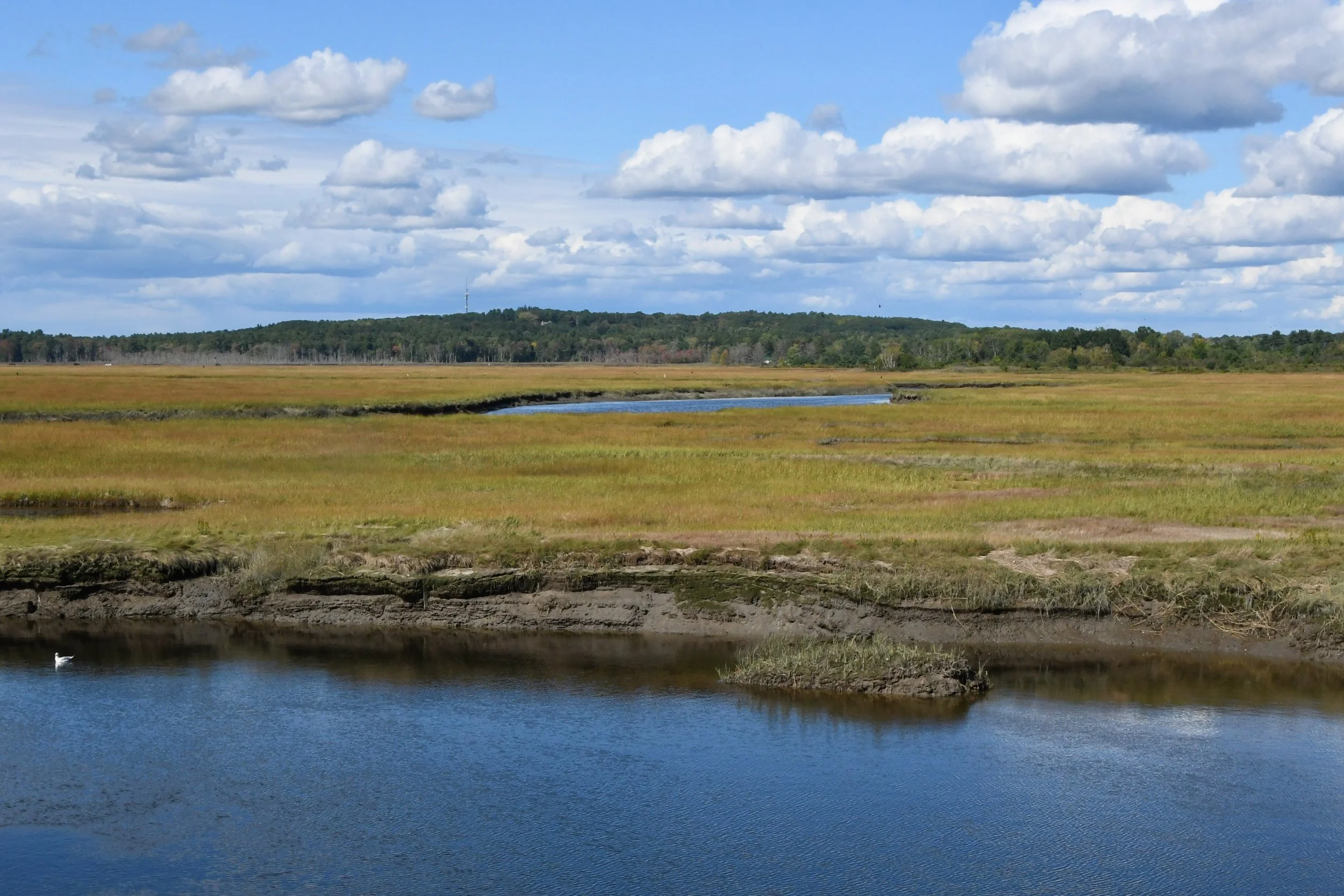
Photo © Liz Thompson
Rates of plant growth and decomposition, sediment supply, rates of sea level rise, historic and present-day land use, and tidal restrictions in the human-built environment combine to determine the ways in which salt marshes expand or shrink. Where marsh migration and elevation gain are possible, many a marsh can keep up with rising seas. But only to an extent. Prior to 5,000 years ago, for example, the seas rose quickly. The salt marshes of an older time were drowned. When the rate of sea level rise slowed again between 5,000 and 2,500 years ago, marshes began their return. Many of those marshes have flourished and are still with us today, and new marshes have continued to form over these last few millennia.
Today, the balance is shifting again.
The degree of relative sea level rise between 1970 and 2009 was three to four times higher in the northeastern United States than the global average. NOAA’s Sea Level Rise Technical Report stated that “relative sea level along the contiguous U.S. coastline is expected to rise on average as much over the next 30 years…as it has over the last 100 years.”
“Salt marsh resilience is, in part, a function of both accretion and migration—both made possible by their resident plants.”
Salt marshes are cooperative and competitive, adaptive and resilient, productive and biodiverse ecosystems, all parts of which function to make their edge-life possible. But whether or not marshes will continue to keep pace is an open, complex, and site-specific question.
This is part of the research occurring at the Rachel Carson National Wildlife Refuge.
* * *
The boat bottoms out just once on our way to the first research plot when low tide runs us into a sandbar. Rachel and Sam, sparing my leaky boots, get out to push. I use the moment to take in my surroundings. To the east: a green stretch of marsh and then a thick line of white and beige beach houses that rise between the grass and the ocean, obscuring the view of the sea. To the west: the visible buildings are farther away, with a wider swath of marsh grasses between infrastructure and the river. The other major barrier to marsh migration: human development and shorelines armored against flood. A marsh cannot travel through a concrete wall.
We anchor alongside the marsh bank, which, at low tide, is taller than me, the peat crumbly and wet, slate-black and muddy. We climb up to the marsh platform.
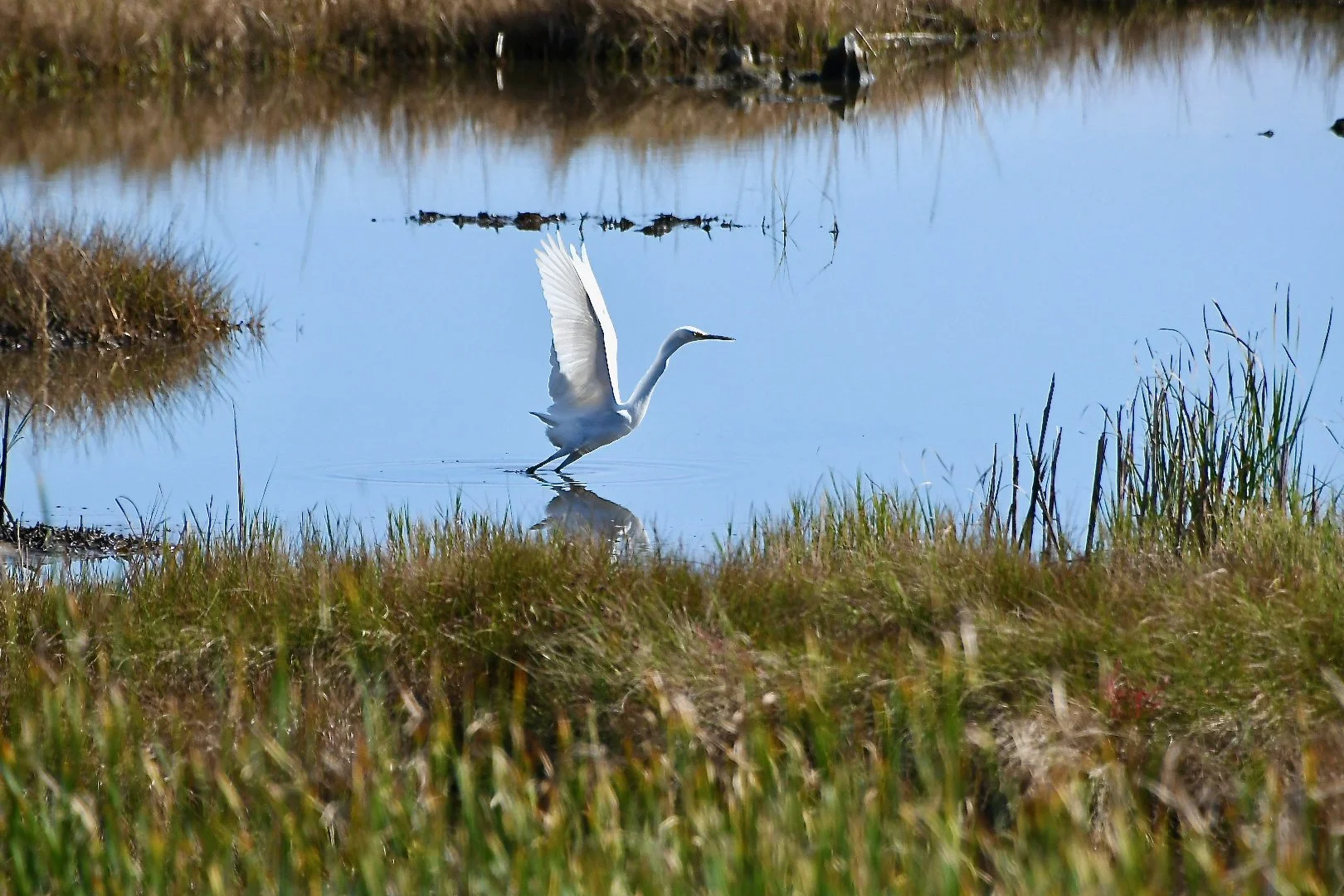
Photo © Liz Thompson
In the last few years, Rachel has set up ten research plots along the Webhannet, each a triangle formed by six pieces of PVC pipe standing vertically in the marsh—“triangle arrays” that provide five transect lines from which to measure the distance from the plot to the defined edge of the marsh (the “defined edge” being the place where the vegetation stops growing or where the channel bank drops vertically). She takes measurements at each of the ten plots once a year to monitor whether the seaward edge of the marsh is holding its ground, expanding, or eroding, and how quickly. Though she cautions that a conclusion requires long-term data and nothing definitive can be said yet, she tells me that it’s already quite clear that the edges are retreating.
At this particular site, they think the erosion is, in part, due to the Army Corps of Engineers dredging upriver near the harbor and then dumping the collected material out to sea, thus removing large amounts of sediment from the bottom of the channel. Meaning: the salt marsh will be exposed to a higher volume of water between high and low tide. If data from this erosion study can help show that this is the case, the refuge might be able to make the case for reapplying the dredge material to the marsh platform instead of hauling it away.
At each plot, Rachel and Sam make note of what vegetation is growing, all of it still young and low to the ground at this time of year. At this first plot:
Puccinellia maritima, seaside alkali grass: blooming now in the delicate, subtle way of grass.
Triglochin maritima, seaside arrow grass: Rachel hands me a blade of it and says, “If you break it apart, it smells like cilantro.” It does. I’m tempted to taste it. “Don’t eat it though; it’s toxic,” she adds, just in time.
Distichlis spicata, spike grass: both living and present as thatch (last year’s growth that will decompose into peat). “You can tell it’s Distichlis thatch,” Rachel instructs Sam, “because its leaves curl.”
Salicornia seedlings, pickleweed: a succulent. “You can eat this one,” Rachel says, handing me a stout green tip. It tastes bright and salty.
Plantago maritima, sea plantain: stem in the shape of a crescent moon.
Limonium nashii, sea lavender: soon to burst into purple and white flowers.
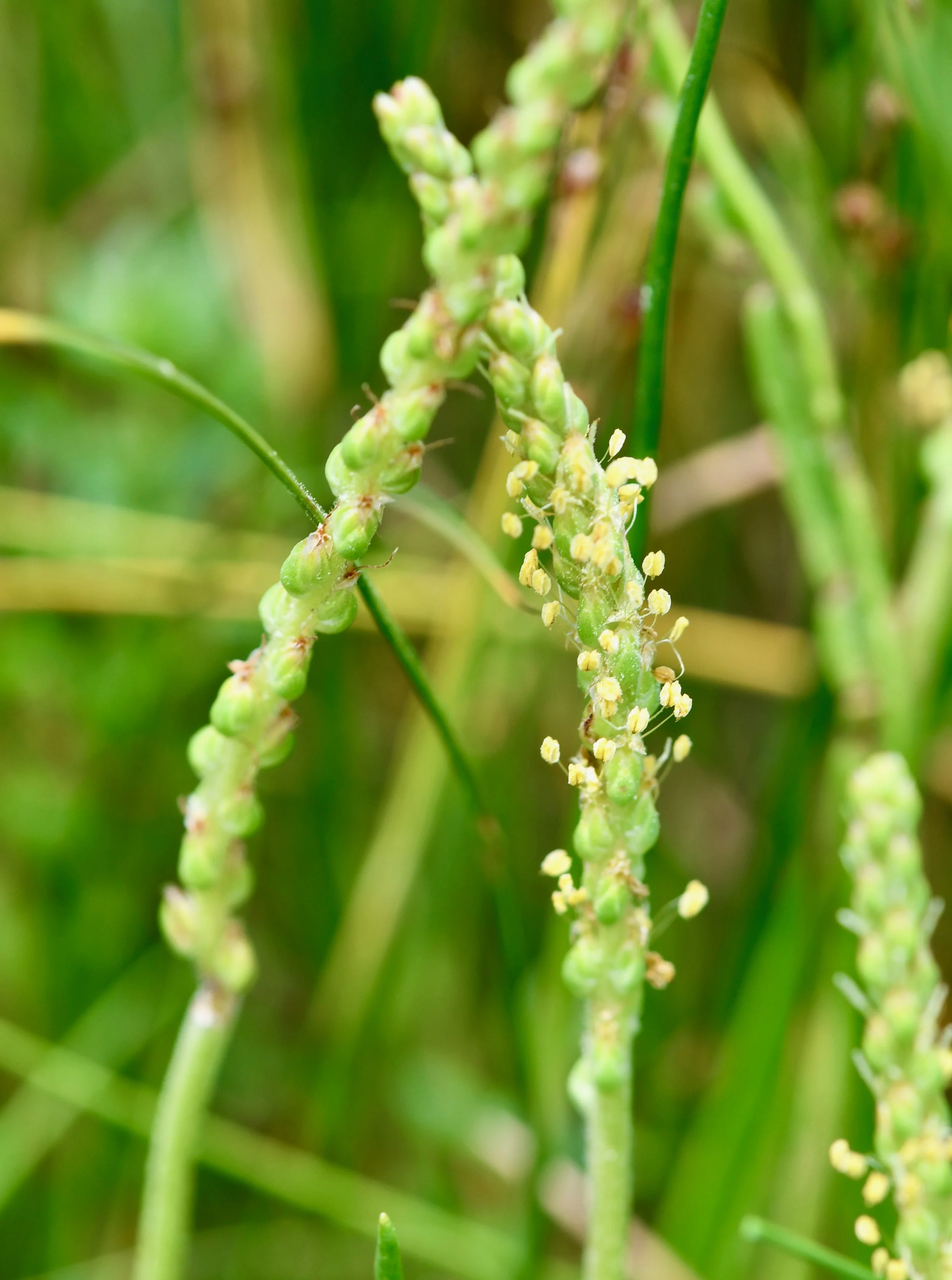
Sea plantain. Photo © Liz Thompson
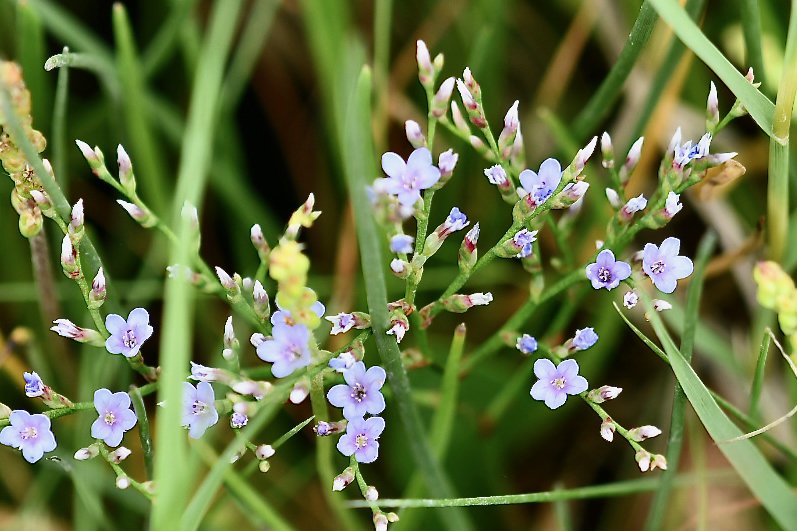
Sea lavender. Photo © Liz Thompson
Measuring tape in hand, Rachel backs two meters away from the edge and then measures another meter to the right, parallel with the marsh edge. Here, she presses a metal rod into the soil, twists a knob at the top, pulls it out, and gives Sam the reading: 2.1. She does this twice more. She is measuring the shear strength—the ability to resist tearing—of the peat in kilopascals. Her hypothesis is that the higher the reading (i.e., the greater the shear strength), the more roots and organic material are present within the peat, and, therefore, the healthier and more resilient the marsh edge. Conversely, peat that is hummocky and soft—a low shear strength—is a sign of a marsh in distress.
* * *
Between 1300 and 1850, sea level rise in New England occurred at a rate of one millimeter per year. In 2007, the Intergovernmental Panel on Climate Change (IPCC) predicted that it could get as high as nearly six millimeters per year this century. Others have predicted rates as high as sixteen millimeters per year, which would drown today’s healthy, intact salt marshes.
The peat-based marshes of New England are some of the least likely to keep pace with rising seas, because they have comparably low sediment accretion rates, relying primarily on peat buildup from plant detritus to gain elevation—a slower process. Marsh migration may help them persist where such migration is possible. But there are many human barriers. Casco Bay in Maine, for example, has already armored a fifth of its shoreline against sea level rise, therefore armoring it against marsh migration as well. And across the northeastern United States, shifting vegetation patterns, widening channel networks, marsh pool formation, and changing sediment structures are evidence that marshes may be lagging behind rising oceans.
At another plot later in the day, the kilopascal reading will be zero after the instrument meets a large pocket of air beneath a thin layer of peat. “This one isn’t looking good,” Rachel will say. That wild edge is falling into the sea.
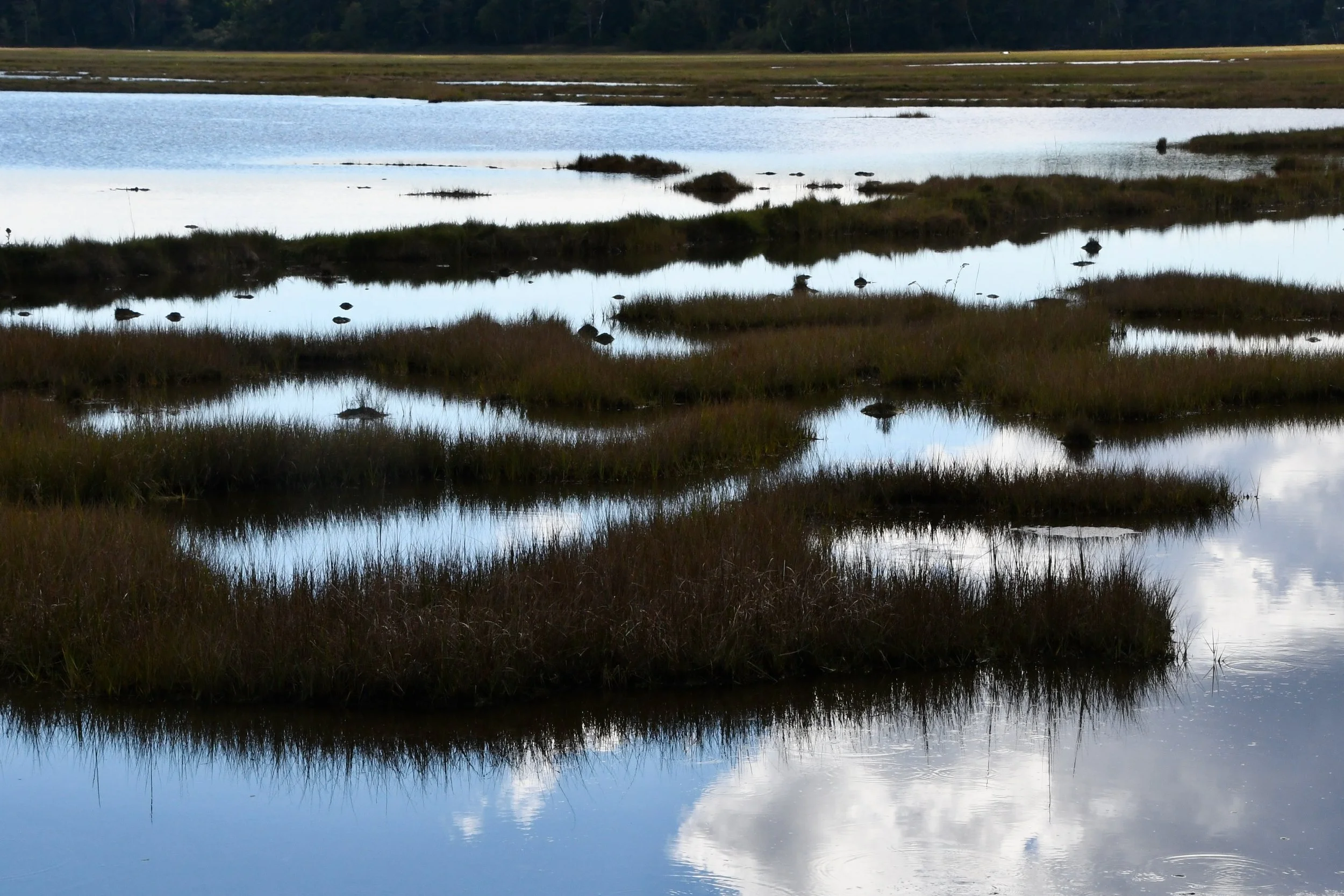
Photo © Liz Thompson
Copyright © 2025 Chelsea Steinauer-Scudder. Published by Broadleaf Books. All rights reserved. Except for brief quotations in critical articles or reviews, no part of this book may be reproduced in any manner without prior written permission from the publisher. Email copyright@broadleafbooks.com or write to Permissions, Broadleaf Books, PO Box 1209, Minneapolis, MN 55440-1209.
Chelsea Steinauer-Scudder is the author of Mother, Creature, Kin: What We Learn From Nature’s Mothers in a Time of Unraveling, published by Broadleaf Books in spring 2025. Her writing can also be found in The Atlantic, Emergence Magazine, The Common, the EcoTheo Review, the edited poetry collection Writing the Land, and in Katie Holten’s The Language of Trees: A Rewilding of Literature and Landscape. She lives with her family in Rochester, Vermont.