
Forests and the Climate Reckoning
Lessons from Thoreau and the Far North
Original artwork © Jon Luoma
Editor’s Note: I met the writing of Jamie Sayen and the art of Jon Luoma through the pages of the Northern Forest Forum, a delightfully insightful and provocative magazine (1992–2002) that provided an inspiringly integrated vision for New England’s future while exposing the rapacious behavior of institutions that continue to degrade it. It is delightful to see them rejoined here, challenging society anew while exploring two subjects dear to both of them—northern Wildlands and the insights of Henry Thoreau. – David Foster
“How important is a constant intercourse with nature and the contemplation of natural phenomena to the preservation of moral and intellectual health… He approaches the study of mankind with great advantages who is accustomed to the study of nature.”
—Thoreau, Journal, May 6, 1851
The lifetime of Henry David Thoreau coincided with the period of greatest deforestation in his hometown of Concord, Massachusetts. In August 1846, to immerse himself in the surviving ancient forests of New England, Thoreau traveled 300 miles to interior, northern Maine lands that were virtually uninhabited and unmapped all the way to Canada.
His journal accounts of trips in 1846, 1853, and 1857 were posthumously published as The Maine Woods, an invaluable account of the ecology and culture of vanishing pre-settlement forests: “What is most striking in the Maine wilderness,” he wrote after his 1846 adventure, “is the continuousness of the forest, with fewer open intervals or glades than you had imagined. Except the few burnt lands, narrow intervals on the rivers, the bare tops of the high mountains, and the lakes and streams, the forest is uninterrupted. It is even more grim and wild than you had anticipated, a damp and intricate wilderness, in the spring everywhere wet and miry.”
While rambling along the shores of Chesuncook Lake in 1853, he reflected: “The woods were as fresh and full of vegetable life as a lichen in wet weather, and contained many interesting plants; but unless they are of white pine, they are treated with as little respect here as a mildew, and in the other case they are only the more quickly cut down.”¹
The canopies of old, unlogged forests Thoreau visited were dominated by red spruce, balsam fir, and northern hardwoods such as sugar maple, yellow birch, beech, elm, and ash. Towering white pines were uncommon in the Pine Tree State’s northern and interior forests. After three decades of intensive cutting of this most economically valuable tree, the days of the great white pine river drives were nearly over by 1846.
“When a chopper would praise a pine,” Thoreau wrote contemptuously in 1857, “he will commonly tell you that the one he cut was so big that a yoke of oxen stood on its stump; as if that were what the pine had grown for, to become the footstool of oxen… Why, my dear sir, the tree might have stood on its own stump, and a great deal more comfortably and firmly than a yoke of oxen can, if you had not cut it down. What right have you to celebrate the virtues of the man you murdered?”
The lumbermen, observed Thoreau, seemed intent, “like so many busy demons, to drive the forest all out of the country, from every solitary beaver swamp, and mountain side, as soon as possible.”
On his return trips to Maine, Thoreau hired Penobscot guides Joe Aittean (1853) and Joseph Polis (1857), because he wished to study the ways of people who had lived on the land since time immemorial. The Maine Woods brims with fascinating accounts of Penobscot place names, hunting practices, techniques for curing moose meat and hides, building and maintenance of canoes made of birch bark, and even instruction on more efficient paddling in the bow of a canoe.
Thoreau concluded, “One revelation has been made to the Indian, another to the white man. I have much to learn of the Indian, nothing of the missionary. I am not sure but all that would tempt me to teach the Indian my religion would be his promise to teach me his.”
After his 1853 visit, he asked, “Why should not we… have our national preserves… in which the bear and panther, and some even of the hunter race, may still exist, and not be ‘civilized off the face of the earth’…? or shall we, like villains, grub them all up, poaching on our own national domains?”
Original artwork © Jon Luoma
Quebec’s Disappearing Wild Forests
These days, to experience untrammeled wild nature on a landscape scale, I have had to travel 300 miles north to a series of lovely lakes about 70 miles—as Raven flies—northwest of Quebec City. When I first ventured there in the 1960s, we hired Innu guides to help us survive for two weeks in the wilds.
The Innu had hunted in this territory from time immemorial until the Canadian government exiled them in the mid-nineteenth century to a reserve on the southwest shore of Lac St. Jean 100 miles farther north. They kindled a fire with birchbark to cook lunch in a deluge. Their techniques for portaging and paddling canoes inspired me to try to master these arts, however imperfectly. I am forever indebted to these kind and wise hommes de bois.
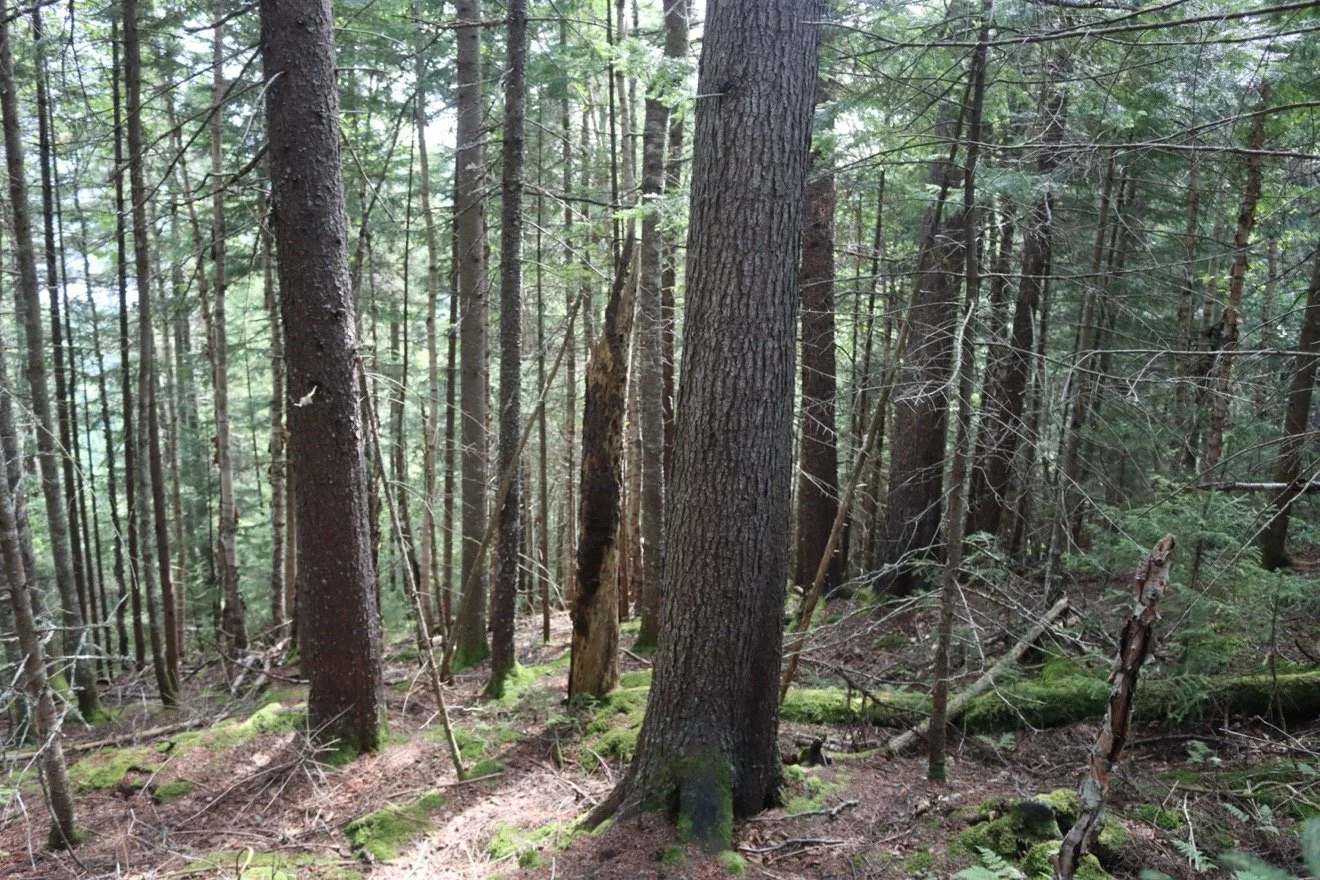
Red spruce high on southwestern hillside of Lac Austin. Photo © Jamie Sayen
The canopy of these Quebec woods is dominated by red spruce, black spruce, yellow birch, white birch, and trembling and big-tooth aspen. Tamarack abounds in wetlands and along shores.
My base these days is on a beautiful 10-mile-long lake that is more like a river with numerous bays linked together by narrows that are favored as crossings by wildlife. At one of these narrows, my wife, son, and I encountered a lynx swimming at dusk.
On three occasions, moose have approached me when my canoe drew too close to them while they munched on aquatic vegetation. In spring, hungry bears break into the few camps scattered around a 400-square mile territory. Beavers have recovered from colonial-era trapping that had virtually extirpated them. Otters, though uncommon, cavort, often in family groups. Red squirrels chatter, scold, and occasionally drop spruce cones on trespassers.
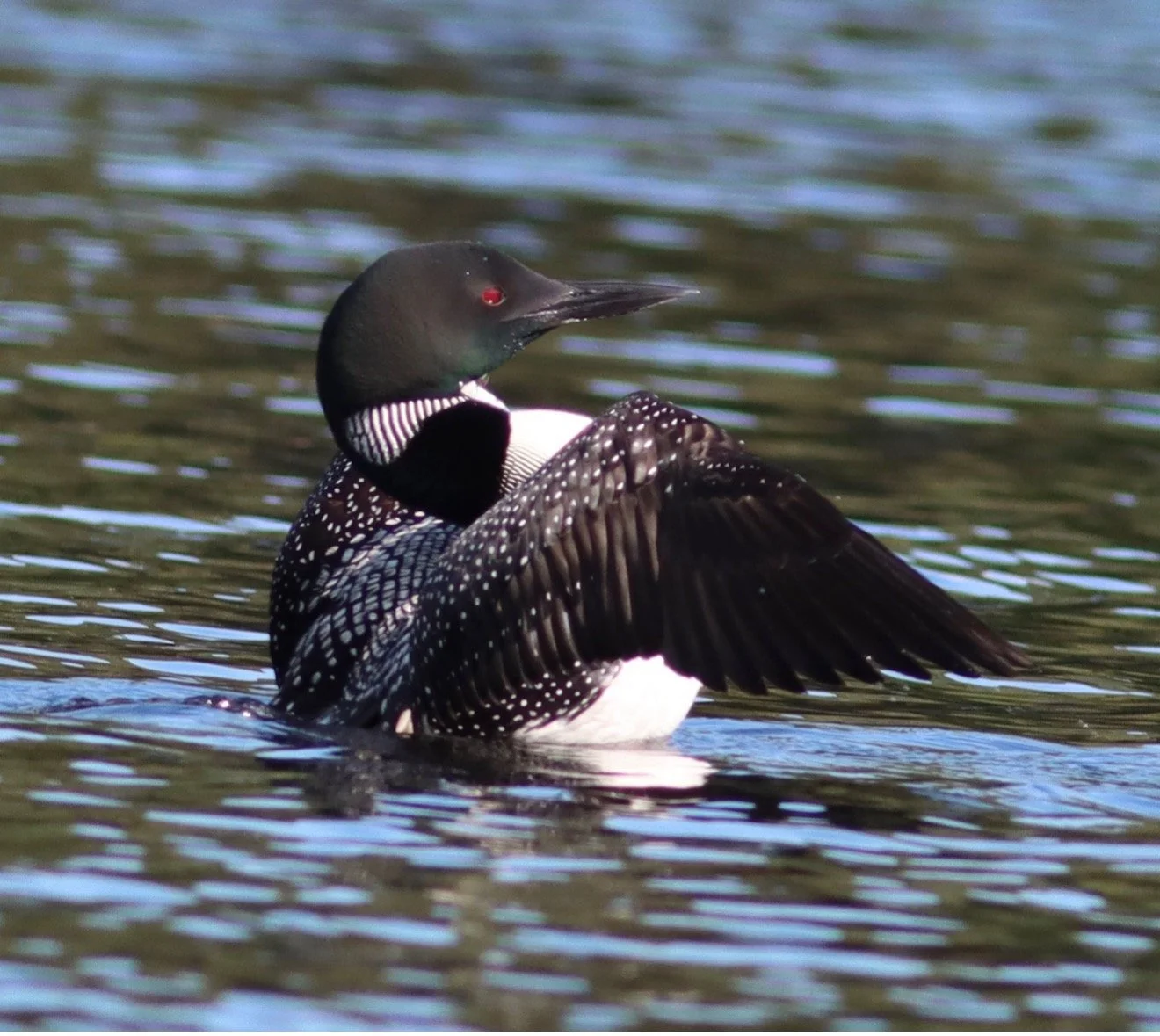
Common Loon on Quebec waters. Photo © Jamie Sayen
Common loons cast a primordial spell over the countless glacial lakes. Overhead, osprey circle and dive; they build huge stick nests in standing dead conifers near the shore. Kingfishers swoop and dive along shorelines, emitting a ratchety call. The songs of Swainson’s thrushes and white-throated sparrows, characterized by Thoreau as “the prevailing bird in the northern part of Maine,” accompany evening’s fading light.
In the late 1990s, the Quebec provincial government opened this wilderness to an unregulated timber industry. Today, there are numerous logging roads where one can hike through spindly, recovering forests. Several large, ugly camps have been constructed on once quiet shores. All-terrain vehicles, motorboats, and cruising cocktail party boats, with blaring radios and chattering anglers, disturb wild nature’s music.
In my rambles this summer, I observed the sharp contrast between older, mixed forests with moss-clad, downed trees, and the more desiccated, mostly low-economic-value, hardwoods that sprout after a clearcut. Large yellow birch and red spruce dominate these all-aged stands. Although extremely rare in the boreal forest, the occasional white pine grows on ridge lines where they tower over the tallest spruce.
I encountered wolf tracks on an old logging road and moose tracks scarring an exposed slab of rock. One afternoon, a lake darner landed on my heart. Our eyes, mere inches apart, gazed into each other for a minute or more—deep time with a living being whose ancestors appeared some 200 million years ago.
No one should have to travel to distant places to experience raw nature. Let us protect managed forests from further rapacious logging practices, rewild vast swaths of suburbia, and establish a network of urban parks that would offer semi-wild experiences, while intercepting much of the urban carbon dioxide that constitutes about 70 percent of global carbon emissions.
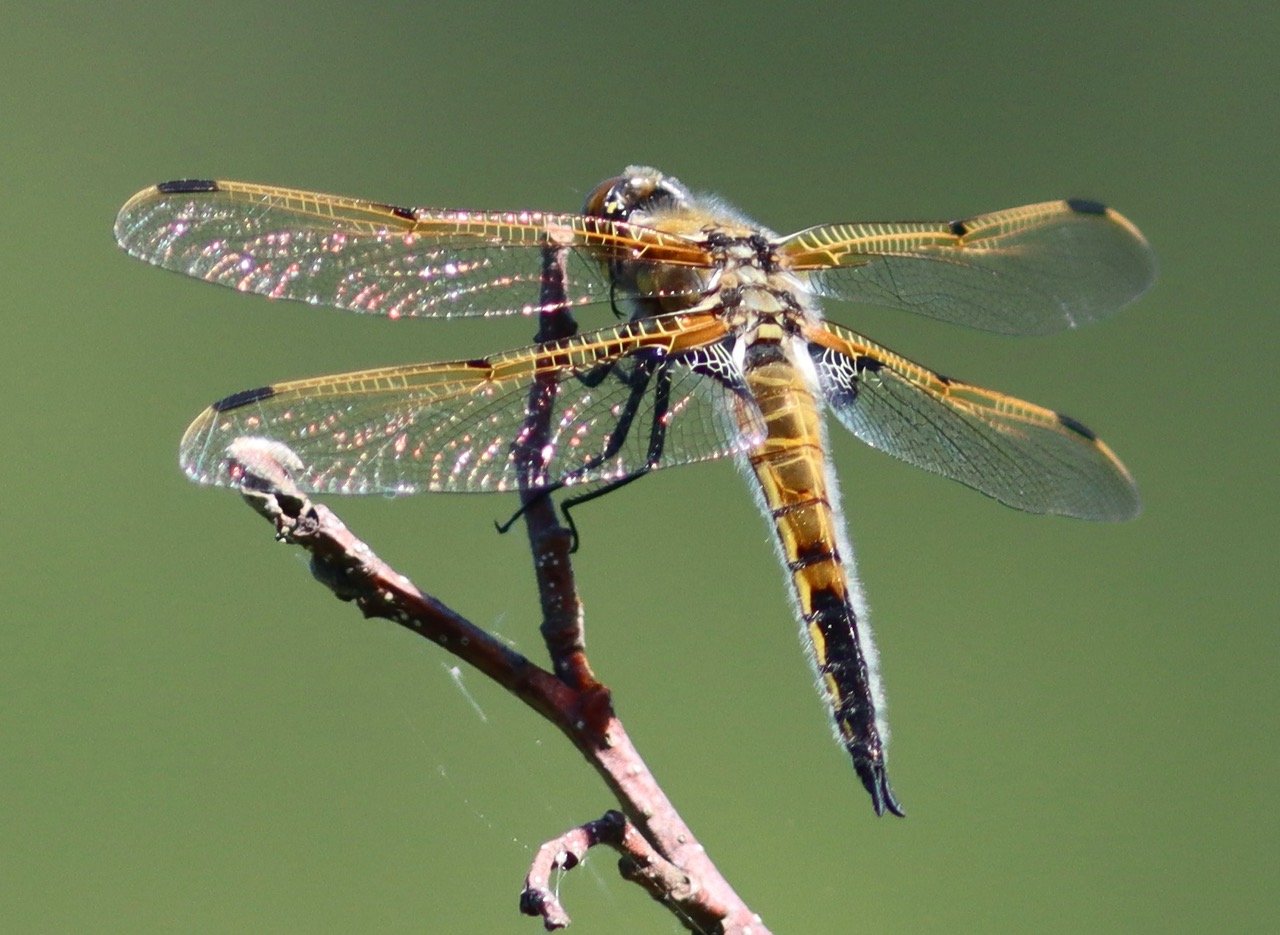
Four-spotted skimmer, Quebec. Photo © Jamie Sayen
Forests and the Climate Crisis
In 1988, climate scientist James Hansen warned the United States Congress that global warming posed an existential threat and must be aggressively addressed. A year later, Bill McKibben published The End of Nature, a book that shocked the public conscience in a manner similar to Rachel Carson’s Silent Spring a quarter century earlier.
Since 1990, we have doubled our carbon emissions. The United States, with about four percent of the world’s population, is responsible for about one quarter of the world’s carbon emissions. Our leisure time activities, computers, artificial intelligence, and digital currency are major culprits.
Forests absorb 40 percent of annual carbon dioxide emissions via photosynthesis. Preserving our maturing and older forests from further logging will significantly reduce levels of atmospheric carbon. Rewilding forests could sequester and store carbon long term at an even greater rate if we ended industrial deforestation.
The timber industry has traded in northern New England’s old-growth forests for young stands, nearly half of which are considered “degraded.” By following the logic of arbitrary discount rates, commodity pulp wood cut today is worth more than quality sawlogs would fetch half a century hence.
It is unconscionable that an industry without moral standing has been allowed to discount the rights of unborn generations of all species while exacerbating the climate crisis. Planet Earth now demands payment for our species’ Faustian bargain with excess, indulgence, and greed.
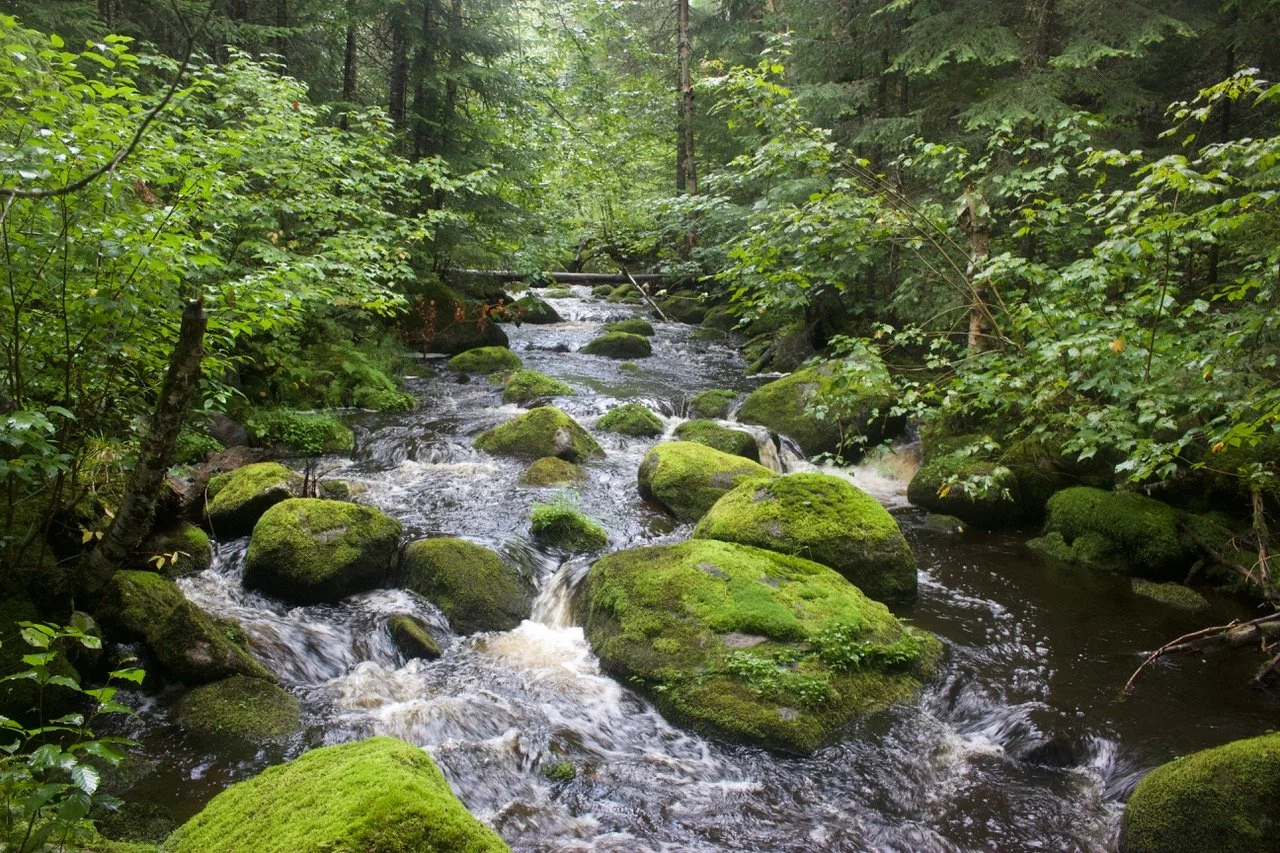
Quebec stream after a week of rain. Photo © Jamie Sayen
The Reckoning
There are limits to the use of nature, and beyond those limits, nature is prevented from fulfilling its cycles and functions.²
To prevent the planet from warming more than 1º C, we must achieve net zero carbon emissions by 2050. The consequences of further denial and dithering are already manifesting themselves in extreme weather events such as floods, droughts, and fires. Climate change makes all social, economic, and political injustices worse.
Twenty-first-century democracy in America has failed to preserve biotic integrity, address the climate crisis, and assure environmental justice. It is time to build a new political culture that sprouts from the grassroots.
A month before Thoreau’s first trek into Maine’s wilds, he was arrested for non-payment of a poll tax to finance the United States’ invasion into Mexico to expand slave territory. In his essay “Resistance to Civil Government,” published in 1849, Thoreau wrote: “I cannot for an instant recognize that political organization as my government which is the slave’s government also. All men recognize the political right of revolution.” He added that if the state “requires you to be the agent of injustice to another, then, I say, break the law.”³
To those who despair that it is folly to oppose the State, he answered: “A minority is powerless while it conforms to the majority;… but it is irresistible when it clogs [the machinery of government] by its whole weight.”
Half a century ago, poet Gary Snyder imagined a societal renunciation of an unjust, corrupt government:
The USA slowly lost its mandate
in the middle and later twentieth century
it never gave the mountains and rivers,
trees and animals,
a vote.
all the people turned away from it
myths die; even continents are impermanent
Turtle Island returned.⁴
Transformation
When human aspirations conflict with natural laws and limits, humans must modify their behavior. As we transform ourselves into “plain citizens” of the biotic community, Nature is our most faithful teacher. When cougar, spruce, dragonfly, or fungi object to our behavior, we are wise to back off. Rivers and mountains teach us how to live sustainably with them. We are not authorized to compromise the rights of nature!
We become advocates for nature’s right to flourish when we ask: Will this proposal compromise or degrade any element of the biosphere? This right to flourish—to realize one’s evolutionary potential—applies to all species, including humans, especially those who have suffered oppression.⁵
Nature teaches the sequence in which we effect this transformation:
1. Preserve the Integrity of the Biosphere
Degraded forests begin to heal the instant we cease exploiting and degrading. To reverse alarming trends in climate warming and extinction rates, it is imperative that we preserve vast tracts of self-rewilding nature to provide native, climate-stressed species adequate habitat to survive and retain optimal amounts of genetic diversity.
Thirty years ago, I proposed an 8-million acre Wildlands reserve in northern Maine, New Hampshire, and Vermont’s Northeast Kingdom.⁶ Such landscape-scale reserves—future old growth—would also store vast amounts of carbon that trees, shrubs, and plants withdraw from the atmosphere. Their healthy soils provide vital carbon storage services.
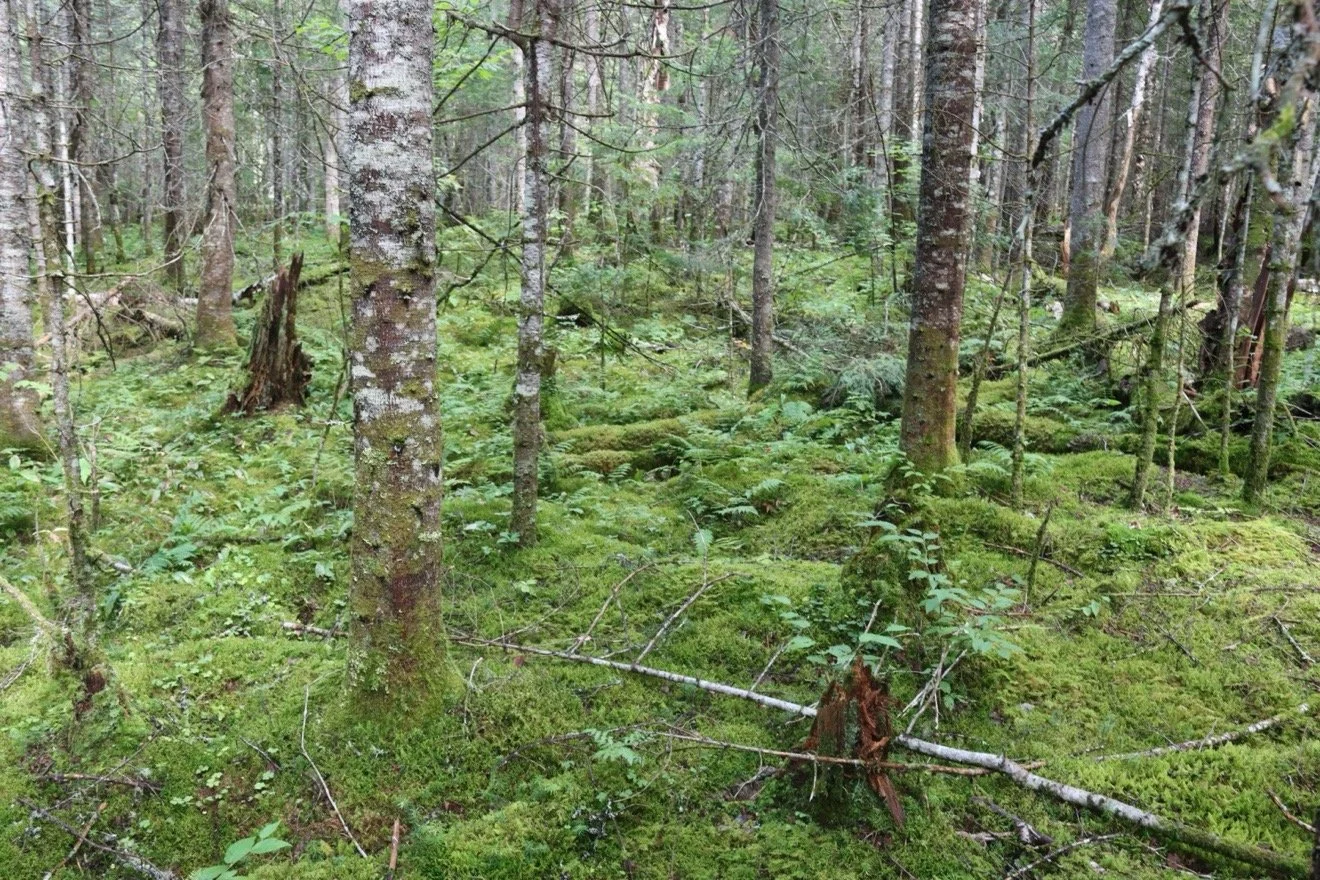
Coniferous Quebec wetland. Photo © Jamie Sayen
Landscape-scale Wildlands in northeastern North America, linking wildlands in Quebec and New England, will contribute to the establishment of a continental Wildlands network. Wolves and lynx of Quebec can reinforce New England’s scarce, scattered populations of these top predators.
2. Transform Human Behavior
In “Resistance to Civil Government,” Thoreau wryly observed: “they who assert the purest right, and consequently are most dangerous to a corrupt State, commonly have not spent much time in accumulating property. To such the State renders comparatively small service.”
Wealth greatly in excess of what is required to meet our basic needs does not improve people’s lives. If affluence means living a rich life, and abundance means requiring little, we can rediscover ways of procuring life’s necessities without approaching planetary limits.
By reducing our consumption of unnecessary consumer products—toxic plastics, biocides, gas guzzlers, and all manner of fripperies, coupled with a permanent boycott of box stores and franchises—we begin the process of liberating ourselves from nature estrangement and maldistribution of wealth.
“Demand Reduction,” Mitch Lansky has written, “acknowledges that some forms of wealth are not best measured in dollars but instead are a form of biological wealth—a part of our life support system.”
With its focus on necessities and basic needs, Demand Reduction is an essential tool for disengaging from globalism. Reducing fossil fuel emissions to net zero by 2050 becomes a realistic aspiration.
3. Meet Basic Needs
In northern New England, the establishment of landscape-scale Wildlands on absentee-owned industrial forests could liberate New England’s largest forests from low-paying, global commodity markets and create an opportunity to reward practitioners of low-impact forestry. The region’s small woodlot owners can produce high-value wood products on their own premises, or earn premium prices selling modest amounts of high-value sawlogs to low-impact, run-of-the-stream, water-powered sawmills and crafters of high-value products.
Local agriculture that eschews petrochemical fertilizers, genetically modified seeds, and monocultures is essential to community revitalization.
Support for local, low-impact farmers, loggers, and craftspeople ensures that revenues recirculate within the community instead of being sucked out by global rent-seekers.
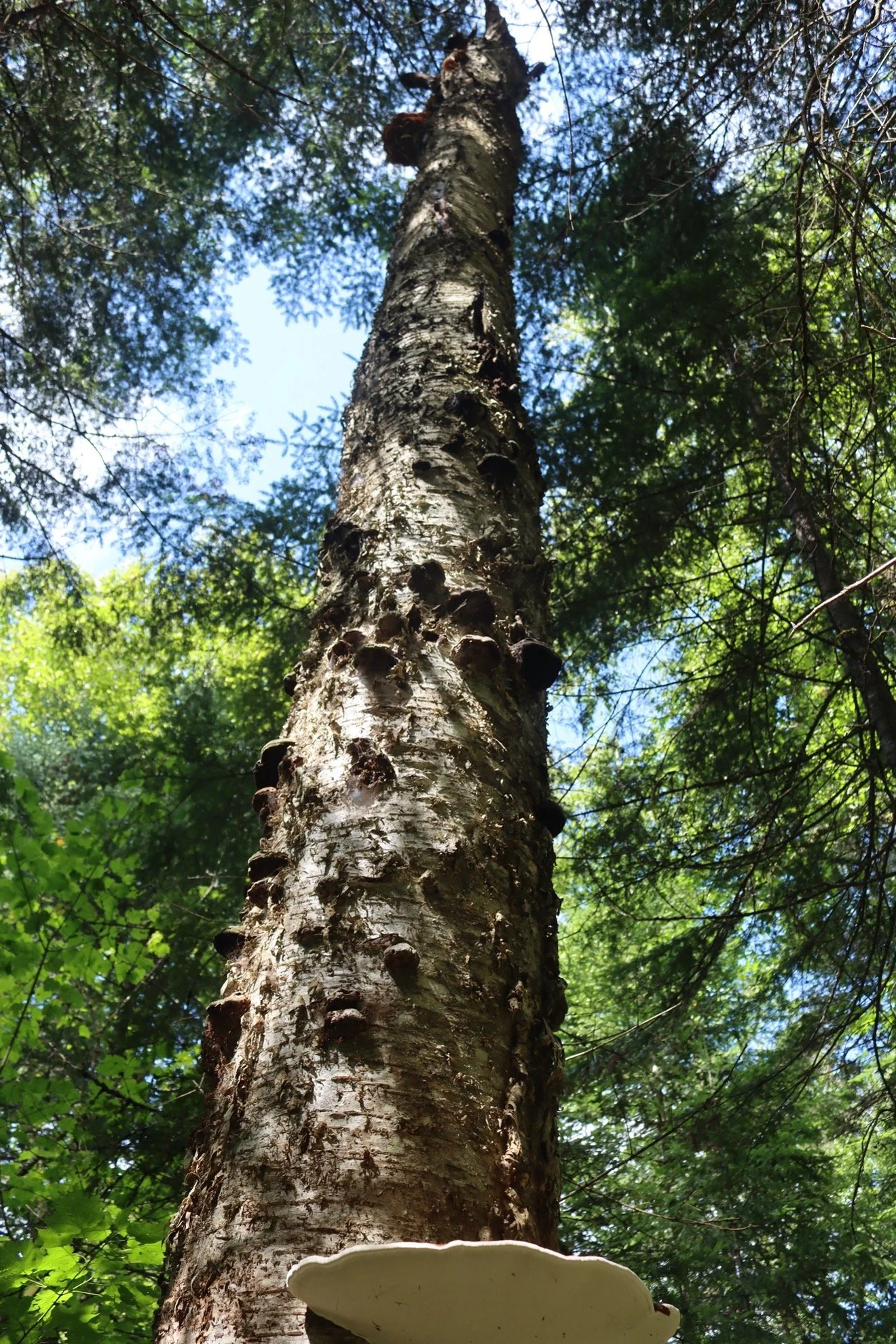
Yellow birch and artist’s conk, Quebec. Photo © Jamie Sayen
4. Natural Democracy
Degradation of habitat impacts humans, non-humans, and unborn generations of both. Prohibiting depredation of nature constitutes a form of atonement.
People defend what they know and love. A citizen-initiated watershed approach to Natural Democracy could creatively enfranchise non-humans and unborn generations.⁷
Poet and Gulf of Maine Books owner Gary Lawless observes that children are born with an “all-species empathy.” He and a friend have organized walks for kids in a local nature reserve. They lead the children to moss- and lichen-covered stumps, or to wetlands where dragonflies abound. “A lot of the kids get very excited because they don’t know much about that world,” Gary said. “They are all inside. They are not encouraged to encounter that world. So how do we expect them to want to protect it?” Imagine the mental, physical, and spiritual benefits for children who spend their childhoods nurtured by soils and wild nature.
“Think of our life in nature,” Thoreau sang in The Maine Woods, “daily to be shown matter, to come in contact with it,—rocks, trees, wind on our cheeks! the solid earth! the actual world! the common sense! Contact! Contact! Who are we? where are we?”
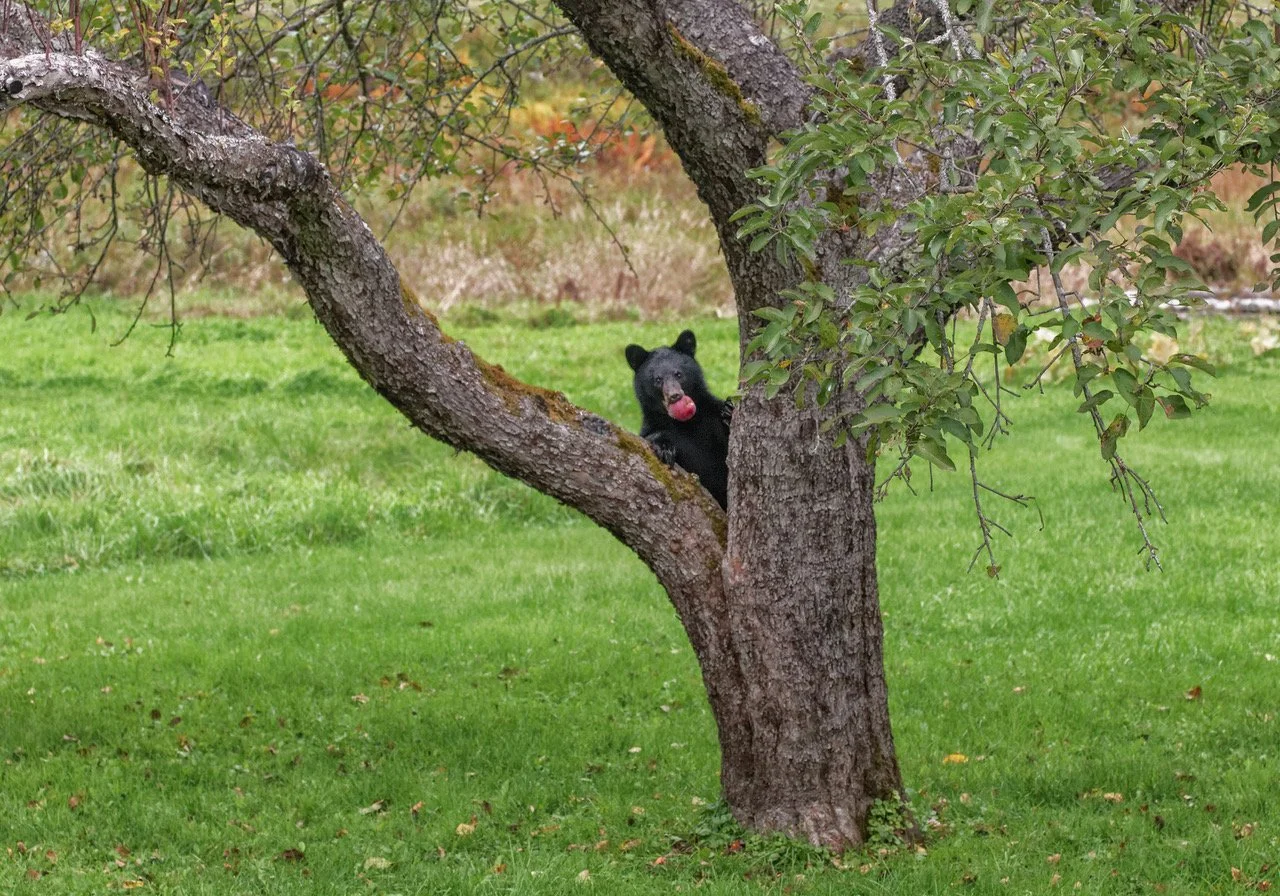
Photo © Fletcher Manley
1Henry D. Thoreau, The Maine Woods: A Fully Annotated Edition, ed, by Jeffrey S. Cramer (New Haven: Yale University Press, 2009) 71-72. Additional quotes from The Maine Woods are, in order, found on pages 119, 213, 3, 169, 144–145, 179, 64.
2Ramiro Ávila Santamaría, “The Systemic Theory of Law in the Jurisprudence of Nature in Ecuador: From the Machine to the Web of Life,” in César Rodríguez-Garavito (ed.), More than Human Rights: An Ecology of Law, Thought and Narrative for Earthly Flourishing (New York: New York University More Than Human Rights Project, 2024) 288–289.
3Henry D. Thoreau, “Resistance to Civil Government,” in Essays: A Fully Annotated Edition, ed. By Jeffrey S. Cramer (New Haven: Yale University Press, 2013) 148–149 and 155. Additional quotes from “Resistance to Civil Government” are, in order, found on pages 157–158, 158.
4Gary Snyder, “Tomorrow’s Song,” Gary Snyder, Turtle Island (New York: New Directions Publishing Corporation, 1974) 77.
5Emily Jones, “Can the Rights of Nature Transform the Way Rights Are Conceptualized in International Law?” César Rodríguez-Garavito (ed.), More than Human Rights: An Ecology of Law, Thought and Narrative for Earthly Flourishing (New York: New York University More Than Human Rights Project, 2024) 233-235.
6Northern Forest Forum, Vol. 3 No. 5, Summer 1995. See also, David Foster et al., Wildlands in New England: Past, Present, and Future, 2023: 18–19, 91–92; Jamie Sayen, Children of the Northern Forest: Wild New England’s History from Glaciers to Global Warming (New Haven: Yale University Press, 2023) 208–211. Jamie Sayen, “Landscape Scale Wildlands in Northern New England Threatened by Friendly Fire,” in From the Ground Up, Issue 4, Fall 2024.
7Two wonderful books on a Watershed approach to restoration, preservation, and governance in the Mattole River Watershed in northern Coastal California are: Freeman House, Totem Salmon: Life Lessons from Another Species (Boston: Beacon Press, 1999) and Freeman House, A Watershed Runs Through You: Essays, Talks, and Reflections on Salmon, Restoration, and Community (Chimacum, Washington: Empty Bowl Press, 2023).
Jamie Sayen is a longtime Wildlands activist who lives in northern New Hampshire. He is author of Children of the Northern Forest: Wild New England’s History from Glaciers to Global Warming (2023) and You Had a Job for Life: Story of a Company Town (2017 and 2023).
Jon Luoma is an artist and illustrator in Maine. He studied painting and printmaking in the United States, and traditional Chinese ink painting in Sichuan, China. He was the illustrator for the weekly Maine Times and for the Northern Forest Forum between 1985 and 2000. Since then, he has exhibited paintings–mostly watercolors and mostly of landscapes and natural subjects–throughout southern Maine, in galleries and in several one-man shows. Learn more