
On the Road with Real Naturalists
Editor’s Note: This fun, slightly tongue-in-cheek article about hunting for rare species in the early days of the natural heritage inventories is a good companion to our interview, in this issue, with Larry Master, who offers some perspective on the history and goals of the Heritage network, now called NatureServe. Further fleshing out this picture are two stories of modern-day discoveries, one of a very rare plant, one of a rare natural community. Brian Donahue’s “not a naturalist” perspective on this work is refreshing and enlightening. – Liz Thompson
I am not a naturalist. As a farmer, woodcutter, and environmental historian, I have spent much of my life outdoors, working in nature. I am an aspiring naturalist—I can identify many common plants and animals, have an idea where I am likely to find them, and have some sense of what they are doing there.
Real naturalists are a different breed of cat. They can identify everything—not just common (and rare) birds, trees, and wildflowers, but mussels, moths, and mosses—and they know exactly where to find them. They also know exactly what these creatures are doing—which, besides being part of an ecosystem, is waiting for a real naturalist to come along and make sure they are still there.
My childhood friend Charles Bier is a real naturalist. This was obvious even back in high school, outside of Pittsburgh in the early 1970s. When you go birding with Charles, you see uncommon birds that you wouldn’t have seen by yourself. It isn’t that they are difficult to see—when you go by yourself, they just aren’t there. With Charles, they step out of the bushes and present themselves to you.
Charles went on to a career with the Western Pennsylvania Conservancy. His job, as far as I could tell, was to keep track of every species belonging to every plant and animal phylum in the western half of the state, and to keep them from being destroyed. When I visited Charles we would typically stop in to see several rare species, and then a couple more on the way home—which would involve driving to the end of the road in some state forest and then hiking four or five miles, far beyond any trail, with the sun setting, until we came to a steeply wooded slope indistinguishable from the eight or nine identical slopes we had already traversed, to check out a small colony of some little-known plant. Then we would head home, arriving two or three hours late for dinner.
Charles came up to my home in Weston, Massachusetts, in 1989 to visit and to meet with natural heritage colleagues in the region. I was invited to spend a day with them in the field. The purpose for Charles’ trip was to visit some unusual plants and get a feeling for their landscape context, so he would know where to look back home. I was a full-time farmer and reasonably fit, and this sounded like easy fun. It was June, so the day was long.
We set off soon after daybreak with Larry Master driving—Larry also lived in Weston, down the street from my wife’s parents. We were joined by Margaret Ormes, who worked with Larry at The Nature Conservancy (TNC) in Boston, and Mike Lipford, who was up visiting from the TNC Natural Heritage program in Virginia. By nine o’clock we were in central Massachusetts (I am not allowed to tell you any more than that), where we met Tom Rawinski.
“Real naturalists are a different breed of cat. They can identify everything—not just common (and rare) birds, trees, and wildflowers, but mussels, moths, and mosses—and they know exactly where to find them.”
Tom, like Charles, is legendary for his ability to find plants. Decades later, while Tom was helping us introduce bow hunting to the Weston town forest, he would discover the second-known native population of sweetbay magnolia (Magnolia virginiana) in Massachusetts (a state endangered plant, though common farther south, and widely planted), tucked away behind a—well, I can’t tell you what it is tucked behind, and I don’t know how in the world he found it. I have heard similar stories about Tom from others—a sudden request to stop the car, another rare plant discovered by the roadside.
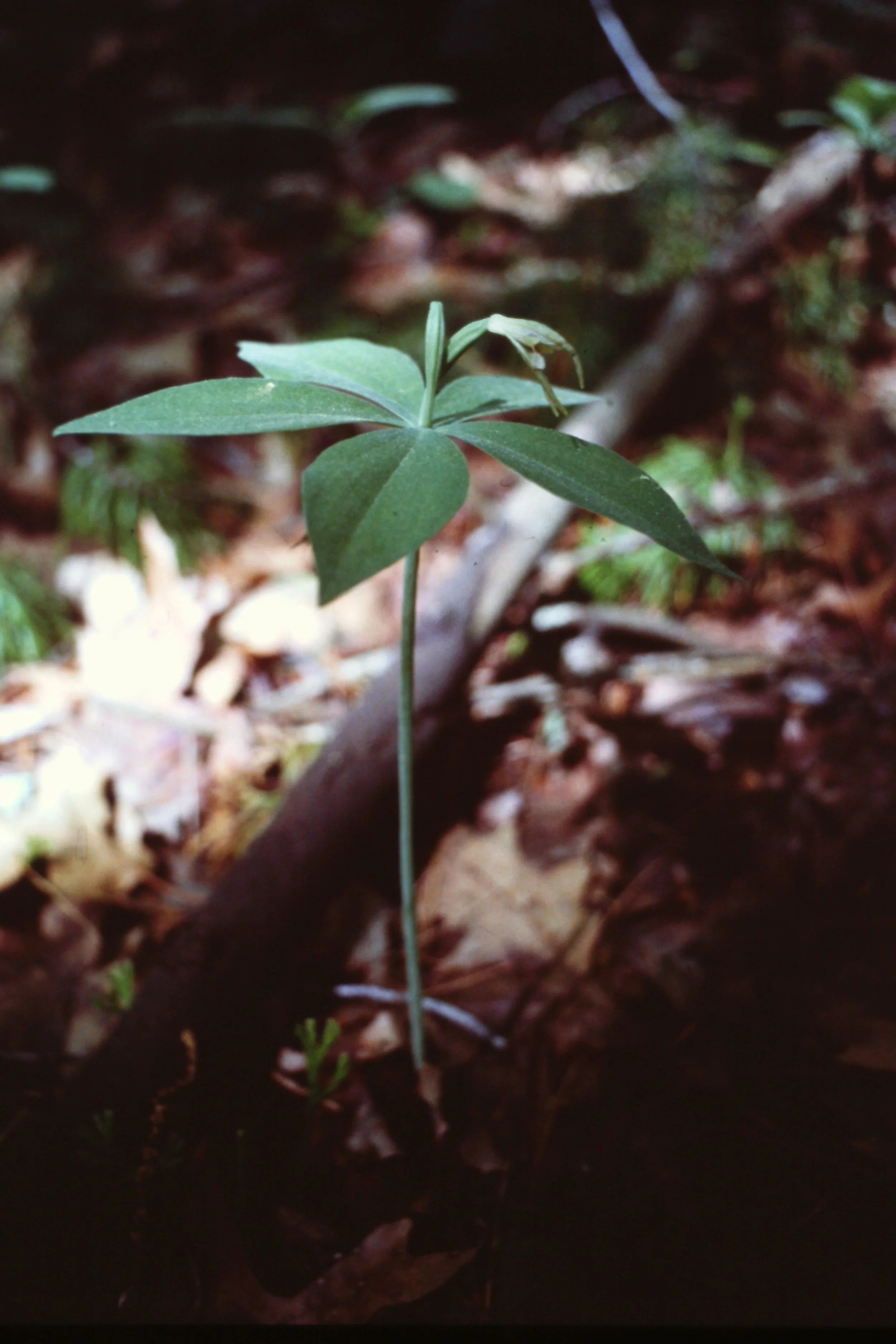
Small whorled pogonia (Isotria medeoloides) in central Massachusetts, 1989. According to Tom Rawinski, this colony is still flourishing today. Photo © Charles Bier
But back in 1989, I was meeting Tom for the first time. He led us to a colony of small whorled pogonia (Isotria medeoloides)—an unassuming but lovely little green orchid, endangered in Massachusetts and threatened across its entire range. Nine populations are known to exist in Massachusetts, and they are extremely vulnerable to disturbance: They depend on mycorrhizal fungi, spend years underground before emerging, and cannot be transplanted. This cluster was on public land but close to a suburban development, and in full flower. I didn’t think about it at the time, but I will almost surely never see this plant again, anywhere—in retrospect, I was fortunate to see it even once.
Then we were off a few towns farther west, somewhere on the Worcester plateau, to check out a small bog that someone in our party thought was worth a look. We waded into that bog—or at least, some of us did. Whatever we were looking for, we didn’t find it. I know this because that stop is not even recorded in Charles’ field notes, which I have borrowed. We ate lunch in our cars by the bog.
After that we set off west again, down into the valley and then bombing up into southern Vermont. This time our target species was the Northeastern bulrush (Scirpus ancistrochaetus)—a waist-high sedge that grows at the edges of wetlands with fluctuating water levels. This species is nationally rare and endangered, with most New England sites along the Connecticut River. So it was that we found ourselves wading knee-deep into an embayment marsh in the late afternoon, looking for a known population. We may or may not have found what we were seeking, because it was too early for this bulrush to be flowering, which is the only thing that really distinguishes it—although that shouldn’t have mattered to these guys.
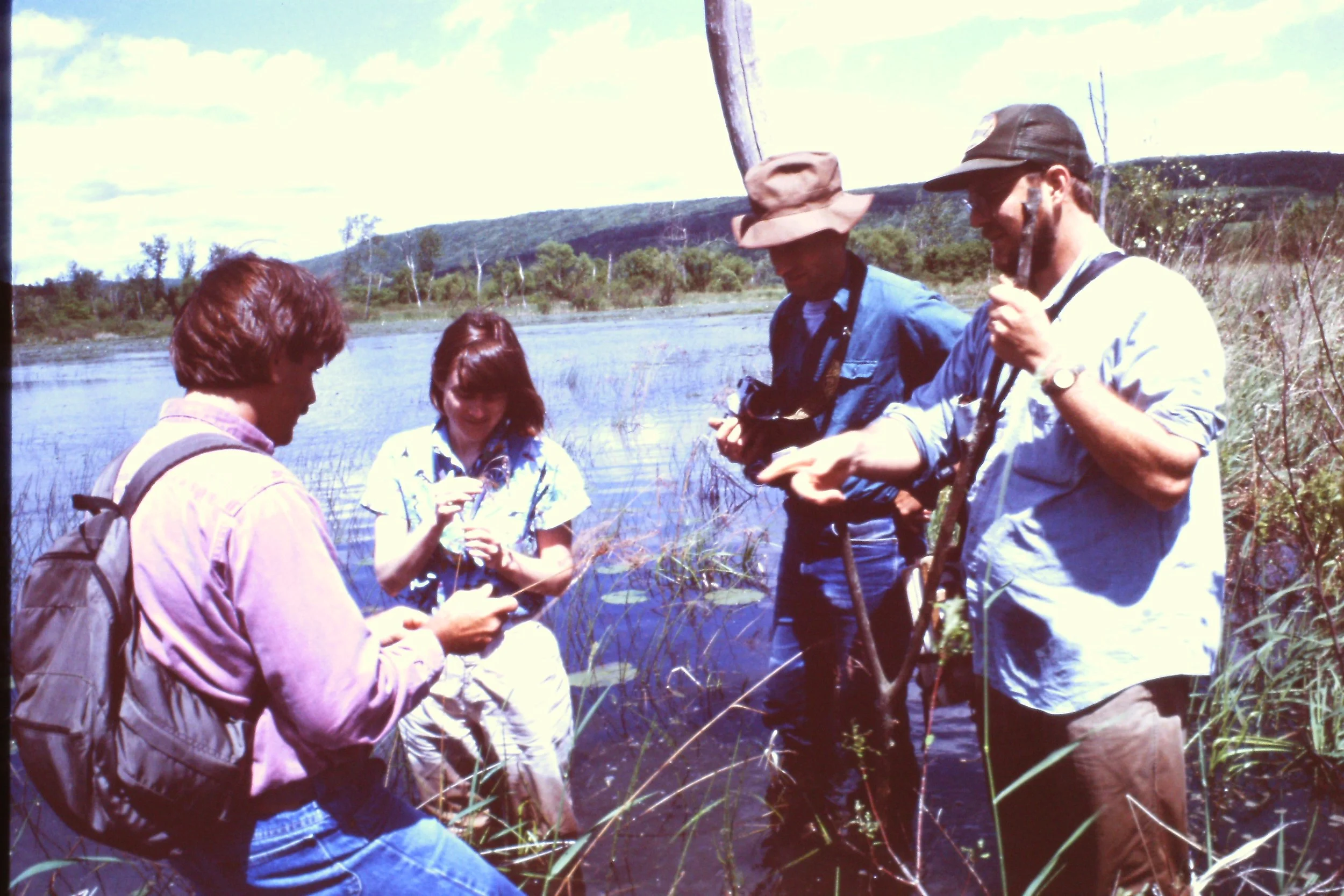
“Is this ancistrochaetus?” “I don’t know—what do you think?” “Could be.” “We should come back in August.” Mike Lipford, Margaret Ormes, Larry Master, and Tom Rawinski in their element. Photo © Charles Bier
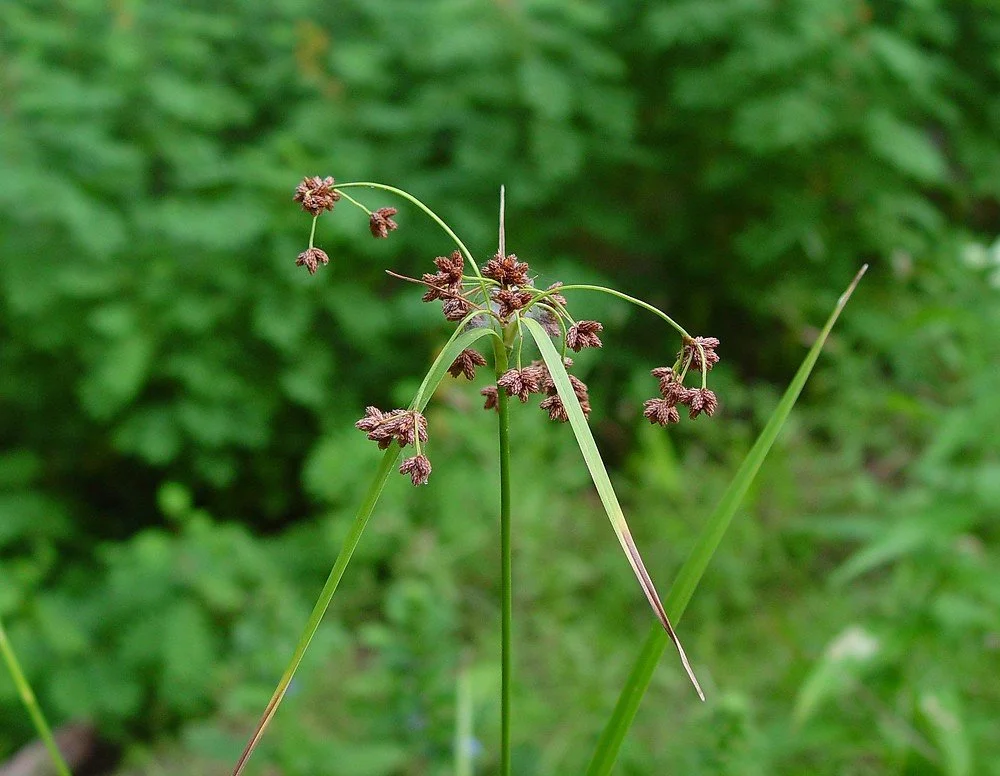
Northeastern bulrush (Scirpus ancistrochaetus). Photo © Arthur Haines, Native Plant Trust
But as we were wading back out of the marsh, we flushed a small bird from the reeds along the shore. This caused a couple members of our party to raise their binos and cry out in great excitement, pointing at the bird. As an experienced birder, what you normally do is call out a shortened version of the bird’s name, to show you are on a first name basis. So, if you saw a hawk you would snap “Coopers!” or “Red-shouldered!” Back in high school, a newbie in our crew once earned our scorn by shouting “Big bird! Big bird!”
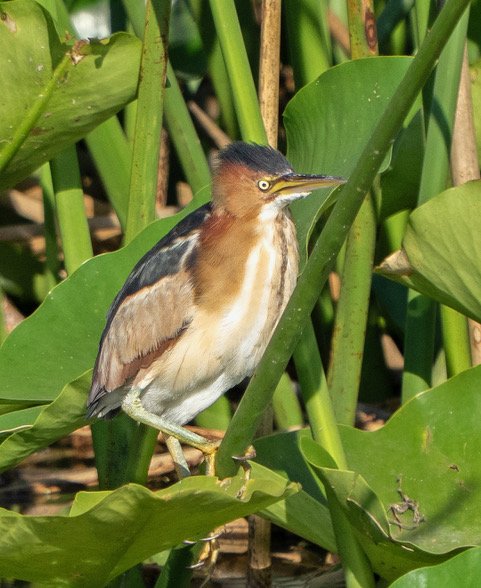
Least bittern (Ixobrychus exilis). Photo © Larry Master
The bird we flushed as we exited the river that day, as I later learned, was a least bittern (Ixobrychus exilis)—a small, shy, retiring heron. As far as I can tell, nobody even knows whether this species is threatened or not, because it is so secretive that nobody ever sees it. There could be millions of them out there, or just a few. But naturally, when it saw we were real naturalists, it promptly revealed itself. Had I been the first to see it, I would have shouted “Little bird! Little bird!” But what the two naturalists who immediately recognized it called out, with jubilation, was not its name. It was: “EO! EO!”
EO? Not only did I still not know what this bird was, I had no idea what EO meant. So I asked, because I am not shy to reveal my own ignorance. EO stands for “element occurrence.” The bittern was the “element” (a species, or sometimes a natural community), and the “occurrence” was the spot where we were standing—the place where the bittern occurred. EO marks a place of practical conservation value. This is the system by which conservation biologists keep track of the things they are conserving—a system developed, in part, by the very people I was standing there with.
But to me, it sounded like more than that. It sounded like a mystical incantation, roughly meaning: “We have come to the right place!”
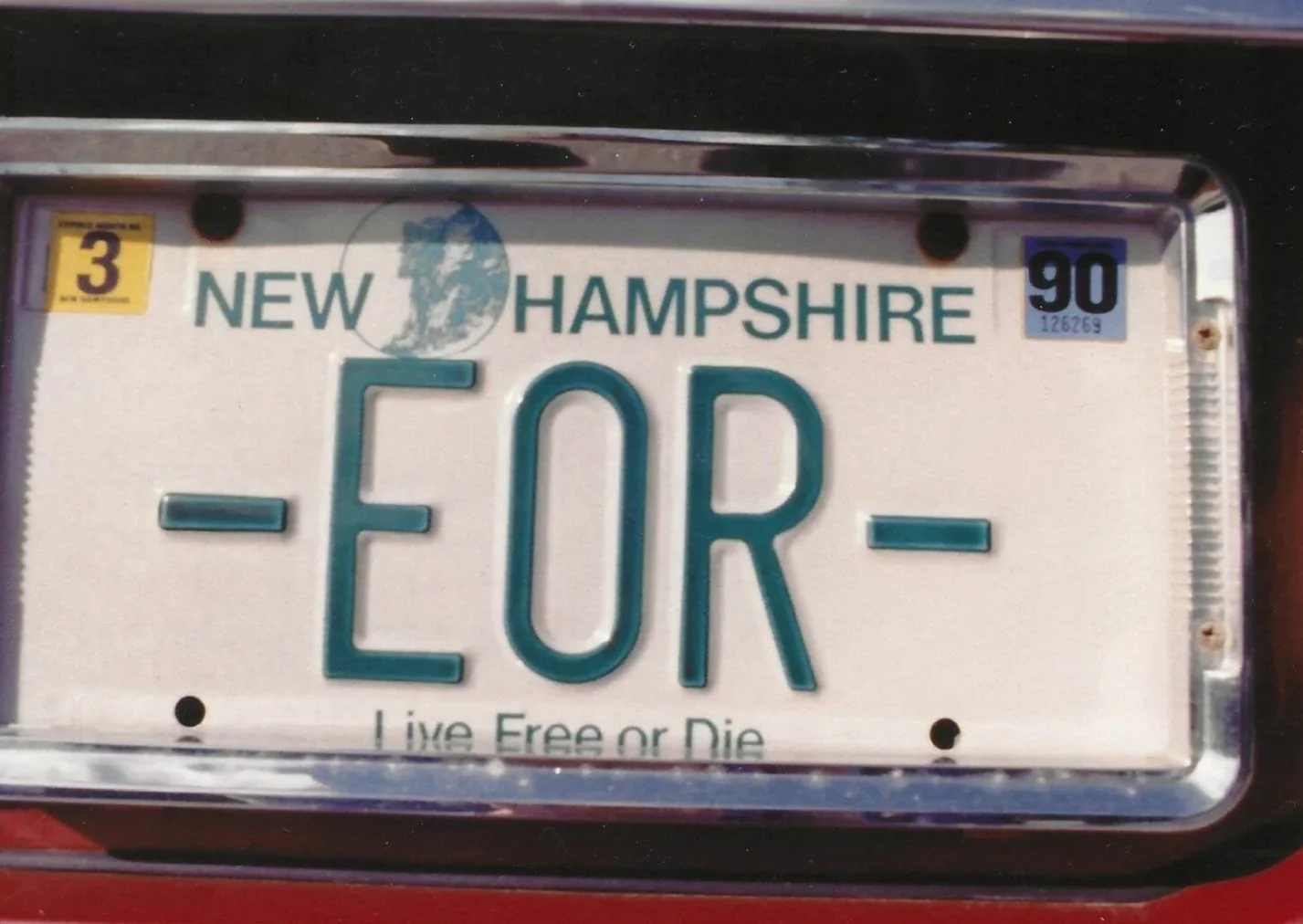
Seen in the parking lot where we stopped for ice cream, this plate belonged to a woman whose friends called her “Eeyore.” “EOR” also stands for “Element Occurrence Record,” which caused great hilarity among the naturalists present. Photo © Charles Bier
Back at the cars with a little daylight left, we crossed the river into New Hampshire and headed north again. Tom led us to a riverside seep that he thought might be interesting, but we didn’t find anything unusual. We also scrambled up to an outcropping high above the river to visit a site for American field chickweed (Cerastium strictum), which grows on such cliffs, but I don’t remember whether we found it or not.
The sun had set. We drove on up to I-89 and cruised down to Concord, New Hampshire, where Larry had a favorite Mexican restaurant in an old mill near the capital. We enjoyed our beer and burritos closer to midnight than sundown. Then we headed home on Route 3, where Larry demonstrated his technique for passing expeditiously through the tolls when traffic was light, which involved accurately tossing in three quarters while traveling at a high rate of speed—an early analog version of E-ZPass.
I admit, I was beat. As a vegetable farmer I was used to putting in long days, but not quite at that pace. And I was impressed. Looking back on it, I was seeing the work by which our generation of naturalists, who came of age with the first Earth Day in 1970, built the system that allows us to see what in this world we need most urgently to conserve. And today, we still have to fight like hell to protect that system, and that understanding, and everything else.
The Element today is all of life, and the Occurrence is planet Earth. We have come to the right place. EO! EO!
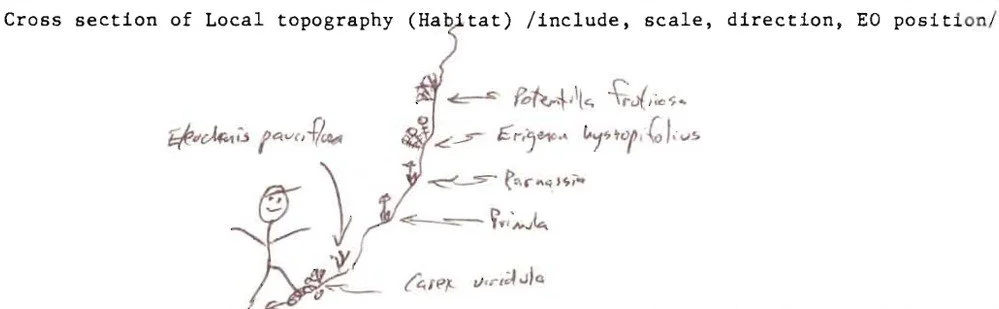
Tom Rawinski self-portrait from a 1984 New England Natural Heritage Program “site survey form.” Image courtesy of Tom Rawinski and the Vermont Fish and Wildlife Department
Brian Donahue is Professor Emeritus of American Environmental Studies at Brandeis University, and a farm and forest policy consultant. He co-founded and for 12 years directed Land’s Sake, a nonprofit community farm in Weston, Massachusetts, and now co-owns and manages a farm in western Massachusetts. He sits on the boards of the Massachusetts Woodland Institute, the Friends of Spannocchia, and Franklin Land Trust. Brian is author of Reclaiming the Commons: Community Farms and Forests in a New England Town (1999), The Great Meadow: Farmers and the Land in Colonial Concord (2004), and Slow Wood: Greener Building from Local Forests (2024). He is co-author of Wildlands, Woodlands, Farmlands & Communities (2017) and A New England Food Vision (2014).