
Think Like a Cougar
A Vision for Rewilding the Northeast
Editor’s Note: The process of rewilding is multifaceted and comprehensive across trophic levels. Our recent focus on the potential for wolves thriving in the Northeast leaves open the question of the other great top predator that remains missing from the New England woods—cougars. Few people have a better perspective on the transformative role that these animals should play in wildland conservation than John Davis, a tireless advocate for the wild. – David Foster
Imagine for a moment that a cougar entering our region met kindness—not cars or guns or traps but people who welcome diversity and love the natural world. Consider, then, where Walker might have moved, after entering our region in 2011. Walker is the posthumously named young male cougar who wandered from South Dakota’s Black Hills to New York’s Adirondacks in 2010–2011, only to be killed by a car in Connecticut, while he was still looking for a mate. You can read his story in Will Stolzenberg’s powerful book Heart of a Lion. Had Walker not been killed by a speeding vehicle, where might he have most safely traveled through our region?
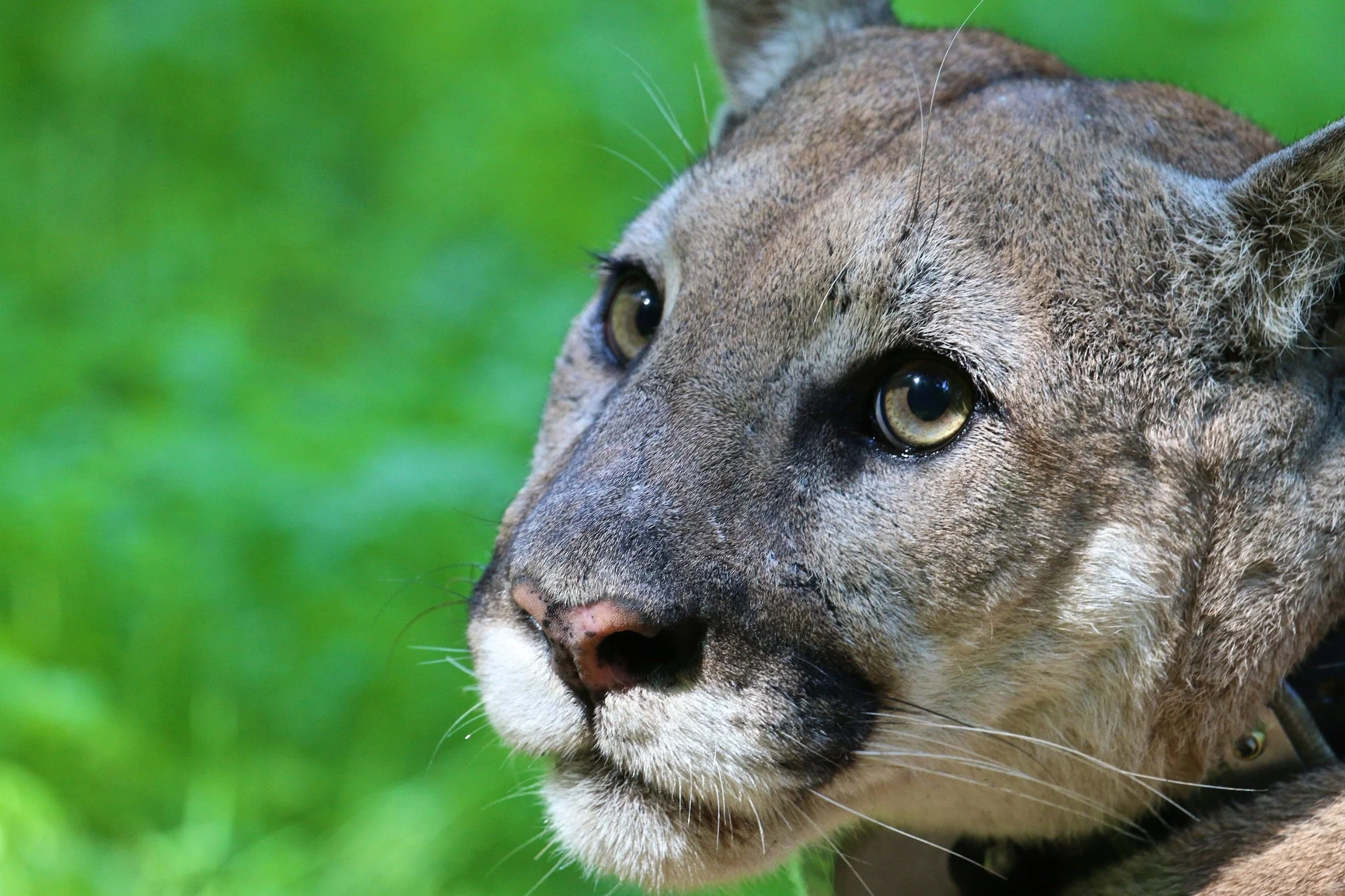
Photo courtesy of Stockvault
In the long term, most of our region and most of the world should be wild. It is only fair to the tens of millions of species with whom we share planet Earth that we let them rule most of it. In the near term, we need to be strategic about how we meet and then exceed “Half Earth” goals. Looking through a wandering cougar’s eyes can be helpful in this endeavor. What are the wild cores and wildlife corridors, the wildways, we can most feasibly protect and restore in the near term, so that a wandering cougar or wolf might get around safely, and so that most of our region’s biodiversity can survive this century of climate chaos?
Walker’s journey was heroic but fatal, because our region is dangerously fragmented and bereft of mates, from the perspective of top carnivores. Let’s hopefully imagine that another young male puma—perhaps a younger cousin—makes a journey similar to Walker’s but does not make the mistake of going south of Adirondack Park. Let’s call that cougar cousin Roamer.
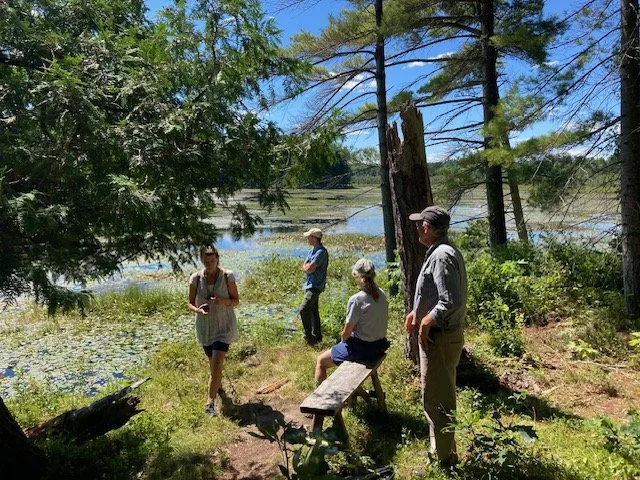
A2A colleagues at Indian River Lakes Conservancy preserve on United States side of Algonquin to Adirondack axis, key wildlife corridor for reconnecting Northern Forest. Photo © John Davis
Roamer likely would enter the FUS (Formerly United States) by one of only a few relatively safe border crossings, particularly the Algonquin to Adirondack axis (A2A); Suttons to Greens (Cold Hollow to Canada, from Vermonters’ perspective); Upper Connecticut watershed; or the Three Borders area where Quebec, New Brunswick, and Maine meet. Let’s accept circumstantial evidence and assume Walker followed the Algonquin to Adirondack link, crossing the St. Lawrence River into New York through the Thousand Islands, and that Roamer will do the same. Listening to the land, along with thinking like a cougar, suggests this island hopping route, for the Great Lakes and their outlet, the St. Lawrence Seaway, form one of the longest and widest natural divides in North America, with the easiest crossings being over islands in St. Mary’s River near Sault Ste. Marie (a tenuous crossing, due to intense industrial and urban development around it, yet likely where a wide-ranging carnivore would try to cross into Canada after traversing Michigan’s still largely intact Upper Peninsula). Roamer would find the St. Lawrence Valley a risky place to travel, as farms and towns have displaced much of the northern forest that would grow naturally here. Still, going upstream along northwest-flowing St. Lawrence tributaries, partly through land trust preserves, Roamer likely can gain the relative safety of New York’s great Adirondack Park.

Brad Meiklejohn of The Conservation Fund shows colleagues the first choice site for a wildlife crossing of Route 2 at Bowman, to reconnect Presidential and Kilkenny ranges. Photo © John Davis
As a brief aside from Roamer’s hypothetical journey, to think like a cougar, we must consider not only broad-scale connections but also obstacles on the nearby ground. Carnivores have keen senses—they are generally able to see, hear, or smell much farther than we can—but even the sharpest eyes and ears and noses can only read signals accurately for a few miles out. The riparian buffer Roamer follows may stretch ahead many miles, but Roamer must also negotiate barriers on the scale of yards. A single busy road, or a farm with livestock left temptingly untended at night, could ruin Roamer’s life. Thus, we wildlife advocates must think and ground truth at micro- as well as macro-scales.
That local point made, where goes Roamer from Adirondack Park? Hopefully, he’ll go east to Vermont’s Green Mountains via the Southern Lake Champlain Valley. (Split Rock Wildway, in the Central Lake Champlain Valley, is another good west-east connection, but the Vermont side of the valley there is mostly farmland.) Having crossed east into the Greens, Roamer will enjoy relatively intact forest habitat as long as he goes north or south. If he guesses well and turns north, he may be safe through the Central and Northern Green Mountains, though most of his preferred prey, white-tailed deer, are lower down, where herbivores find abundant young forage and lands lacking predators who can eat them (other than humans, who commonly set their hunting regulations to maximize numbers of “game” species, not to mimic natural predation).

Katahdin Woods and Waters National Monument, part of much larger proposed Maine Woods National Park. Photo © John Davis
From the Green Mountains, Roamer should be able to sneak across Vermont’s Northeast Kingdom in relative safety, as sparsely peopled as it is. He might then trend eastward across New Hampshire’s Mahoosuc Range and into Maine’s Boundary Mountains, and thus enter the great Maine Woods—where RESTORE: The North Woods has crafted a bold proposal for a National Park three and a half million acres in size. Northern Maine has perhaps the greatest rewilding opportunities in the East, for it is largely uninhabited by people and held in relatively few large absentee ownerships—some of which Wildlands philanthropists might buy (as Roxanne Quimby years ago bought tens of thousands of acres of forest and donated them to create Katahdin Woods & Waters National Monument). Northern Maine can be suitable but not yet optimal habitat, as it is laced with logging roads and almost completely robbed of original forest by centuries of timber management. Also, it is still boreal enough to be more of a moose system than a white-tailed deer system. Maine actually needs wolves—effective hunters of moose—even more than it needs cougars, who would likely prefer warmer climes where deer abound. Still, as an adaptable and resourceful predator (able to eat beavers, snowshoe hares, deer, and small or sick moose), cougars as well as wolves should ultimately thrive from New York’s Tug Hill Plateau to Maine’s North Woods—if we humans can relearn to coexist with large predators.

Three Borders International Peace Park (where Quebec, New Brunswick, and Maine meet). Photo © David Foster
Again, then, connectivity is necessary but not sufficient. Coexistence is equally important. Unless people are willing to coexist with carnivores, no landscape in the East is wild enough to accommodate wide-ranging predators. Wildlife governance reform is a prerequisite to achieving many of our rewilding goals; for, as presently funded and oriented, wildlife agencies are unfriendly to big, toothy predators. Until we modern peoples regain a sound coexistence ethic, and as long as civilization is based on exploiting wild Nature, strictly protected ecological reserves will be needed. Conservation biology tells us at least half of Earth’s lands and waters should be in these. Concurrent with expanding and reconnecting protected areas, we must transform wildlife and land management agencies so that they serve the whole community of life.
In summary, to achieve biodiversity protection goals across our region, several measures in addition to new reserves, parks, and wilderness areas will be needed:
Provide strong economic incentives for landowners to conserve their forests and the wildlife thereon. This might be done through various combinations of payments for ecosystem services, carbon credits, and conservation easements.
Afford full protection to all public Wildlands. This means phasing out commercial exploitation of public lands while allowing quiet recreation to continue.
Reform wildlife governance. Wildlife generally does not need management; people do. The job of wildlife agencies should be to protect and restore the full native biota, not to maximize “game” numbers.
Close and remove unneeded roads and dams. Such ecological austerity measures will be urgently needed as climate chaos renders much infrastructure indefensible.
Install safe wildlife crossings on busy roads. We can make needed infrastructure permeable to wildlife movement even as we make it more durable in the face of worsening storms. Some studies have been done, many more are needed, to determine where wild animals want to cross roads—animals ranging from frogs and salamanders (for which small tunnels may suffice) to beavers and moose and their returning predators.
As Wildlands visionary Jamie Sayen pointed out decades ago—in his proposal for a nine-million-acre Headwaters Reserve System protecting most of the Northern Forest, from the Northern Greens through Northern Maine—our country could rewild much of our region, to the benefit of local communities as well as wildlife, for less than the cost of a few B1 Bombers. Let’s imagine cougars and wolves returning to recovering forests in one of the largest protected area systems in the world.
Presentation from the Northeastern Old Growth Conference 2025
September 17-21, 2025 | Middlebury College - Bread Loaf campus | Ripton, Vermont
View all recorded presentations from the conference.
John Davis is a rewilding advocate, Adirondack Council, and author of Big, Wild, and Connected: Scouting an Eastern Wildway from the Everglades to Quebec, and Split Rock Wildway: Scouting Adirondack Park’s Most Diverse Wildlife Corridor.